A new arXiv paper from Brigham Young University researchers pits three AI underwriting pipelines against each other for small commercial insurance — and the multi-agent "Agentic RAG" system came out on top [S1]. Its largest gains came in exactly the scenarios where automated underwriting breaks down: multi-step rule evaluation and missing information. The question is whether a synthetic test environment tells insurers enough to risk real policy flows.
The problem straight-through underwriting can't solve alone
Straight-through underwriting — where a policy is approved or declined with no human in the loop — is the holy grail for small commercial insurance. Business Owner Policies (BOPs) are low-premium, high-volume, and barely profitable if a human underwriter touches each one. But the moment you remove the human, two things break: the system can't reason through multiple interlocking rules, and it can't tell when it's missing information it needs.
The paper's authors — Robert Richardson, Josh Meyers, Brian Hartman, and David Sandberg [P2] — frame the problem bluntly: AI is starting to significantly alter actuarial work, especially when professionals must analyze disorganized text, pull from varied databases, and follow strict regulatory procedures to make decisions [S1]. That's a polite way of saying the documents are messy, the data comes from everywhere, and regulators are watching.
Three pipelines, one winner
The researchers built a synthetic but realistic experimental environment [S1] and ran three systems through it:
- A single-LLM baseline — one model, one prompt, one shot at the decision. This is the "just use GPT" approach.
- A naive RAG system — retrieval-augmented generation, where the model can look up relevant documents before answering. RAG is the technique of fetching reference material and feeding it to the model alongside the query, so the model has grounding rather than relying on its training data alone.
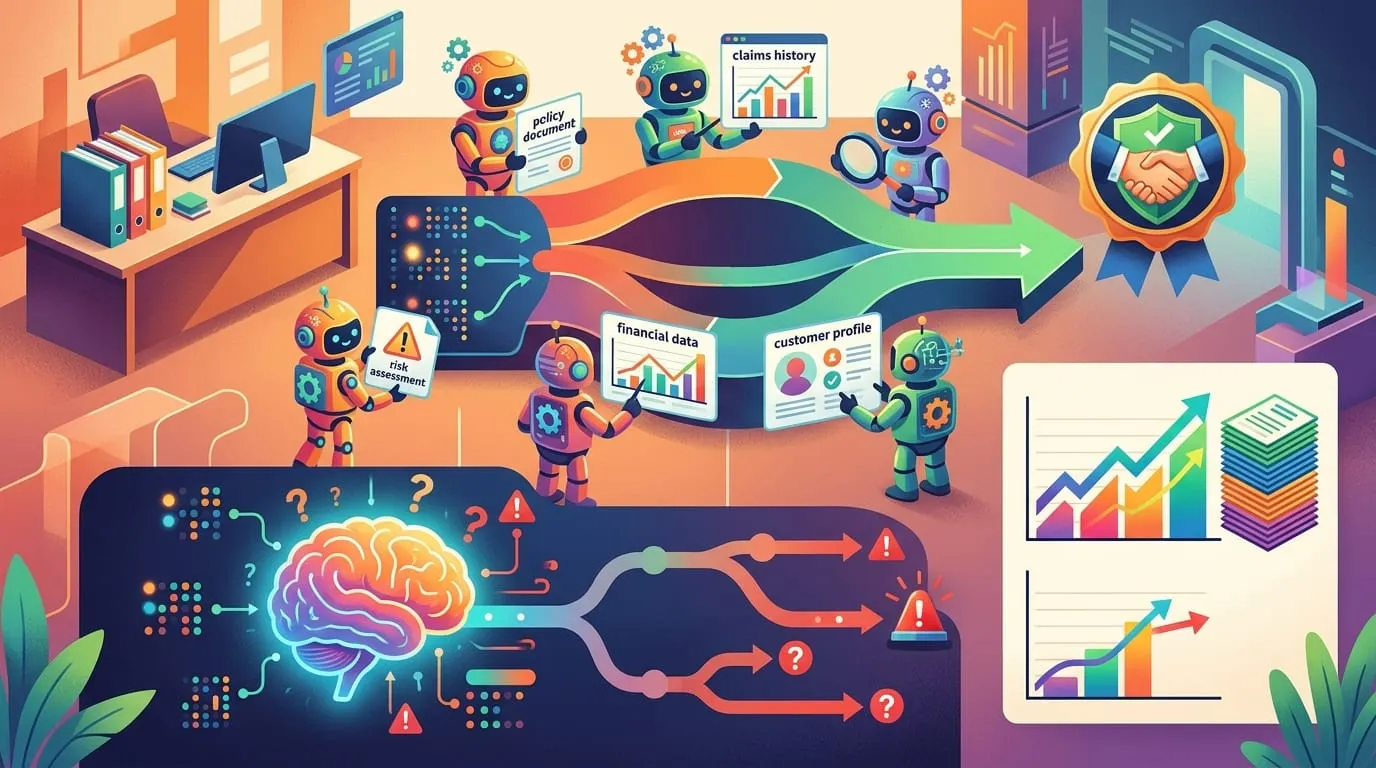
- An "Agentic RAG" pipeline — a multi-agent system combining targeted retrieval, third-party data checks, and explicit multi-step rule evaluation [S1].
The agentic system performed best overall, with the largest gains in multi-step and missing-information scenarios [S1]. Crucially, structured retrieval and reflection — the system's ability to check its own work and notice gaps — helped it avoid unsupported straight-through decisions [S1]. The most sophisticated pipeline was also the most cautious. It knew when it didn't know enough to decide.
What it means
The result challenges the default assumption in AI underwriting: that a bigger, smarter model is the answer. The single-LLM baseline is the "throw a powerful model at it" approach. The naive RAG system is the "give it a search box" approach — let the model look things up, but don't structure how it uses what it finds.
The agentic pipeline wins not because it has a better model, but because it has better scaffolding: targeted retrieval (fetching the right documents for the specific rule being evaluated), third-party data checks (verifying claims against external sources), and explicit multi-step rule evaluation (breaking a complex underwriting decision into discrete, auditable steps). Each step leaves a trace. Each decision can be traced back to which documents were retrieved, which rules were evaluated, and which external data was consulted.
For actuaries, that traceability is not a nice-to-have. It's a regulatory requirement. The paper's framing around transparency, auditability, and human-in-the-loop governance [S1] is the real contribution — not the performance gain, but the demonstration that you can build an AI underwriting system a regulator could actually audit.
What it means for business
For a small insurance brokerage or a regional underwriter handling BOPs at volume, the practical implication is specific. Today's automated underwriting systems — whether rule-based or simple ML — tend to either approve everything that meets basic criteria (and take losses on the edge cases) or escalate too many cases to human review (and destroy the cost advantage of automation).
The agentic architecture suggests a middle path: a system that handles straightforward cases automatically, flags the ones with missing information rather than guessing, and breaks multi-step rules into auditable components. For a two-person brokerage, that could mean a workflow where the AI handles the bulk of BOP applications straight-through, routes the uncertain ones to a human with a pre-filled analysis of what's missing, and declines the rest outright — each with a documented reasoning trail.
The open-source ecosystem is already building toward this. InternLM's Agent-FLAN [P3], which provides agent-tuning methods for large language models, and Hugging Face's rag-end2end-retriever [P4] offer the building blocks. A production-grade AI underwriting platform on GitHub [P5] already demonstrates agentic workflows with human-in-the-loop review, evaluation gates, and observability — the exact architecture this paper validates.
But none of this is plug-and-play yet. The gap between a GitHub demo and a deployed system that a regulator will sign off on is measured in months of integration, testing, and compliance work.
What we don't know yet
The paper's most significant limitation is its experimental environment: synthetic, not real [S1]. No actual policy flows, no real claims data, no live regulatory scrutiny. "Performs best overall" is a qualitative summary — the abstract provides no quantitative accuracy metrics, no confidence intervals, no loss ratios [S1].
We also don't know how the agentic system compares against traditional rule-based automation — the paper's three-way comparison is between AI architectures only, not between AI and the incumbent technology [S1]. And the study is a single-source preprint, unpeer-reviewed, with no independent validation [S1].
The next concrete signal to watch: whether any insurer or insurtech publishes results from a live deployment of an agentic RAG underwriting pipeline — real policies, real loss ratios, real regulatory sign-off. Until then, this paper is a promising blueprint, not a proof.
If you want to keep tracking the gap between AI research and real-world deployment, subscribe — we'll be watching this space.
Sources
- [S1] arXiv: "Agentic AI and Retrieval-Augmented Models in Straight-Through Underwriting" (2607.07858), published 11 July 2026
- [P2] Full HTML version of the paper, arxiv.org
- [P3] InternLM/Agent-FLAN, GitHub
- [P4] Hugging Face rag-end2end-retriever, GitHub
- [P5] vijaynsingh/ai-underwriting-assistant-platform, GitHub
Sources
- [S1] Agentic AI and Retrieval-Augmented Models in Straight-Through Underwriting — arXiv cs.AI new (official RSS) (attributed)
- [P2] Agentic AI and Retrieval-Augmented Models in Straight-Through Underwriting — Agentic AI and Retrieval-Augmented Models in Straight-Through Underwriting (attributed)
- [P3] InternLM/Agent-FLAN — InternLM/Agent-FLAN (attributed)
- [P4] transformers-research-projects/rag-end2end-retriever at main · huggingface/transformers-research-projects · GitHub — transformers-research-projects/rag-end2end-retriever at main · huggingface/transformers-research-projects · GitHub (attributed)
- [P5] vijaynsingh/ai-underwriting-assistant-platform — vijaynsingh/ai-underwriting-assistant-platform (attributed)
More from Not A Tech Guy
- Medical AI survey tests 18 LLMs, finds general models beat specialists
- Infinity-Parser2 tops document parsing benchmarks at 87.6%
- AI agent harness blocks leaks, keeps full 120/120 utility
Generated from an audited evidence pack with primary-source research. Social-media items are discussion signals, not verified facts. Nothing here is financial, legal or medical advice.