
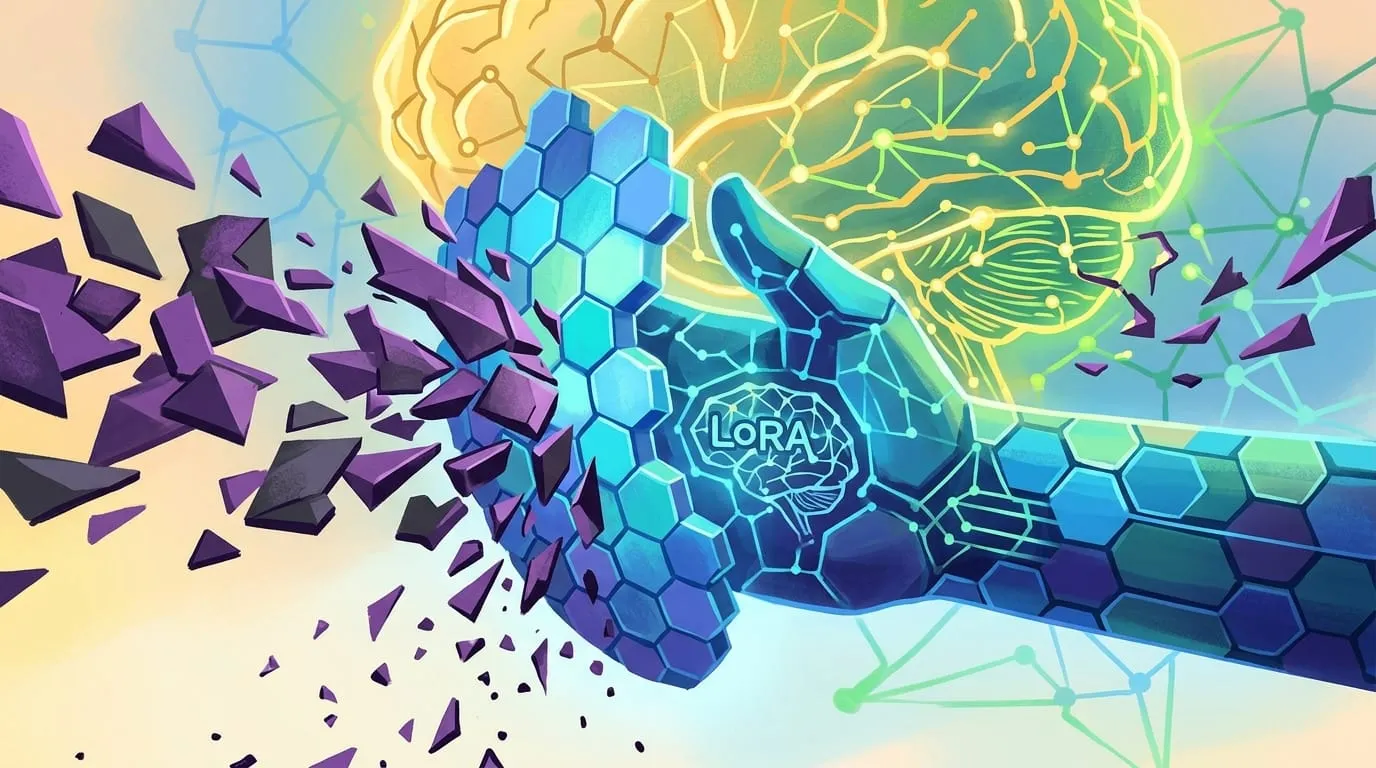
An adaptive backdoor attacker who poisons fine-tuning data hits 100 percent success against a standard LoRA-adapted language model — but when the same model's adaptation is locked to a subspace built from trusted adapters, that attack rate collapses to 8 percent on tasks where the malicious behaviour is unlike anything in the pool [S1]. That contrast is the spine of a preprint posted to arXiv on July 7 [S1], and it asks a question every team fine-tuning open models now needs to answer: can you make poisoning structurally impossible, rather than just statistically unlikely?
The attack that LoRA can't stop
LoRA — short for Low-Rank Adaptation, the technique that lets you fine-tune a large language model by training only a small set of extra weights instead of the full network — has become the default way teams customise open models. It's cheap, it's fast, and it assumes your training data is clean. When it isn't, the model learns whatever you feed it. Under targeted label inversion — where an attacker flips labels on specific examples to corrupt outputs — standard LoRA collapses to between 3 and 26 percent exact match on the task it was supposed to perform [S1]. The model doesn't just degrade. It breaks.
This matters because fine-tuning data increasingly comes from outside the organisation. Public datasets, user-generated content, scraped corpora — all are attack surfaces.
The subspace idea
The preprint's central insight is deceptively simple. A LoRA adapter's useful functional content exists within a low-dimensional shared subspace [S1]. They discovered that 30 to 38 percent of an adapter's weight norm serves no purpose for the evaluated task distributions [S1]. A chunk of what LoRA learns is noise, and that noise is exactly where poisoned data can drag the model.
Their fix: estimate a subspace from a pool of trusted existing task adapters, then restrict all new adaptation to that subspace. The model can only move in directions the trusted adapters already know about. Limiting gradient adaptation to only 128 coordinates within this subspace achieves performance equal to full LoRA fine-tuning on clean classification tasks [S1]. You give up almost nothing on legitimate tasks — and you gain a structural barrier against movement in directions no clean adapter would ever go.
Why 120x matters
Here's where the numbers get striking. When facing targeted label inversion, the restricted model maintains a 62 to 96 percent exact match on covered tasks, compared to the 3 to 26 percent drop seen in standard LoRA [S1]. But the more elegant result is the loss separation. The adaptation loss of the restricted model shows a two-order-of-magnitude separation between clean and corrupted data, resulting in a 120x difference [S1]. This difference acts as an out-of-distribution indicator without the need for an external detector [S1]. The defence doesn't just resist the attack; it makes the attack visible, by construction.
For an adaptive backdoor attacker who optimizes inside the subspace—the most difficult scenario where the attacker is aware of the defense and attempts to bypass it—attack success drops to 8 percent for tasks with target behaviors foreign to the pool, compared to 100 percent for standard LoRA [S1]. But the defence is not universal. If the attacker's target aligns with a common behavior already in the pool, the attack success rate is only partially reduced to 85 percent [S1]. Results from the two evaluated tasks align with the proximity of the target to the pool's directions, which the authors note hints at but doesn't confirm a pool-relative boundary [S1].
What it means
The core idea is a shift from detection to constraint. Most poisoning defences try to spot bad data before it enters training — filtering, anomaly detection, robust aggregation. This approach instead says: even if bad data gets through, the model physically cannot move in the direction the attacker wants, because that direction isn't in the subspace. It's the difference between guarding the door and locking the corridors.
For anyone fine-tuning open-weight models, the practical appeal is obvious. You don't need a separate poisoning detector running alongside your training pipeline. The constraint is baked into the optimisation itself. The 120x loss gap means you get a built-in alarm: if a batch of data produces adaptation loss two orders of magnitude higher than your clean baseline, something is wrong — and you didn't need to buy or build a separate tool to tell you.
But the trade-off is real. For tasks poorly represented by the pool, standard fine-tuning performs better than the restricted approach [S1]. You are trading peak plasticity — the ability to learn genuinely new behaviours — for robustness against manipulation. Additionally, this defense relies on the pool being trustworthy [S1]. Should an attacker compromise the adapters used to estimate the subspace, the whole defense fails.
What it means for business
For a two-person AI consultancy fine-tuning open models for clients, this method could change the risk calculus of accepting third-party training data. Today, if you fine-tune on a client's scraped dataset, you're trusting that dataset's integrity entirely. With subspace-constrained adaptation, you could build a trusted adapter pool from your own verified work, then constrain all client-data fine-tuning to that subspace. Poisoned data would either fail to move the model meaningfully or trigger the 120x loss alarm — both without adding a separate security tool to your stack.
For a suburban agency building custom language models for local businesses, the trade-off matters more than the defence. If your clients' tasks are close to what your trusted pool already covers — classification, summarisation, extraction — you lose almost nothing. If a client needs something genuinely novel that your pool doesn't span, the constrained method underperforms, and you'd need to either expand the pool or fall back to unconstrained fine-tuning with traditional safeguards.
The code and data are public on GitHub under the repository infinition/z-manifold [P4], released under an MIT licence — meaning any team can experiment with the approach immediately, though the method is empirical, not a formal guarantee.
What we don't know yet
This research is a single preprint that has not undergone peer review [S1]. The study examines a single model, flan-t5-large, along with a collection of 196 public LoRA adapters [S1]. It remains unclear if this subspace characteristic applies to larger models, alternative adapter designs, or specialized domain pools. The 120x loss difference is an empirical observation rather than a mathematically proven detection method. The concept of a pool-relative boundary—where protection levels correlate with the similarity of an attacker's target to the pool's directions—is based on two data points and thus not firmly established [S1].
The partial failure case is the most important open question. If an attacker's target matches common pool behaviors, 85 percent of attacks remain successful [S1]. That means the defence is strong against novel attacks but weak against attacks that camouflage themselves as legitimate tasks the model already knows. Determining that boundary—and if expanding or diversifying pools can lower the success rate—is the crucial next step.
Reproducing these results independently across various models and adapter pools is the specific action needed to elevate this from an intriguing preprint to a reliable defense. Until that happens, the 8 percent statistic represents a finding from a single experiment, not an absolute certainty.
If this kind of structural defence thinking is useful to you, subscribe — we'll be tracking replication results and the next wave of fine-tuning safety work as they land.
Sources
- [S1] Learning Only What Valid Adapters Can Express: Subspace-Constrained Adaptation Against Fine-Tuning Poisoning — arXiv preprint (cs.CR, q-fin.GN) (attributed)
- [P2] Learning Only What Valid Adapters Can Express: Subspace-Constrained Adaptation Against Fine-Tuning Poisoning — Learning Only What Valid Adapters Can Express: Subspace-Constrained Adaptation Against Fine-Tuning Poisoning (attributed)
- [P3] Learning Only What Valid Adapters Can Express: Subspace-Constrained Adaptation Against Fine-Tuning Poisoning — Learning Only What Valid Adapters Can Express: Subspace-Constrained Adaptation Against Fine-Tuning Poisoning (attributed)
- [P4] infinition/z-manifold — infinition/z-manifold (attributed)
- [P5] SC-LoRA: Balancing Efficient Fine-tuning and Knowledge Preservation via Subspace-Constrained LoRA — SC-LoRA: Balancing Efficient Fine-tuning and Knowledge Preservation via Subspace-Constrained LoRA (attributed)
More from Not A Tech Guy
- Printed text slows AI robots nearly 7x via overthinking attack
- New framework unifies privacy and adversarial defense in distributed AI
- Browser crypto wallets leak address links across 35M users
Generated from an audited evidence pack with primary-source research. Social-media items are discussion signals, not verified facts. Nothing here is financial, legal or medical advice.