
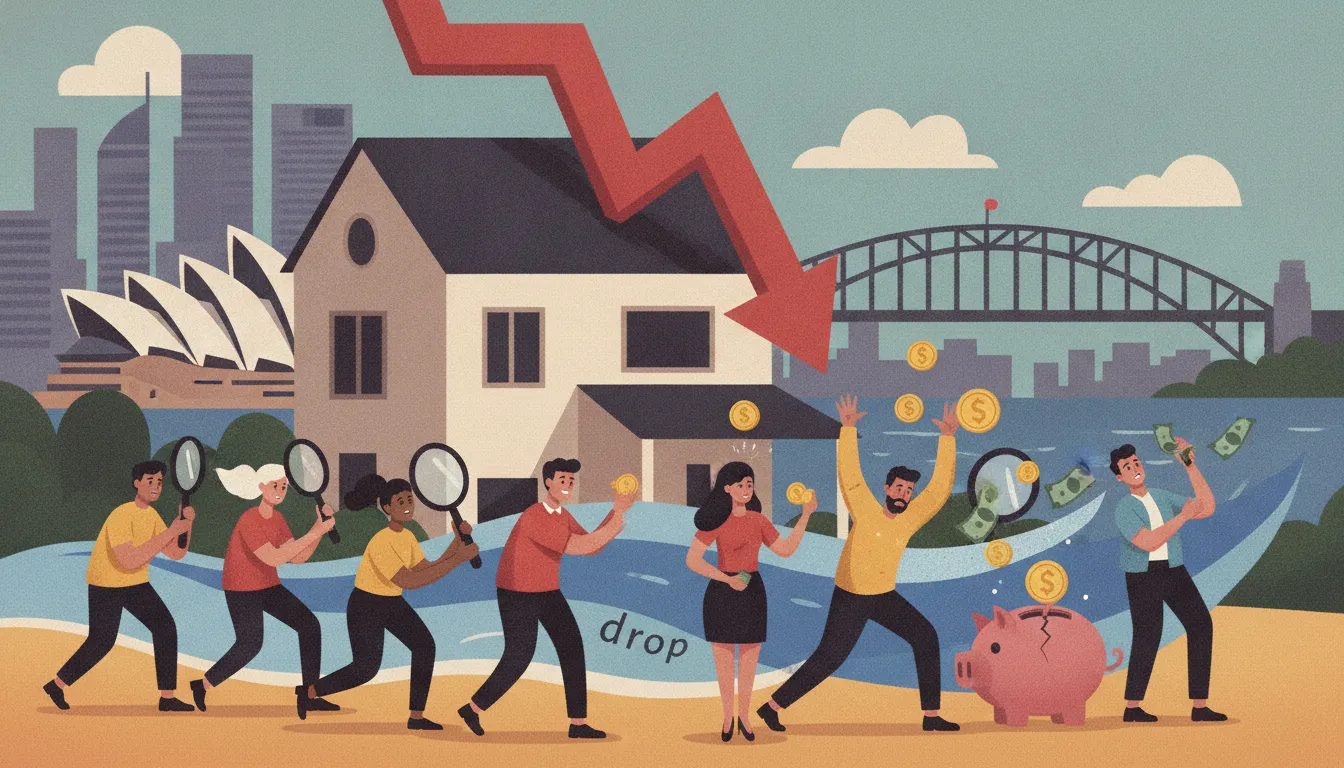
Sydney's median dwelling has shed $31,000 in value since February. For most owners, that's a paper cut. For someone who bought with a 5 per cent deposit through the government's low-deposit scheme, it's something else entirely — and the slide is getting faster, not slower.
The numbers, plain
PropTrack's Home Price Index shows Sydney dwelling values dropped 0.5 per cent in June — a steeper fall than May's 0.2 per cent slide [S1]. The median price across houses, units and townhouses has retreated to $1.222 million, having been $1.253 million back in February [S1]. That represents a 2.5 per cent fall from the peak, and the rate of decline is picking up.
Seven weeks under 50
Here's the signal that should make any Sydney watcher sit up: auction clearance rates have remained under the 50 per cent mark for seven consecutive weeks [S1]. Clearance rates are the market's pulse. When fewer than half the homes taken to auction actually sell, buyers hold the leverage and prices typically follow south. It's a leading indicator, not a lagging one.
Two forces, one downturn
Anne Flaherty, an economist at REA Group, identifies a pair of factors behind the downturn: rising interest rates and uncertainty stemming from tax measures signalled in the May federal budget [S1]. The Albanese government's budget package, released 12 May, promised "more homes and a fair go for first home buyers" and flagged reforms to make the tax system "fairer" for homeownership [P3]. Treasurer Jim Chalmers and Housing Minister Clare O'Neil later laid out the government's plan to reform what they called Australia's "broken housing system" in a National Press Club address [P2].
According to reporting, Flaherty specifically cited restrictions on negative gearing as part of the budget fallout [S1]. The precise detail of those changes remains a matter of debate — the evidence pack flags this attribution as potentially inaccurate. But the broader point stands: uncertainty itself has a chilling effect. When buyers don't know what the rules will be, many simply wait.
The thin-equity trap
The sharpest edge of this downturn falls on the newest, most leveraged buyers. The government's low-deposit scheme allows eligible first-home buyers to purchase with as little as a 5 per cent deposit, with the government guaranteeing the gap. That's a powerful leg-up when prices are rising. When they fall, the maths flips.
Put down roughly $61,000 on a $1.222 million dwelling — about 5 per cent — and your equity is wafer-thin from day one. A $31,000 decline wipes out half of it. A further fall of similar size puts you in negative equity: you owe the bank more than the property is worth.
According to reporting, there are warnings that buyers who used the scheme could soon find themselves in exactly that position [S1]. That's a "could," not a "has" — no evidence is cited of buyers already in negative equity, and the headline framing of buyers going "bust" overstates what the article body actually reports. But the direction of travel is the concern.
Who feels what
- First-home buyers on low deposits: The most exposed. Thin equity buffers mean even modest further falls could tip them underwater, making it hard to refinance or sell without taking a loss.
- Investors: Negative gearing uncertainty adds a layer of policy risk on top of falling values. Some may be reassessing whether the numbers still stack up.
- Vendors: Seven weeks of sub-50 per cent clearance rates mean more properties passing in. Sellers face a choice: accept a lower price or withdraw.
- Renters: Falling prices don't automatically mean falling rents. The supply shortage pushing rents higher remains the dominant force for tenants.
What to watch
The next PropTrack index release will show whether June's acceleration continued into July. The RBA's next cash rate decision — the single biggest lever on borrowing power — will shape whether the slide deepens or stabilises.
For anyone who bought recently with a small deposit, the question to put to your lender or broker is straightforward: what's my loan-to-value ratio right now, and what happens if values fall another 2 per cent? You don't need a crisis to ask. You just need to know where you stand.
Subscribe for the next data drop and the RBA decision — straight to your inbox, no noise attached.
Sources
- [S1] ‘Mess’: Aussies on Albo’s scheme will go bust | news.com.au — Australia’s leading news site for latest headlines — Web search lead (reported)
- [P2] Address to the National Press Club, Canberra | Treasury Ministers — Address to the National Press Club, Canberra | Treasury Ministers (primary)
- [P3] More homes and a fair go for first home buyers | Treasury Ministers — More homes and a fair go for first home buyers | Treasury Ministers (primary)
- [P4] Sydney and Melbourne drive property price rise of 2.4% | Australian Bureau of Statistics — Sydney and Melbourne drive property price rise of 2.4% | Australian Bureau of Statistics (primary)
More from Not A Tech Guy
- Sydney and Melbourne property prices falling — HSBC warns worse is coming
- Australian house prices cool as new home loans fall 6.2%
- Three hikes, then a pause: the public data lean HOLD for the RBA’s August decision
Generated from an audited evidence pack with primary-source research. Social-media items are discussion signals, not verified facts. Nothing here is financial, legal or medical advice.


