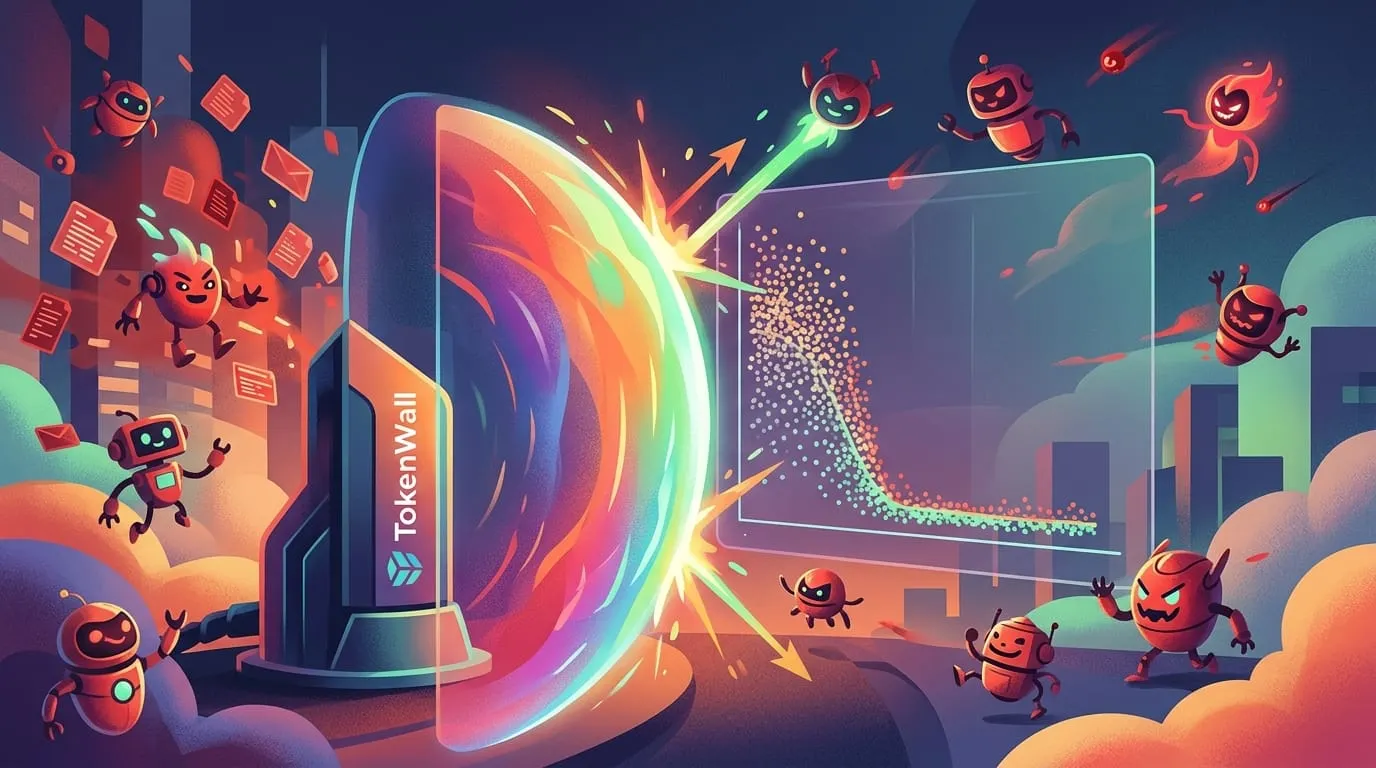
A new arXiv preprint posted on 10 July 2026 reports a runtime defence framework called TokenWall that reduces the success rate of attacks against persistent AI agents to 12.5%, while letting 97.4% of benign actions through without human confirmation — at a cost of just 0.69 seconds of added latency [S1]. The paper, titled Token-Flow Firewall: Semantic Runtime Auditing for Persistent AI Agents, is explicitly marked as not peer-reviewed [S1]. But the problem it targets is one that anyone building tool-using agents is already losing sleep over: once an agent can call shell commands, read files, and send HTTP requests, a poisoned prompt isn't just a conversational nuisance — it's an execution problem [P2]. The question is whether a lightweight semantic firewall can actually catch the attacks that matter, or whether 12.5% residual risk is still too high to trust in production.
Why persistent agents are a different beast
Most AI security research has focused on chatbots — one prompt in, one response out, no memory, no tools. Persistent agents break that model entirely. They carry state across sessions, reuse learned skills, and mediate interactions through external tools. The authors observe that nearly all security-critical interactions in these agents flow through natural-language tokens: memory updates, tool arguments, retrieved files, and inter-component messages [S1].
That creates what the authors call a "substantially larger semantic attack surface" [S1]. A malicious instruction doesn't need to come from the user directly. It can hide in a retrieved document, ride in a memory entry from a previous session, or piggyback on a reusable skill that was contaminated weeks ago. The attack surface grows with every tool the agent touches and every session it remembers.
This echoes a broader shift noted in related research: tool-using LLM agents are moving the unit of computation from explicit human-issued commands to model-driven tasks with stateful consequences [P4]. Agents that act autonomously need a fundamentally different trust model than agents that merely suggest.
How TokenWall works
The framework sits inline between the agent's reasoning and its tool execution. Rather than auditing sporadically or sending every decision to a remote large model for oversight — both common in current approaches — TokenWall aims for full-coverage pre-execution mediation [S1].
The mechanism has three layers:
- Structured audit records. Every token flow is tagged with its source (where it came from) and its sink (where it's going), creating a traceable record of what entered the agent and what it's about to do [S1].
- Lightweight local inspection. Before any action executes, a local check screens the token flow for unsafe content. This is fast and runs on every action, not just a sample [S1].
- Selective escalation. When the local check flags something ambiguous or high-risk, the case is escalated to a stronger arbitration module — a heavier model that makes the final call. Crucially, this escalation is selective: only ambiguous cases trigger it, which is how the system keeps latency down [S1].
The design philosophy mirrors an existing open-source project, AgentFirewall, which sits inline and decides allow, review, block, or log before a side effect happens — and recommends starting in log-only mode to inspect the audit trail before enforcing [P2]. TokenWall extends that idea from tool-call gating to full semantic auditing of the token streams flowing between agent components.
The numbers — and their limits
On CIK-Bench, the authors report that TokenWall cut the attack success rate to 12.5% while maintaining a 97.4% benign pass rate without requiring human confirmation [S1]. The added latency on benign cases was 0.69 seconds [S1].
Those are promising figures, but every one of them comes with an asterisk. CIK-Bench is not a widely recognised standard benchmark — readers have no independent context for its scope or difficulty. The latency and efficacy numbers come from experimental conditions, not real-world production deployment. And the entire paper is a single-source, non-peer-reviewed preprint: all empirical claims are self-reported and preliminary [S1].
The 12.5% residual attack success rate also means the system is not foolproof. Roughly one in eight attacks still gets through. For a chatbot that writes marketing copy, that might be acceptable. For an agent with shell access to a production server, it almost certainly isn't.
What it means
The core insight here is simple but important: the security boundary for AI agents has moved. Traditional firewalls inspect network packets. TokenWall inspects meaning — the natural-language tokens that carry instructions, data, and context between an agent's components. If an agent's memory is poisoned, or a retrieved file contains a hidden instruction, the firewall is designed to catch it before the agent acts.
For a reader with no background: think of it as a bouncer who checks not just your ID but the contents of every bag you're carrying, every note in your pocket, and every conversation you had on the way in — then decides whether to let you through, send you to a secondary check, or stop you at the door. The 0.69-second delay is the time it takes to pat you down. Most of the time, you walk straight through.
The broader significance is that the research community is treating agent security as a runtime problem, not just a training problem. You can't train away every possible injection — the attack surface is too dynamic. A firewall that mediates at execution time is a fundamentally different defence layer, and it's one that operators can deploy without retraining their models.
What it means for business
For a two-person startup building a customer-support agent that reads from a knowledge base and files tickets in a CRM, the threat model is real: a crafted support email could inject instructions into the agent's context and trick it into exfiltrating data or modifying records. A semantic firewall like TokenWall — or the simpler AgentFirewall pattern [P2] — offers a deployable mitigation layer that doesn't require retraining or switching models.
The practical workflow shift: instead of trusting the agent blindly, an operator could run in log-only mode first, inspect what the firewall flags, then tighten to review or block once the audit trail looks clean [P2]. The 0.69-second latency overhead is negligible for most customer-facing interactions — it's less than the time a typical support chat already spends generating a response.
For a suburban real-estate agency using an agent to draft listings, pull suburb data, and schedule open homes, the risk is lower but non-zero. A poisoned data feed could instruct the agent to overwrite listings or send client details externally. A pre-execution firewall that audits tool arguments before they fire would catch the obvious cases.
The cost question is still open. TokenWall's local inspection is lightweight by design, but the escalation module — the heavier model that handles ambiguous cases — carries compute costs the paper doesn't fully quantify. Operators will need to understand how often escalation triggers in their specific workload before they can budget for it.
What we don't know yet
Several critical questions remain unanswered:
- CIK-Bench's validity. The benchmark is not widely known, and the paper provides no comparison against established agent-security benchmarks. Without independent validation, the 12.5% figure is hard to contextualise. Related work like AuditBench [P5] exists in this space, but no head-to-head comparison is offered.
- Real-world performance. All figures come from controlled experiments. Production agents face messier token flows, noisier inputs, and adversarial conditions that benchmarks rarely capture fully.
- Escalation frequency and cost. The paper says remote arbitration is reduced, not eliminated [S1]. How often escalation triggers in practice — and what it costs — will determine whether the system is economically viable for high-volume deployments.
- Peer review. The paper is a preprint. Until it survives review, every claim should be treated as provisional.
- The q-fin.GN categorisation. The paper appears in both cs.CR (cryptography and security) and q-fin.GN (general finance), which is unusual for a security paper. The reason for the finance categorisation isn't explained in the available evidence.
The next concrete event to watch: whether the authors release code or a reproducible benchmark, and whether the framework gets picked up by any of the open-source agent-security projects already in flight [P2][P5]. Until then, the 12.5% number is a promising signal — not a guarantee.
Sources
- [S1] arXiv preprint, Token-Flow Firewall: Semantic Runtime Auditing for Persistent AI Agents, 10 July 2026 — https://arxiv.org/abs/2607.08395v1
- [P2] AgentFirewall README, GitHub — https://github.com/0xrem/agent-firewall/blob/main/README.md
- [P4] Cordon: Semantic Transactions for Tool-Using LLM Agents, arXiv — https://arxiv.org/html/2606.17573
- [P5] safety-research/auditing-agents (AuditBench), GitHub — https://github.com/safety-research/auditing-agents
Sources
- [S1] Token-Flow Firewall: Semantic Runtime Auditing for Persistent AI Agents — arXiv preprint (cs.CR, q-fin.GN) (attributed)
- [P2] README.md — README.md (attributed)
- [P3] ByteVisionLab/TokenFlow — ByteVisionLab/TokenFlow (attributed)
- [P4] Cordon: Semantic Transactions for Tool-Using LLM Agents — Cordon: Semantic Transactions for Tool-Using LLM Agents (attributed)
- [P5] safety-research/auditing-agents — safety-research/auditing-agents (attributed)
More from Not A Tech Guy
- ProjAgent hits 41% on REPOCOD with procedural code retrieval
- Quantized LLMs behave differently despite matching accuracy
- SLORR cuts LLM training overhead below 1%
Generated from an audited evidence pack with primary-source research. Social-media items are discussion signals, not verified facts. Nothing here is financial, legal or medical advice.