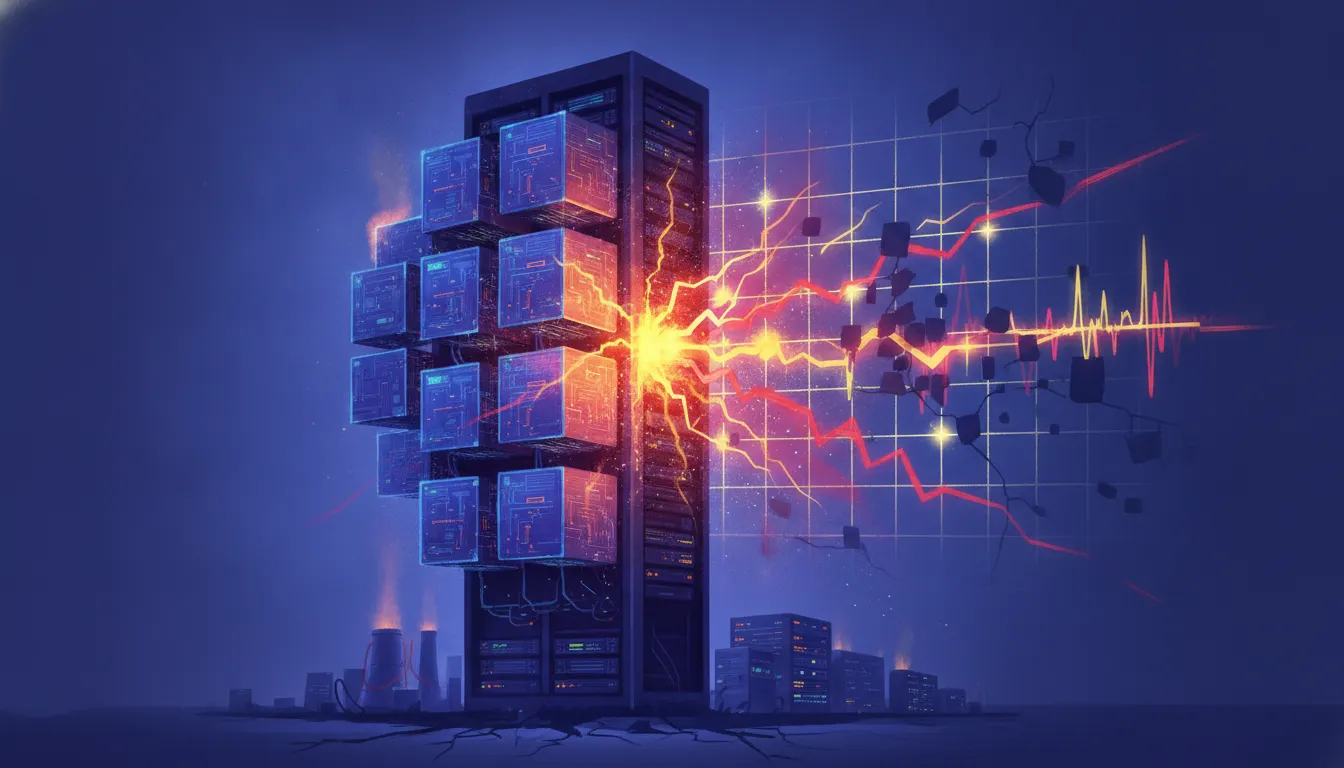
A non-peer-reviewed arXiv preprint claims that manipulating just 1,000 GPUs inside a renewable-powered data centre can push electrical distortion to 46.8% and tip the local grid into a state where oscillations feed on themselves instead of damping out [S1]. The attack, named Bit2Watt, never touches a wire or a breaker — it runs as legitimate compute. And the question it forces is uncomfortable: if the workload looks legal and the standard telemetry looks clean, who is watching the high-frequency signals nobody bothers to record?
The attack that hides inside your own workload
Modern data centres have become a tightly coupled cyber-physical system — GPU clusters drawing megawatts, increasingly fed by on-site solar and battery installations whose inverters convert DC to AC through fast-switching electronics [S1]. That coupling is the seam Bit2Watt exploits.
The authors describe an attack in which an adversary — operating as a legal cloud tenant, running code they're entitled to run — deliberately modulates GPU workloads to create rapid, synchronised swings in power draw [S1]. Where conventional grid attacks demand physical access or network compromise, this approach stays entirely within the software domain [S1]. You rent the GPUs. You run the jobs. You just run them in a pattern designed to make the power electronics sing in the wrong key.
The weapon is timing. By synchronising power spikes and dips across many GPUs at specific frequencies, the attacker induces high-frequency power modulations that the grid's renewable-energy inverters struggle to absorb [S1]. In grids with high penetration of DERs — distributed energy resources, the umbrella term for small-scale solar, wind, and battery systems — the effect is amplified because these power-electronic interfaces respond differently to disturbances than the spinning turbines of traditional power plants [S1].
The number that should make you uncomfortable
Under the authors' worst-case model, manipulating 1,000 GPUs in a 1-megawatt local power system with 90% DERs pushes current THD — total harmonic distortion, a measure of how badly the electrical waveform is mangled — to 46.8% [S1]. For context, IEEE standard 519 typically recommends keeping THD below 5–8% at the point where a facility connects to the grid. The same scenario produces a damping ratio of -0.27 [S1]. A negative damping ratio means the system doesn't absorb disturbances; it amplifies them. Small oscillations grow instead of fading.
The reported fallout spans everything from overstressed power-delivery hardware and protective shutdowns to, at the most extreme end of their simulations, cascading breakdowns that could reach transmission-level infrastructure [S1]. To support their case, the researchers combined impedance modelling, grid simulation software, and bench-top tests using actual GPUs alongside solar inverters connected to a real grid [S1].
Why your monitoring probably misses it
The most unsettling claim in the paper is about visibility. Routine cloud and facility monitoring struggles to flag Bit2Watt because the attack uses normal job-execution channels and buries its telltale signature in high-frequency bands that everyday telemetry either smooths away or never samples in the first place [S1]. The dashboards show a tenant running jobs. The power meters show load fluctuating within plausible ranges. The signature lives in the frequencies between the samples.
The authors also sketch a reverse path they call Watt2Bit — where the power-system disturbance feeds back into the computing layer, creating denial-of-service conditions or enabling covert data exfiltration through electromagnetic interference (EMI) side channels [S1]. This builds on prior research showing that GPU power and thermal signatures can leak information about the models running on them [P4].
What it means
Bit2Watt exposes a blind spot at the intersection of two disciplines that rarely talk to each other: cloud workload scheduling and power-electronics engineering. Data centre operators have spent years optimising GPU utilisation for throughput and cost. Grid engineers have spent years ensuring power quality under disturbances they assumed came from outside — lightning strikes, equipment failures, faults on transmission lines. Neither group has been watching for a tenant who weaponises the gap between them.
The attack model is plausible because the prerequisites are mundane: cloud access, enough rented GPUs to create synchronised draw, and a local grid with high renewable penetration. The authors note this is increasingly the default configuration for large AI training and inference deployments [S1].
The paper's core argument is that defences must become cross-layer: workload scheduling that accounts for its power-electronic footprint, and grid monitoring that captures the high-frequency signatures of malicious compute patterns [S1]. Today, those two systems are managed by different teams with different tools and different time horizons.
What it means for business
For data centre operators, the immediate practical question is whether their power-quality monitoring captures high-frequency components — the sub-second fluctuations that standard SCADA systems and cloud telemetry typically smooth over or ignore. If your monitoring reports at one-second or one-minute intervals, you may be blind to exactly the frequencies Bit2Watt exploits.
For cloud providers, the threat model expands. A tenant running a legitimate job is not currently considered a grid-security risk. If Bit2Watt's claims hold under peer review, providers may need to add power-side behavioural analysis to their existing tenant-monitoring stack — not just watching what code runs, but how its power draw oscillates.
For a two-person AI startup renting cloud GPUs, the direct risk is service disruption: if a co-tenant or a compromised account on the same infrastructure triggers power-quality events, your jobs go down with theirs. The paper's cascading-failure scenarios are simulated and extreme, but the protection-trip mechanism — where power-delivery equipment shuts down to protect itself — is grounded in how real systems behave [S1].
For grid operators in regions with high renewable penetration, the paper suggests that data-centre load is not just a capacity problem but a stability problem. Inverter-dominated grids respond differently to disturbances, and a malicious workload pattern could exploit dynamics that traditional stability analysis doesn't model [S1].
What we don't know yet
This is a single-source, non-peer-reviewed arXiv preprint [S1]. Every technical claim — the 46.8% THD figure, the -0.27 damping ratio, the cascading-failure scenarios — reflects the authors' own modelling and experiments. No independent research group has verified the findings, and the results may not generalise to all data-centre or grid configurations.
The worst-case numbers come from a specific model: 1,000 GPUs, a 1-MW system, 90% DERs, synchronised attack. Real-world data centres vary enormously in size, grid connection, renewable mix, and inverter topology. The paper's real-world experiments involved GPUs and grid-connected PV inverters, but the transmission-scale cascading failures are explicitly described as extreme simulated cases [S1].
The Watt2Bit feedback path — including the EMI side-channel exfiltration — is described as plausible and analysed, but the paper does not present experimental validation of data theft through this channel [S1].
What to watch next: whether the paper survives peer review, whether cloud providers or grid operators publicly acknowledge the threat model, and whether any facility publishes high-frequency power-quality data from a GPU cluster under adversarial load. The first concrete signal will be either a peer-reviewed version or an independent replication. Until then, Bit2Watt is a well-constructed warning, not a confirmed threat.
If this kind of cross-disciplinary security analysis is useful to you, subscribe — the next story might be the one that changes how your team thinks about infrastructure risk.
Sources
- [S1] Bit2Watt: A Cyber-Physical Vulnerability Exploiting GPU Workloads Across Power and Computing Infrastructures — arXiv preprint (cs.CR, q-fin.GN) (attributed)
- [P2] cadema-PoliTO/Bill2Watt — cadema-PoliTO/Bill2Watt (attributed)
- [P3] GPU-to-Grid: Voltage Regulation via GPU Utilization Control — GPU-to-Grid: Voltage Regulation via GPU Utilization Control (attributed)
- [P4] "Energon": Unveiling Transformers from GPU Power and Thermal Side-Channels — "Energon": Unveiling Transformers from GPU Power and Thermal Side-Channels (attributed)
- [P5] deepseek-ai/open-infra-index — deepseek-ai/open-infra-index (attributed)
More from Not A Tech Guy
- AI agent memory injection attack hits 87.5% success rate
- World Models: arXiv Paper Defines AI's Most Debated Concept
- Neural networks beat NTK by 100,000x on compositional tasks
Generated from an audited evidence pack with primary-source research. Social-media items are discussion signals, not verified facts. Nothing here is financial, legal or medical advice.