
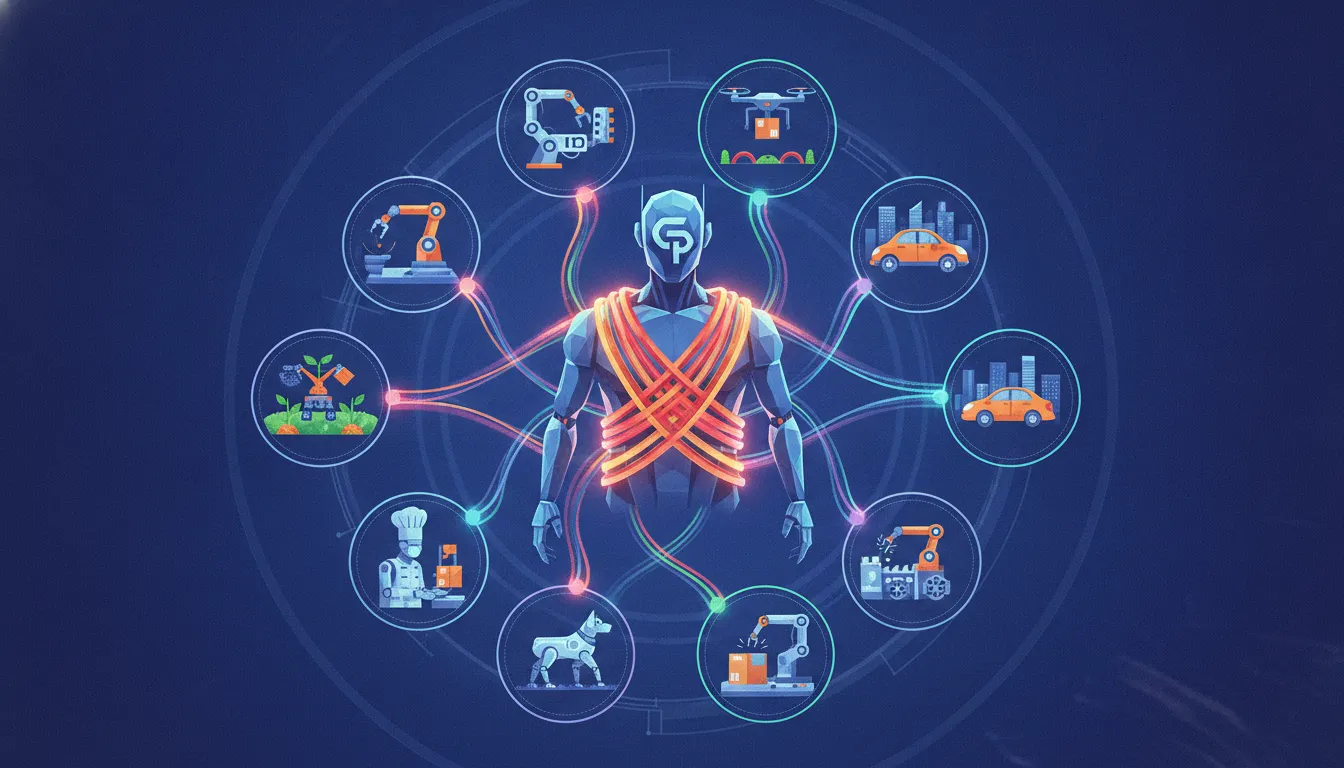
A new arXiv preprint introduces GaP — a multi-agent coding harness that builds computation graphs for robot tasks and rehearses them in parallel simulation until they work [S1]. Tested across eight benchmarks spanning simulation and the real world, the framework targets a class of problems where objects shift and deform in ways that break traditional automation [S1]. But the paper leaves a critical question dangling: how much of that simulated success actually survives the jump to physical hardware?
The problem: robots that can't handle messy
Industrial automation thrives on repetition. A robotic arm on an assembly line works because every part arrives in the same orientation, the same shape, the same place. The moment objects start varying — different geometries, unpredictable poses — that precision falls apart.
The GaP paper gives this problem a name: Variational Automation, or VA — tasks where object geometry and pose vary more than fixed automation can tolerate [S1]. Think of a bin-picking task where parts tumble into a container in random orientations, or an assembly step where the component arrives slightly rotated each time.
The authors note that model-free policies — the "learn by trial and error" approach powering much of modern robot learning — often struggle to close the reliability gap for these variable tasks [S1]. A policy that works in a controlled demo might collapse when the lighting changes or the object shifts by a few centimetres.
How GaP works: graphs, not just neural networks
GaP — short for Graph-as-Policy — takes a different tack. Instead of training a single monolithic neural network to handle everything, it composes existing robot skills into a directed computation graph [S1].
Here is the mechanism, step by step:
- GaP draws from MORSL — a Modular Open Robot Skill Library — to assemble a graph with three types of nodes: perception (seeing the scene), planning (deciding what to do), and control (executing the motion) [S1].
- It spins up an internal simulation environment and runs multiple versions of that graph in parallel — different structures, different parameters [S1].
- It measures which graphs succeed and which fail, then iteratively refines both the graph's wiring and its node settings to push success rates and throughput higher [S1].
The key insight: rather than learning a policy from scratch, GaP searches through possible combinations of existing skills, with simulated rehearsal acting as the fitness function. It is evolution, not deep learning — and the graph structure makes the result inspectable in a way a black-box neural network is not.
This connects to a broader current in robotics research: composing modular skills rather than training one giant model. GaP pushes that idea further by adding the self-learning simulation loop.
The test: eight benchmarks, four on real robots
The authors evaluated GaP on eight new open benchmarks for Variational Automation tasks — four in simulation and four on physical robots [S1]. They report that GaP achieves success rates "significantly outperforming baseline methods" [S1].
That claim comes with caveats. The paper is an arXiv preprint listed under cs.AI and cs.LG and has not been peer-reviewed [S1]. The abstract does not disclose specific numerical success rates, making it impossible to gauge the margin of improvement from the summary alone. And the eight benchmarks are newly created by the authors, not established industry standards.
What it means
For anyone trying to build robots that work outside structured assembly lines, GaP represents a meaningful shift in approach. The core idea — compose skills into a graph, rehearse in simulation, refine the graph — sidesteps the data-hungry training that model-free policies demand. Instead of needing thousands of real-world demonstrations, the system learns by trying different arrangements of existing skills in a simulated world.
The graph structure matters for a second reason: transparency. When a GaP-controlled robot fails, you can look at the computation graph and see which node broke — was it the perception node that misidentified the object, or the planning node that chose a bad grasp? A black-box policy offers no such diagnostic.
For regular people, this points toward robots that could eventually handle the unstructured messiness of real environments — sorting recycling, packing variable produce, assembling products where parts are not perfectly standardised. None of that is happening tomorrow, but the research direction is clear.
What it means for business
A two-person automation shop eyeing a bin-picking contract — the classic VA problem — should understand what GaP is and is not. It is not a commercial product. It is a research framework with open code and data available at the project site [S1]. The "multi-agent" in its description refers to AI agents that write and refine code, not multiple robots working in concert.
For a small manufacturing operation, the practical signal is this: the state of the art in variable automation is moving from "train a policy and hope" toward "compose skills, simulate, and refine." If you are evaluating robotics vendors, ask whether their system can decompose a task into inspectable modules or whether it is a single opaque model. The former is where the field is heading.
A suburban warehouse or logistics firm dealing with mixed-SKU palletising — where every box is a different size — faces exactly the kind of Variational Automation GaP targets. The technology is not ready to deploy today, but the open benchmark set and public code mean a technical team could prototype against it.
What we don't know yet
Several critical questions remain unanswered:
- The numbers. The abstract claims GaP significantly outperforms baselines but does not quantify the gap [S1]. Without specific success rates, it is impossible to assess whether the improvement is 5% or 50%.
- Real-world versus simulation breakdown. Four of the eight benchmarks ran on physical robots, but the abstract does not separate those results from the simulation-only tasks [S1]. The sim-to-real gap — the difference between what works in simulation and what works on hardware — is the single hardest problem in robotics, and we do not know how GaP performed on each side.
- Independent verification. No third party has replicated these results. The benchmarks are new, the claims are the authors' own, and the paper has not been peer-reviewed [S1].
- Commercial readiness. GaP is a research harness, not a product. There is no evidence it is deployed in any live industrial environment.
The next concrete event to watch: peer review and community replication. The open code and data at the project site [S1] make independent testing possible — whether anyone takes up that challenge will tell us whether GaP's approach holds up beyond its authors' lab.
If robot self-learning is the thread you are following, subscribe to keep reading — we will be tracking which of these simulation-to-reality claims survive contact with the physical world.
Sources: [S1] arXiv preprint, GaP: A Graph-as-Policy Multi-Agent Self-Learning Harness For Variational Automation Tasks, arxiv.org/abs/2607.05369v1
Sources
- [S1] GaP: A Graph-as-Policy Multi-Agent Self-Learning Harness For Variational Automation Tasks — arXiv preprint (cs.AI, cs.LG) (attributed)
- [P2] GaP: A Graph-as-Policy Multi-Agent Self-Learning Harness For Variational Automation (VA) Tasks — GaP: A Graph-as-Policy Multi-Agent Self-Learning Harness For Variational Automation (VA) Tasks (attributed)
- [P3] HarnessForge: Joint Harness and Policy Evolution for Adaptive Agent Systems — HarnessForge: Joint Harness and Policy Evolution for Adaptive Agent Systems (attributed)
- [P4] Autonomous Integration and Improvement of Robotic Assembly using Skill Graph Representations — Autonomous Integration and Improvement of Robotic Assembly using Skill Graph Representations (attributed)
- [P5] yh2371/ModSkill — yh2371/ModSkill (attributed)
More from Not A Tech Guy
- Language models don't just measure culture — they shape it
- Cyber incident response taxonomy maps 417 studies
- FDIFormer: Transformer AI matches expert grid attack detection
Generated from an audited evidence pack with primary-source research. Social-media items are discussion signals, not verified facts. Nothing here is financial, legal or medical advice.