
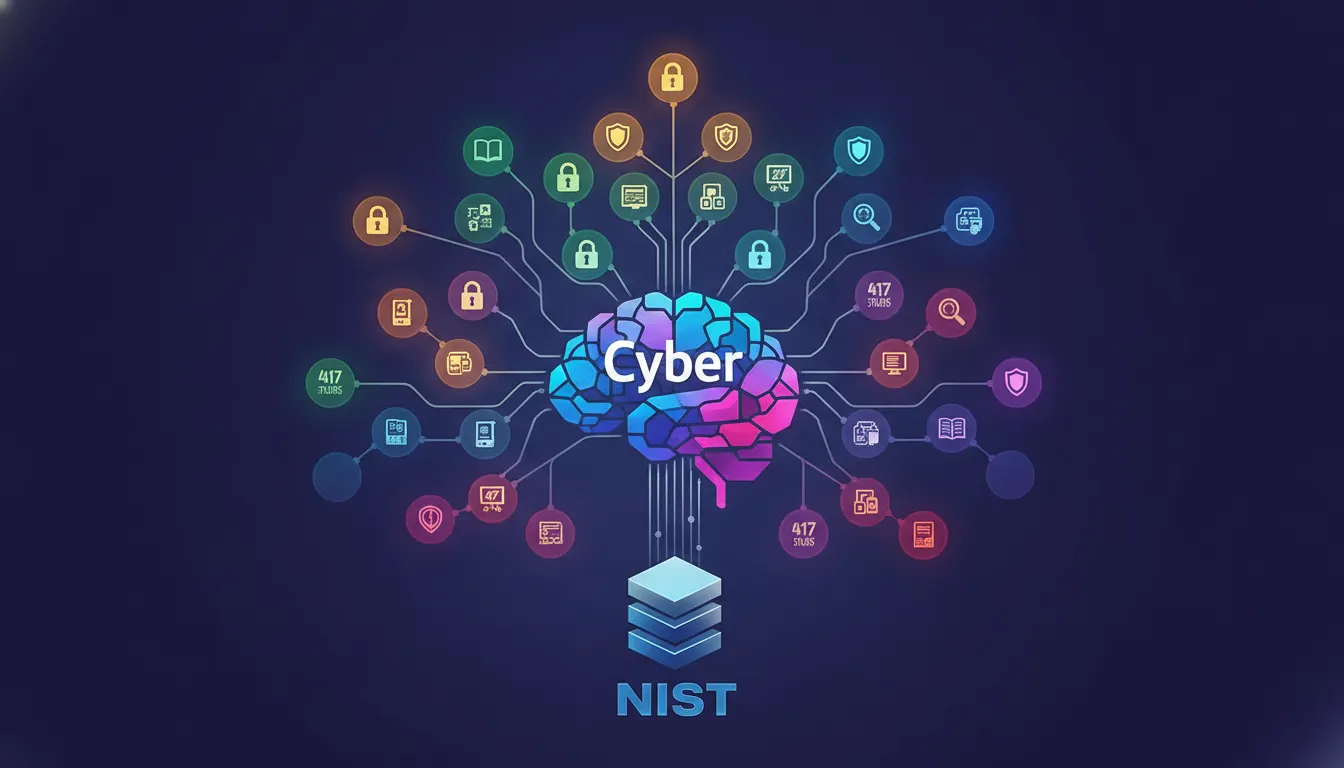
Researchers have distilled 417 academic studies and 40 industry publications spanning 1999 to mid-2024 into a single taxonomy of what actually influences cybersecurity incident response [S1]. The field has operated for a quarter-century without a unified framework to organise that knowledge — and the gap matters because incident response sits at the intersection of technology, human behaviour, organisational structure, and psychology [S1]. What did the authors find when they compared their taxonomy against seven established scientific frameworks and NIST's own incident response profile — and which factors have been hiding in plain sight?
The 25-year knowledge gap
Cybersecurity incident response is not a single discipline. The authors of the preprint — Thomas Biege, Marius Brockhoff, Jonas Kaspereit, Fabian Ising, Lea Gröber, and Sebastian Schinzel — note that it spans technology, human-computer interaction, organisational theory, and human factors [S1][P2]. Each of those fields has produced its own research, its own terminology, its own assumptions about what matters when a breach happens.
The problem is that nobody has stitched it together. The authors state plainly that "a unified framework for systematically organising the accumulated knowledge remains absent" [S1]. That absence has a real cost: a security team reading the literature gets fragments. A finding about alert fatigue from a human-factors journal. A framework about containment timing from a technical paper. An organisational-theory study about decision-making under pressure. None of them reference each other's vocabulary.
This is the landscape the open-source incident-response community has been navigating pragmatically. Repositories like ATC-REACT (665 stars on GitHub) and the awesome-playbooks collection (132 stars) have crowdsourced actionable response techniques and playbooks in Python and Jinja templates [P4][P3]. They are practical, bottom-up efforts — but they are not taxonomies. They tell you what to do, not what factors shape whether doing it actually works.
How the taxonomy was built
The authors conducted a systematic review — 417 academic literature items and 40 non-scientific publications — covering the period from 1999 to mid-2024 [S1]. From that corpus they derived what they call the Cybersecurity Incident Response Influencing Factor Taxonomy, or CIR-IF Taxonomy [S1].
Then they did something most taxonomy papers skip: they stress-tested it. The taxonomy categories were systematically compared against seven established scientific frameworks and against the NIST Cyber Security Framework elements referenced in NIST Special Publication 800-61r3, the US government's incident response profile [S1]. The seven frameworks are not named in the available text, so we cannot assess how directly comparable they are — but the exercise itself is the point. A taxonomy that only references itself proves nothing.
The authors' own assessment is that the CIR-IF Taxonomy delivers "a richer, more rigorous, and more systematically organised view of the factors that drive and shape incident response" than the frameworks they compared it against [S1]. That is their claim, not an independent finding — and it has not been peer-reviewed.
What it means
For a reader with no background in cybersecurity, here is the clear version. When a company gets hacked, the response is not just a technical problem. It is also a people problem (who is tired, who is trained, who panics), an organisational problem (who has authority to shut down a system, who needs to be told), and a human-factors problem (how does the interface of the security tool help or hinder decisions under stress).
For 25 years, researchers have studied these dimensions separately. This paper attempts to lay them out on a single map. The value is not in discovering new factors — it is in showing how the known factors relate to each other, where the overlaps are, and where the blind spots sit. Think of it as the difference between having a pile of street maps for different suburbs and having one city map with a legend.
If the taxonomy holds up under peer review, it gives security teams a shared vocabulary. A CISO can point to a specific factor category and say, "this is where we are weak." A vendor can map a product to a factor and show where it helps. A researcher can see which factor categories are understudied.
What it means for business
The concrete impact falls first on small and mid-sized security operations — the two-person firm, the suburban IT services provider, the in-house security lead at a 200-person company who also manages the firewall.
These teams already use playbook-style tools. The ATC-REACT knowledge base and similar open-source repositories give them step-by-step response techniques [P4]. But playbooks assume you already know which factors matter for your environment. A taxonomy of influencing factors gives those teams a diagnostic layer: before you run the playbook, you can ask which organisational, human, and technical factors are in play.
For a managed security services provider, the taxonomy could become a scoping tool — a structured way to assess a new client's incident-response readiness across all dimensions, not just the technical ones. For a security tooling vendor, it offers a framework for talking about the human and organisational gaps their product addresses, rather than leading with feature lists.
None of this is actionable this week in a direct sense — the taxonomy is a preprint, not a standard. But security leaders who track the evolution of incident-response frameworks should be aware it exists, because it is the most comprehensive synthesis of the field's empirical knowledge to date.
What we don't know yet
Several things remain open:
-
Peer review status. This is an arXiv preprint that has not been peer-reviewed [S1]. The taxonomy structure and the authors' comparative claims may change or be challenged during review. arXiv preprints can be revised or withdrawn without notice.
-
The seven frameworks. The established scientific frameworks used for comparison are not identified by name in the available text [S1]. Without knowing what they are, it is hard to independently judge whether the comparison is fair or whether the authors cherry-picked weaker baselines.
-
NIST's position. The paper references NIST SP 800-61r3 for comparison, but there is no indication NIST has endorsed, adopted, or validated the CIR-IF Taxonomy. The comparison is the authors' own.
-
No new primary data. The study is a synthesis of existing literature, not a report of new experiments or observational findings [S1]. Its value depends entirely on the quality and completeness of the underlying corpus.
-
Practical adoption. Whether the taxonomy gets picked up by practitioners, tooling vendors, or standards bodies is unknown. The open-source IR community has built its own bottom-up structures [P3][P4]; whether a top-down academic taxonomy complements or competes with those efforts remains to be seen.
The next concrete signal to watch: whether the paper appears in a peer-reviewed venue, and whether any of the seven comparison frameworks' authors respond publicly to the comparative claims.
Sources
- [S1] SoK: A Taxonomy for Cybersecurity Incident Response Influence Factors, arXiv preprint (cs.AI, cs.LG), https://arxiv.org/abs/2607.02451v1
- [P2] Full HTML version, arXiv, https://arxiv.org/html/2607.02451v1
- [P3] luduslibrum/awesome-playbooks, GitHub, https://github.com/luduslibrum/awesome-playbooks
- [P4] atc-project/atc-react, GitHub, https://github.com/atc-project/atc-react
- [P5] Intrusion Response Systems: Past, Present and Future, arXiv, https://arxiv.org/pdf/2303.03070v1
Sources
- [S1] SoK: A Taxonomy for Cybersecurity Incident Response Influence Factors — arXiv preprint (cs.AI, cs.LG) (attributed)
- [P2] SoK: A Taxonomy for Cybersecurity Incident Response Influence Factors — SoK: A Taxonomy for Cybersecurity Incident Response Influence Factors (attributed)
- [P3] luduslibrum/awesome-playbooks — luduslibrum/awesome-playbooks (attributed)
- [P4] atc-project/atc-react — atc-project/atc-react (attributed)
- [P5] Date of publication xxxx 00, 0000, date of current version xxxx 00, 0000 — Date of publication xxxx 00, 0000, date of current version xxxx 00, 0000 (attributed)
More from Not A Tech Guy
- FDIFormer: Transformer AI matches expert grid attack detection
- HilEnT turns malware into images for AI detection
- Codex and Claude Code: one benchmark run isn't enough
Generated from an audited evidence pack with primary-source research. Social-media items are discussion signals, not verified facts. Nothing here is financial, legal or medical advice.