A pre-trained Transformer model has matched the best hand-tuned detection method for false data injection attacks on smart grid networks, scoring an MCC of 0.595 against XGBoost's 0.604 — without a single manually engineered protocol feature [S1]. The gap is razor-thin, and the implications are not. If a general-purpose language model can spot malicious packets in the time-critical communication protocols that keep power flowing, the question is no longer whether AI belongs in grid security — it's what happens to the domain experts whose craft it replaces.
The attack that looks like normal traffic
Smart grids — power networks laced with communication links and intelligent electronic devices — rely on constant automated messaging to keep electricity flowing reliably [S1]. The more interconnected these systems become, the more exposed they are to cyberattacks: message tampering, false command injection, denial-of-service [S1].
False Data Injection (FDI) attacks are the quiet ones. An attacker deletes, modifies, or adds packets to the communication stream — and in IEC 61850 substations, the stakes are acute [S1]. IEC 61850 is the international standard for substation automation. Within it, GOOSE messages — Generic Object-Oriented Substation Event — carry time-critical protection and control signals between devices [S1]. Tamper with a GOOSE message and you can fool a substation into misreading its own grid.
The reason this is so hard to catch: malicious packets closely resemble legitimate ones [S1]. A tampered GOOSE message looks almost identical to a real one. Existing detection methods lean heavily on manually engineered protocol features — hand-crafted signals that require deep domain knowledge and don't transfer well to new environments [S1].
Turning packets into text
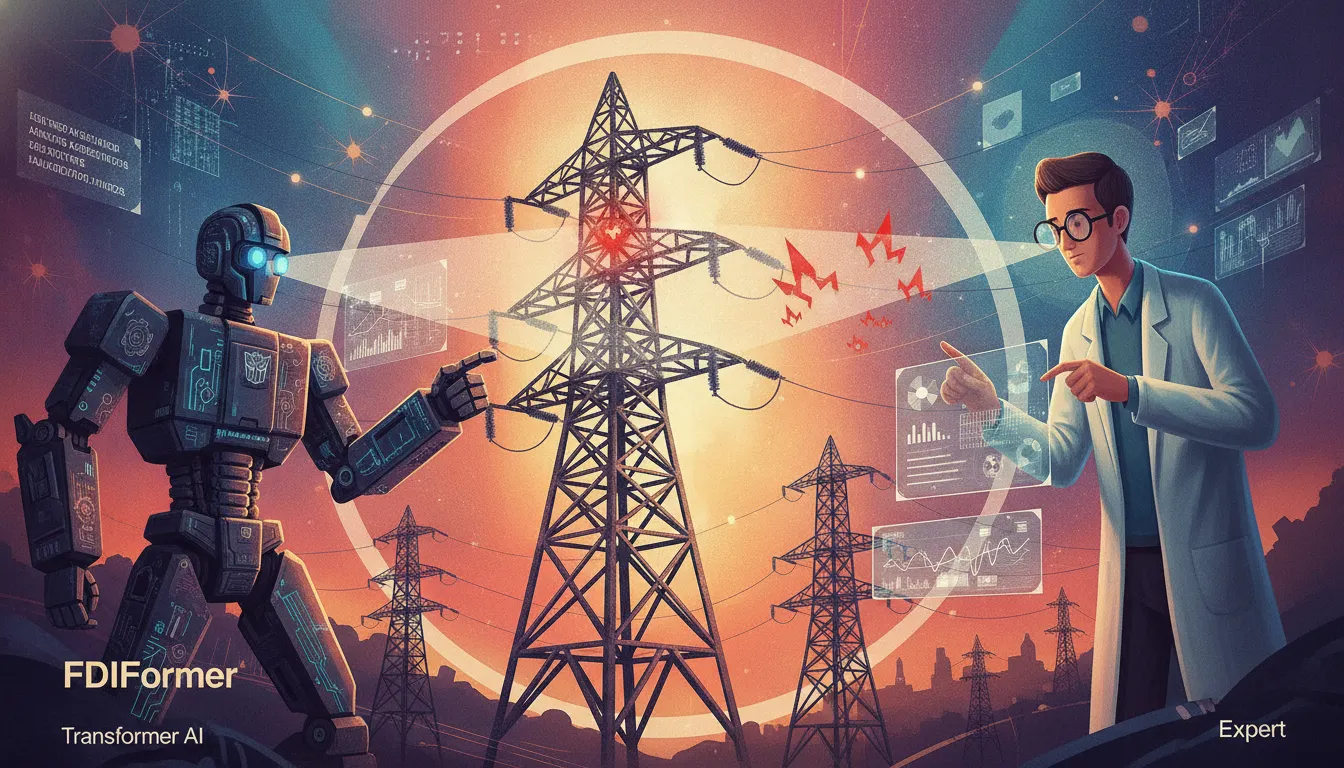
FDIFormer's core idea is deceptively simple. Instead of asking domain experts to identify which protocol fields matter, it converts GOOSE packet sequences into structured text windows — strings that capture communication behaviour — and feeds them to a pre-trained Transformer model [S1].
The Transformer, already trained on vast amounts of code and text, learns to distinguish attack patterns directly from the data. No manual feature engineering. No protocol-specific hand-tuning [S1].
The researchers evaluated the framework on the QUT-ZSS-2023-GOOSE dataset using scenario-level three-fold cross-validation [S1]. The standout model was GraphCodeBERT — a pre-trained Transformer originally built for code understanding — which achieved an MCC (Matthews Correlation Coefficient, a balanced measure of classification quality that accounts for class imbalance) of 0.595 ± 0.122 [S1].
That result improved MCC by 0.133 over TF-IDF baselines — basic text-frequency methods [S1]. But it did not beat the strongest feature-engineered baseline: XGBoost, at MCC 0.604 ± 0.121 [S1].
What it means
The headline number — 0.595 versus 0.604 — tells you the Transformer didn't win. It came close enough that the difference may not matter. The confidence bands overlap (±0.122 versus ±0.121), meaning the two methods are practically indistinguishable on this dataset.
What the Transformer traded away in raw accuracy, it gained back in something harder to measure: the removal of a bottleneck.
Manual feature engineering for protocol-level attack detection requires specialists who understand IEC 61850, GOOSE message structures, and the specific attack surfaces of substation communication. These people are rare. Their work is slow. And the features they craft often don't generalise — a detector tuned for one substation's traffic patterns may fail in another [S1].
FDIFormer sidesteps that entirely. A pre-trained Transformer, fine-tuned on packet data converted to text, learns what matters on its own. The domain expertise moves from feature design to model evaluation — still skilled work, but a different skill set.
FDIFormer applies this logic to physical infrastructure: the same Transformer architecture that powers language models and code analysis can read protocol traffic well enough to catch attacks that look identical to legitimate communication.
What it means for business
For a utility's cybersecurity team — say, a two-person group at a regional distributor — the practical shift is in who does the work. Today, deploying an FDI detector means either hiring or consulting a protocol specialist to engineer features for your specific GOOSE traffic. FDIFormer suggests that step may become optional.
The workflow change: convert your captured GOOSE traffic to structured text, fine-tune a pre-trained Transformer, and deploy. The specialist knowledge moves from building features to evaluating model performance — a skill set more organisations already have in-house.
For vendors building grid security products, this lowers the barrier to entry. A startup doesn't need a team of IEC 61850 experts to build a detector — it needs machine learning engineers and access to training data. Microsoft's own GridSFM project, described as small foundation models for the power grid [P5], signals that the major players are already investing in this direction.
For grid operators, the cost question is inference — the compute required to run a Transformer model in real-time on live traffic. GOOSE messages operate on millisecond timescales; detection latency matters. The paper doesn't address deployment speed, and that gap will determine whether this approach leaves the lab.
What we don't know yet
The findings rest on a single dataset — QUT-ZSS-2023-GOOSE — evaluated with one cross-validation strategy [S1]. Whether the approach generalises to other substations, other IEC 61850 implementations, or other communication protocols is unproven.
The paper is an arXiv preprint and has not been peer-reviewed [S1]. The results, while promising, need independent validation.
The 0.133 MCC improvement sounds impressive but applies only to TF-IDF baselines — the weakest comparison. Against the strongest baseline (XGBoost), the Transformer is marginally behind [S1].
Crucially, the evaluation doesn't address real-time performance. GOOSE messages operate on millisecond timescales. Whether a fine-tuned Transformer can classify packets fast enough to matter in a live substation — and at what compute cost — is the question that will determine whether FDIFormer becomes a tool or a paper.
The next signal to watch: peer review and publication, and any deployment study measuring inference latency on operational traffic. Until then, this is a proof of concept with a narrow but genuinely interesting claim: you don't need a protocol expert to catch a protocol attack.
If that idea lands for you, subscribe — the next piece in this series is already in the queue.
Sources
- [S1] FDIFormer: Protocol-Aware Transformer Learning for False Data Injection Attack Detection in Smart Grid Networks — arXiv preprint (cs.CR, q-fin.GN), 8 July 2026
- [P5] Microsoft GridSFM — Small Foundation Models for the Power Grid, GitHub repository
Sources
- [S1] FDIFormer:Protocol-Aware Transformer Learning for False Data Injection Attack Detection in Smart Grid Networks — arXiv preprint (cs.CR, q-fin.GN) (attributed)
- [P2] thu-coai/DA-Transformer — thu-coai/DA-Transformer (attributed)
- [P3] [2209.00778] Detection of False Data Injection Attacks in Smart Grid: A Secure Federated Deep Learning Approach — [2209.00778] Detection of False Data Injection Attacks in Smart Grid: A Secure Federated Deep Learning Approach (attributed)
- [P4] mehedi93hasan/DSTAN-MED — mehedi93hasan/DSTAN-MED (attributed)
- [P5] microsoft/GridSFM — microsoft/GridSFM (attributed)
More from Not A Tech Guy
- HilEnT turns malware into images for AI detection
- Codex and Claude Code: one benchmark run isn't enough
- Backdoor attack hides multiple triggers in speech AI models
Generated from an audited evidence pack with primary-source research. Social-media items are discussion signals, not verified facts. Nothing here is financial, legal or medical advice.