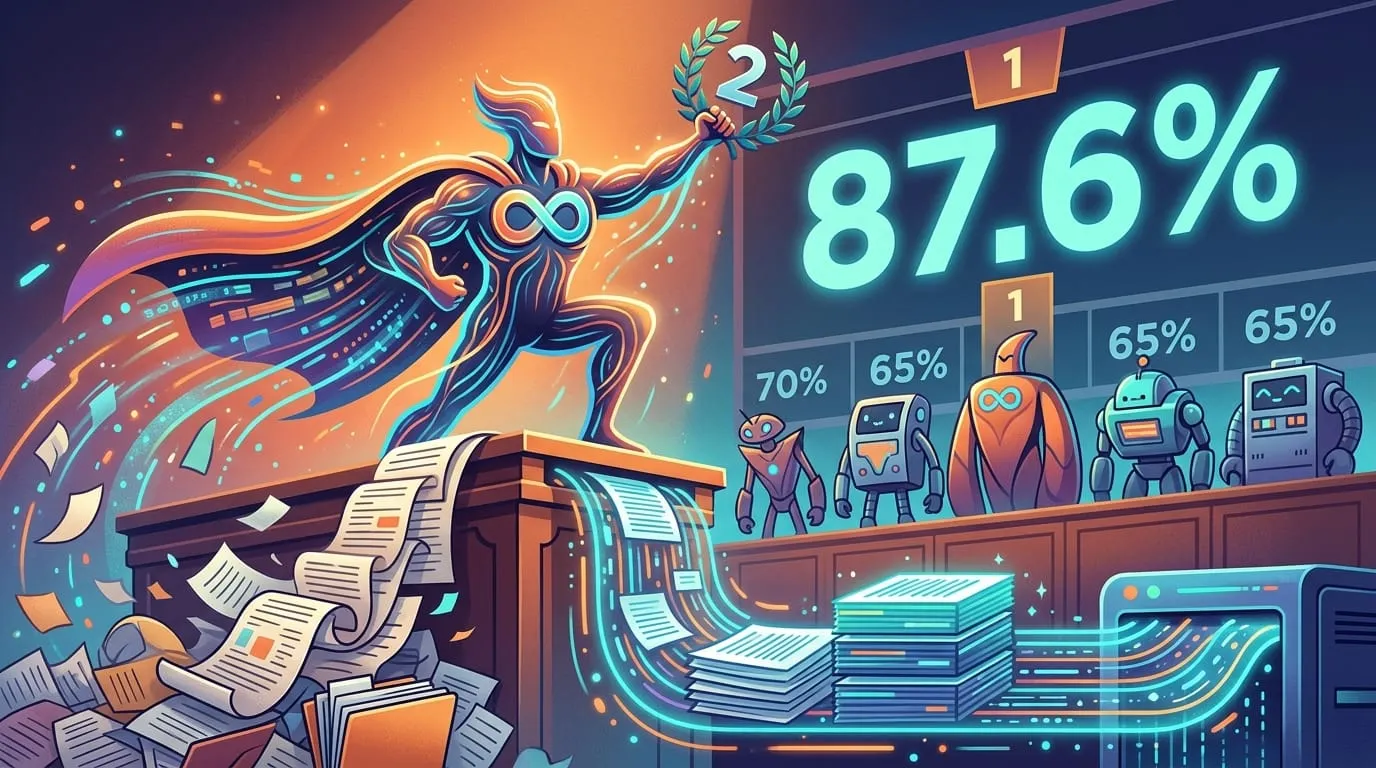
A new multimodal system called Infinity-Parser2, designed for complete document parsing, appeared on arXiv on July 11, 2026. Its Pro edition achieved 87.6% on the olmOCR-Bench, outperforming DeepSeek-OCR-2, PaddleOCR-VL-1.5, and MinerU2.5 [S1]. The release includes a bilingual training dataset of five million samples, plus a Flash model that operates 3.68 times faster than the earlier version [S1]. But the headline numbers mask a more interesting question: what happens when you train one model on eight document tasks simultaneously, and why has nobody done it quite like this before?
Why document parsing is hard
Think about the last time you tried to copy a table from a PDF into a spreadsheet. The columns drift. The headers merge. A footnote sneaks into the data rows. Now imagine that table is buried in a 40-page academic paper, sandwiched between a LaTeX equation and a bar chart — and the whole thing is in Chinese.
Document parsing — turning visual layouts into clean, structured, machine-readable text — sounds trivial until you try it. Tables break. Formulas scramble. Reading order collapses. The models that attempt it have typically been trained on narrow datasets, handling one document type well and fumbling the rest.
The 5-million-sample fix
The INF Team attacked the data problem first. The researchers created and released Infinity-Doc2-5M, a bilingual dataset containing five million English and Chinese samples drawn from academic literature, research repositories, and various document structures [S1, P3]. The dataset provides annotations for element bounding boxes, reading order across full pages, and standardized content formats like Markdown, HTML, LaTeX, SMILES for chemical structures, and charts [S1].
That last detail matters more than it sounds. Reading order — the sequence in which a human would actually read a page — lets a model output text in a logical flow rather than dumping fragments in visual position. Most existing datasets don't annotate it. This one does, across 5 million samples, in two languages.
Eight tasks, one model
With data in hand, the team trained Infinity-Parser2 using what they call Joint Reinforcement Learning across eight different objectives, including layout analysis, parsing for tables, math formulas, charts, and chemical formulas, alongside document visual question answering (VQA) and general multimodal comprehension [S1].
The key word is joint. Instead of training separate models — one for tables, one for formulas, one for charts — the researchers employed a multi-task reward framework with verifiable rewards, allowing them to train all eight goals together within one model [S1]. A model that learns to parse a chemical formula also learns something about spatial reasoning that helps it parse a chart. Knowledge bleeds across tasks.
Two variants emerged. The Flash version is designed for faster processing speeds, achieving 3.68 times the throughput of the earlier Infinity-Parser-7B model [S1]. The Pro version focuses on accuracy, achieving 87.6% on olmOCR-Bench and 74.3% on ParseBench to outperform DeepSeek-OCR-2, PaddleOCR-VL-1.5, and MinerU2.5 [S1]. The researchers note that the model also performs well on charts, chemical formulas, and document VQA tasks [S1].
What it means
For anyone who works with documents — and that's almost everyone — Infinity-Parser2 represents a shift from specialised, single-task OCR tools toward a single model that handles the full spectrum of document content. The Pro variant is available on HuggingFace [P4], and the dataset is published there too [P3], meaning developers can run it locally, fine-tune it, or build on it without depending on a proprietary API.
The bilingual Chinese-English training is significant. Most document parsing benchmarks and datasets are English-heavy. A model trained equally on both languages could narrow the gap for Chinese-language document processing, which has historically lagged.
The multi-task RL approach is the deeper innovation. By co-training eight objectives with verifiable rewards — rewards that can be automatically checked against ground truth, like whether a parsed table matches the original — the team sidesteps the need for human annotation of model outputs during training. That's a scalability lever: more tasks, more data, less manual labelling.
What it means for business
A two-person legal tech startup that needs to extract clauses from contracts, tables from exhibits, and metadata from cover pages could previously do this with three different tools — or one expensive API. A single model that handles all of them changes the build-versus-buy calculus.
A suburban accounting firm processing client financial statements — often scanned PDFs with embedded tables and footnotes — could run Infinity-Parser2-Flash locally for speed, or Pro for accuracy on complex filings. The 3.68x throughput gain over the previous model means more documents processed per hour on the same hardware [S1].
A research agency that needs to extract data from academic papers — tables, equations, chemical structures — gets a model specifically trained on those document types, with SMILES notation support for molecular structures [S1].
The open dataset matters too. A team building a vertical-specific parser — say, for medical lab reports — can use Infinity-Doc2-5M as a pre-training base and fine-tune on their own domain data, rather than starting from scratch.
What we don't know yet
All performance claims come from the authors' own arXiv preprint (v1), which has not been peer-reviewed [S1]. The benchmark results — 87.6% on olmOCR-Bench, 74.3% on ParseBench — are self-reported and may reflect evaluation protocols or test sets chosen by the authors. No third party has independently verified these numbers.
The abstract does not mention the specific open-source licenses for the models or dataset; while the HuggingFace pages show the releases, the exact licensing conditions remain unclear [S1, P4]. The training compute budget, model parameter counts, and detailed architecture are not disclosed in the abstract.
According to the HuggingFace page, the model was released on May 11, 2026 [P4], whereas the arXiv paper was published on July 11, 2026 [S1]. This two-month interval means the models were accessible before a comprehensive technical report was available. Whether the released models match what the paper describes, or whether revisions have been made since the May release, is unclear.
arXiv preprints can be revised or withdrawn, so the v1 claims may change in subsequent versions. The next thing to watch: independent benchmark reproductions, and whether the team releases a detailed model card with parameter counts and licence terms.
If you want document-parsing developments decoded like this before they hit the trade press, subscribe — there's more coming.
Sources
- [S1] Infinity-Parser2 Technical Report, arXiv:2607.07836v1, published July 11, 2026 — arxiv.org/abs/2607.07836
- [P2] Infinity-Parser2 Technical Report (full HTML) — arxiv.org/html/2607.07836
- [P3] Infinity-Doc2-5M dataset — huggingface.co/datasets/infly/Infinity-Doc2-5M
- [P4] Infinity-Parser2-Pro model page — huggingface.co/infly/Infinity-Parser2-Pro
- [P5] INF-MLLM GitHub repository — github.com/infly-ai/inf-mllm
Sources
- [S1] Infinity-Parser2 Technical Report — arXiv cs.AI new (official RSS) (attributed)
- [P2] Infinity-Parser2 Technical Report — Infinity-Parser2 Technical Report (attributed)
- [P3] infly/Infinity-Doc2-5M · Datasets at Hugging Face — infly/Infinity-Doc2-5M · Datasets at Hugging Face (attributed)
- [P4] infly/Infinity-Parser2-Pro · Hugging Face — infly/Infinity-Parser2-Pro · Hugging Face (attributed)
- [P5] infly-ai/INF-MLLM — infly-ai/INF-MLLM (attributed)
More from Not A Tech Guy
- AI agent harness blocks leaks, keeps full 120/120 utility
- EvoSOP lets AI agents write their own playbooks
- Scaling improves LLM social simulation — but not human biases
Generated from an audited evidence pack with primary-source research. Social-media items are discussion signals, not verified facts. Nothing here is financial, legal or medical advice.