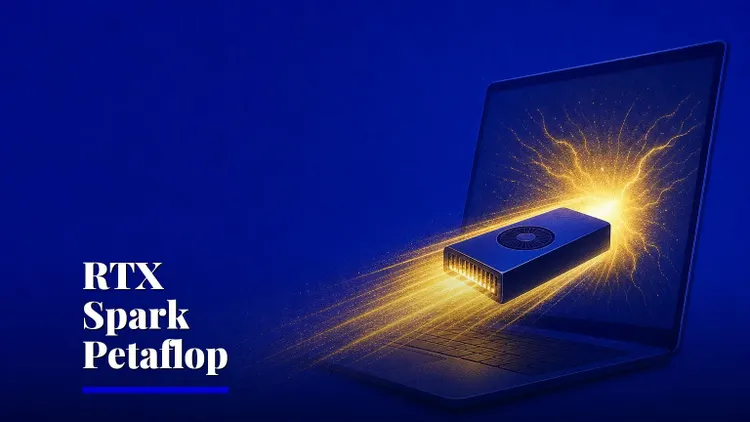

One petaflop. That is the raw computing power Nvidia is packing into its new RTX Spark chip, a metric usually reserved for room-sized servers, not a laptop you carry to a coffee shop. It promises to turn your computer from a passive tool into an active teammate, but can the hardware actually deliver on the hype of "personal AI agents"?
Jensen Huang took the stage in Taipei on Monday to unveil the RTX Spark, a move that signals Nvidia’s aggressive push into the consumer PC market [S1]. This isn't just another graphics card; the company describes it as a "new superchip" designed specifically for the era of personal AI agents [S1]. The official specs are striking: the RTX Spark is rated at 1 petaflop of performance, a massive leap that places it in a league previously dominated by dedicated data centre hardware [P2][P4].
From tool to teammate
The ambition here is to fundamentally change how we interact with our machines. Nvidia’s marketing frames this as a shift from "tool to teammate," suggesting the chip is built to handle complex AI workloads locally on your device rather than relying on the cloud [S1]. This is supported by the underlying architecture, which includes the full CUDA and RTX ecosystems, allowing developers to run sophisticated inference runtimes—managing memory, scheduling, and dispatching tasks—directly on the hardware [P2][P3].
By bringing this level of power to the edge, Nvidia is betting that the future of AI isn't just about chatbots in a browser, but about agents that live on your PC. These systems could theoretically handle everything from real-time language translation to complex code generation without the latency of sending data back to a server.
The Windows coalition
You won't have to wait long to see this silicon in action, provided you are in the market for a Windows machine. A new line of PCs featuring the RTX Spark is set to launch this autumn, with major manufacturers including Lenovo, HP, Dell, Microsoft Surface, Asus, and MSI all signed up [S1]. Models from Acer and Gigabyte are expected to follow shortly after [S1].
This coordinated rollout across the Windows ecosystem is a significant show of force, especially considering that Lenovo, HP, and Dell alone control nearly three-quarters of the global PC market [S1]. It is a clear signal that the PC industry is uniting behind Nvidia's vision of AI-capable hardware to drive a new upgrade cycle.
A challenge to the old guard
This launch represents a direct challenge to the established hierarchy of the PC market. While Nvidia has historically dominated the world of Graphics Processing Units (GPUs), the RTX Spark pushes the company into direct competition with high-profile incumbents like Apple and Intel [S1]. By positioning the Windows PC as the premier platform for "personal AI," Nvidia is betting that AI capability will become the primary deciding factor for consumers, potentially overshadowing traditional metrics like battery life or display resolution.
The announcement comes against a backdrop of intensifying geopolitical tension in the semiconductor industry. Just a day before Huang's keynote, the United States tightened its regulations regarding the sale of Nvidia's most advanced chips to Chinese firms [S1]. While the RTX Spark is aimed at the global consumer market, these restrictions highlight the strategic importance of the technology Nvidia is developing and the high stakes involved in the race for AI dominance.
What to watch
For the everyday user, the promise of the RTX Spark is a future where your laptop can run powerful AI assistants without an internet connection. However, the real test will be software. Hardware is only as good as the applications that use it, and we will need to see if developers can actually build these "teammate" agents to take full advantage of that 1-petaflop engine.
Keep an eye on the software releases this autumn; that is where the real story of AI PCs will be written. If you want to understand the hardware shaping that future, subscribe to our newsletter.
Sources
- [S1] Nvidia announces new AI chip for personal computers — Web search lead (reported)
- [P2] NVIDIA and Microsoft Reinvent Windows PCs for the Age of Personal AI | NVIDIA Newsroom — NVIDIA and Microsoft Reinvent Windows PCs for the Age of Personal AI | NVIDIA Newsroom (primary)
- [P3] gittensor-ai-lab/sparkinfer-runtime — gittensor-ai-lab/sparkinfer-runtime (attributed)
- [P4] NVIDIA Corporation - NVIDIA and Microsoft Reinvent Windows PCs for the Age of Personal AI — NVIDIA Corporation - NVIDIA and Microsoft Reinvent Windows PCs for the Age of Personal AI (primary)
- [P5] yan-labs/jensen-huang-nvidia-catalyst — yan-labs/jensen-huang-nvidia-catalyst (attributed)
More from Not A Tech Guy
- kNNGuard: 10x faster AI safety without retraining
- XGBoost Scored 0.98 Against Hackers. Its Explanations Still Collapsed.
- Masked image modelling beats contrastive learning in messy distributed AI training, Sydney-led team shows
Generated from an audited evidence pack with primary-source research. Social-media items are discussion signals, not verified facts. Nothing here is financial, legal or medical advice.