
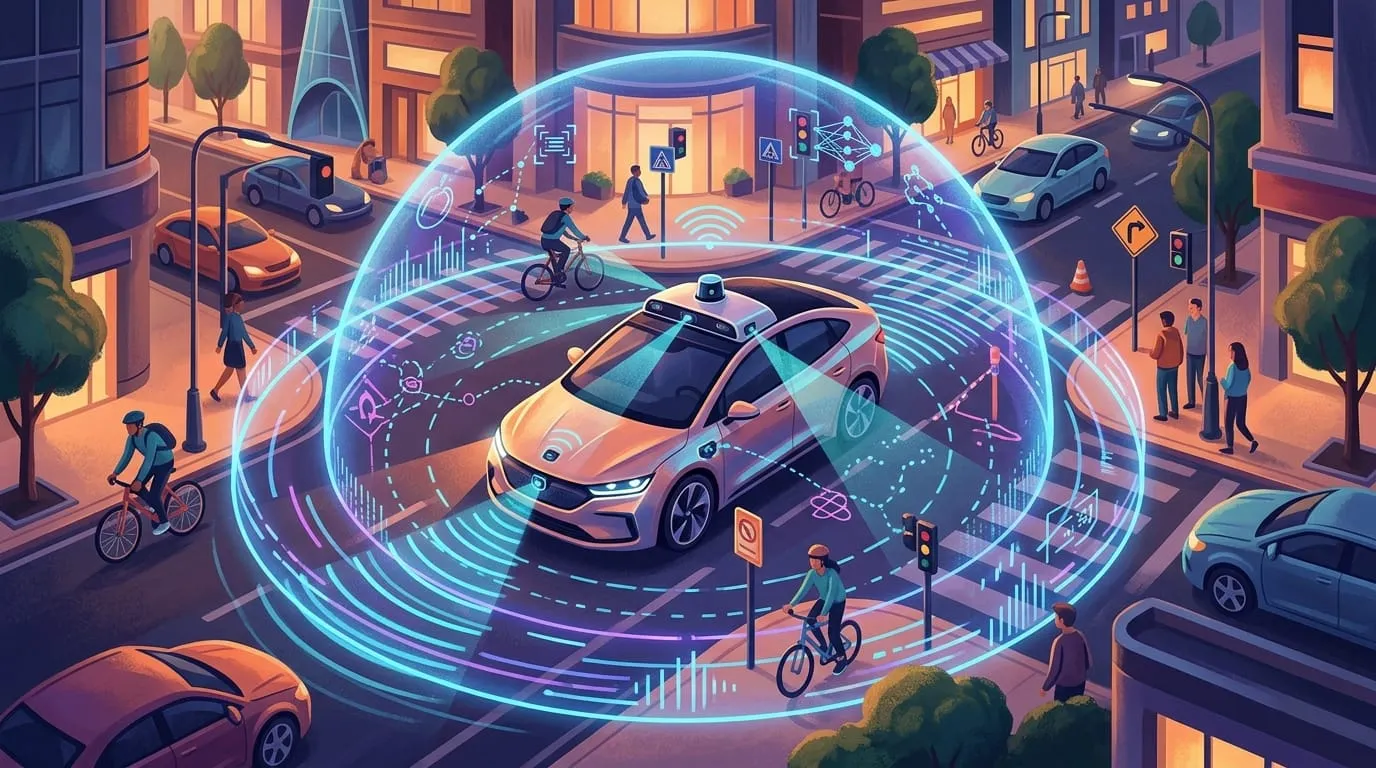
A new arXiv preprint called 4DR360 proposes a 4D radar-camera framework that builds a full 360-degree picture of the road by treating the 3D scene as something the system reasons about continuously, not just draws at the end [S1]. The shift sounds small. It changes how every stage of the perception pipeline talks to every other stage, and whether a self-driving car can trust what it sees when the weather turns bad.
The preprint, posted on 13 July 2026 and listed under arXiv's AI and machine-learning categories, has not been peer-reviewed [S1]. Its claims are provisional. But the architecture it describes addresses a real and well-known gap in autonomous driving perception.
The problem: radar sees dots, cameras see shapes
4D millimeter-wave radar has grown common in autonomous driving stacks thanks to low cost, ruggedness, and the ability to penetrate fog and rain that would blind a conventional camera [S1]. The trade-off is that radar returns are sparse. A radar scan might tell you something solid exists 30 metres ahead, but it won't give you the object's shape or edges. Cameras fill that gap with rich visual detail, but they fail exactly when radar shines.
Fusing the two is the obvious answer. The trouble is that today's radar-camera setups generally keep object detection and 3D scene mapping as largely independent modules that exchange only limited information [S1]. A box-detection module finds cars and pedestrians. An occupancy module fills in the surrounding geometry. They run in parallel, share a few features, and produce their outputs independently.
The fix: occupancy as a living state
4DR360's core idea is to stop treating occupancy, the dense 3D map of what is solid and what is empty, as a terminal output. Instead, the framework keeps a running semantic-occupancy estimate that stays alive across every processing step and gets sharpened as new sensor data arrives [S1].
The authors call this a cross-modal state reasoning paradigm. The occupancy estimate starts coarse, then gets updated and refined as radar and camera features move through the pipeline, progressively gaining detail [S1]. Think of it as a sketch that gets sharpened with each pass rather than a photograph taken once at the end.
Two modules do the heavy lifting. State-guided BEV Enhancement (SBE) strengthens the bird's-eye-view representation within a single frame, using the current occupancy state to guide where the system should pay attention [S1]. Doppler-guided Temporal Fusion (DTF) carries state evidence across time, using the Doppler velocity information that 4D radar provides to track how the scene evolves over longer horizons [S1]. Doppler, in plain terms, is the radar's ability to measure how fast something is moving toward or away from the sensor.
This is a reasoning approach, not just a bigger network. 4DR360 applies that principle to physical space.
The data layer
The authors extended the ManTruckScenes dataset with satellite-map-based generated occupancy labels, then paired it with OmniHD-Scenes in a unified cross-dataset protocol that evaluates both detection and occupancy under one framework [S1]. The experiments cover accuracy, robustness, ablation, and efficiency [S1].
A related prior work, Doracamom, also tackled joint 3D detection and occupancy with multi-view 4D radars and cameras for omnidirectional perception, and was accepted to TCSVT 2026 [P2, P4]. 4DR360 builds on this lineage but introduces the state-reasoning paradigm as its distinguishing move.
What it means
The practical shift is this: most autonomous driving perception systems today run detection and scene-mapping as parallel tasks that barely interact. 4DR360 argues they should be deeply coupled, with the scene map feeding back into detection and vice versa, at every stage.
For a regular reader with no background: imagine you are driving in heavy rain. Your eyes, like a camera, struggle. Your ears, like radar, still work but give you only rough direction and distance. You combine the two instinctively, updating your mental picture of the road as new information arrives. 4DR360 tries to give a self-driving car that same continuous, cross-sensor updating, rather than asking it to draw the scene once and hope it holds.
The occupancy-as-state idea matters because it gives the system a memory of the scene that persists across frames and modalities. A pedestrian who disappears behind a truck for half a second is less likely to vanish from the model's awareness if the occupancy state carries forward.
What it means for business
For autonomous vehicle developers and sensor-fusion teams, the architecture offers a different design pattern for multi-task perception pipelines. A two-person robotics startup building a delivery robot could, in principle, adopt the state-reasoning approach to get more from cheap 4D radar sensors without adding expensive LiDAR.
The cost angle is real. 4D radar is significantly cheaper than LiDAR, and if a framework like 4DR360 can close the perception-quality gap, it changes the sensor bill of materials for autonomous systems. A suburban delivery robot company running on tight margins cares about that difference.
For dataset and benchmark providers, the unified cross-dataset protocol, pairing ManTruckScenes with OmniHD-Scenes, sets a template for evaluating detection and occupancy together rather than in isolation. Teams that build training data for autonomous driving may face pressure to support both tasks in a single annotation pipeline.
The catch for any operator wanting to try this: the code and extended labels are promised only upon the paper's acceptance [S1]. Nobody can reproduce or build on this work yet.
What we don't know yet
The abstract provides no quantitative results. No benchmark scores, no comparative metrics against prior methods, no latency or memory figures. The paper's body reportedly contains experiments covering accuracy, robustness, ablation, and efficiency [S1], but the headline numbers are not in the abstract, and the work has not been independently validated.
The framework name itself appears as a LaTeX artifact in the body text, suggesting the preprint may have been posted before final formatting cleanup [S1].
Key open questions:
- How much does the state-reasoning paradigm actually improve detection accuracy and occupancy prediction compared to Doracamom and other baselines?
- What is the inference cost? State propagation through multiple stages could add latency, which matters for real-time driving.
- Does the Doppler-guided temporal fusion hold up in scenarios with many fast-moving objects, such as urban intersections?
- When will the code and labels be released, and will the paper be accepted?
The next concrete signal to watch is whether the paper appears at a peer-reviewed venue with full quantitative results, and whether the code repository goes public. Until then, 4DR360 is an architecture proposal, not a validated system.
Sources
- [S1] arXiv preprint, "4DR360: State Reasoning for Joint 3D Detection and Occupancy Prediction in 4D Radar-Camera Full-Scene Perception," cs.AI, cs.LG, 13 July 2026
- [P2] Doracamom: Joint 3D Detection and Occupancy Prediction with Multi-view 4D Radars and Cameras (arXiv)
- [P4] TJRadarLab/Doracamom, TCSVT 2026 (GitHub)
Sources
- [S1] 4DR360: State Reasoning for Joint 3D Detection and Occupancy Prediction in 4D Radar-Camera Full-Scene Perception — arXiv preprint (cs.AI, cs.LG) (attributed)
- [P2] Doracamom: Joint 3D Detection and Occupancy Prediction with Multi-view 4D Radars and Cameras for Omnidirectional Perception — Doracamom: Joint 3D Detection and Occupancy Prediction with Multi-view 4D Radars and Cameras for Omnidirectional Perception (attributed)
- [P3] LingFengGold/STReasoner — LingFengGold/STReasoner (attributed)
- [P4] TJRadarLab/Doracamom — TJRadarLab/Doracamom (attributed)
- [P5] guangyaooo/JointRCNN — guangyaooo/JointRCNN (attributed)
More from Not A Tech Guy
- LLM chip design survey maps path to autonomous EDA agents
- ReContext fixes LLM long-context blind spots without retraining
- LLM-as-a-Verifier hits 86.5% on Terminal-Bench V2
Generated from an audited evidence pack with primary-source research. Social-media items are discussion signals, not verified facts. Nothing here is financial, legal or medical advice.