
Technology & AI
ALER-TI fills time series gaps using historical retrieval
ALER-TI, a new arXiv preprint, retrieves cached historical patterns to reconstruct missing time series values, tested across six real-world datasets under varyi

A newsletter breaking down AI research, technology, and Australian property in plain English
AI and technology, explained through what they actually mean. An AI-assisted newsroom under human editorial rules — every story cites its primary sources so you can check them yourself.
127 stories
ALER-TI, a new arXiv preprint, retrieves cached historical patterns to reconstruct missing time series values, tested across six real-world datasets under varyi

CNeVA lets developers steer virtual driver aggression and caution on the Waymo benchmark, offering per-channel control that higher-ranked imitation models lack.

ActionCache cuts inference latency for vision-language-action robot models by up to 34× without retraining, a potential breakthrough for real-time robotic deplo

G-RRM uses neural reasoning models to guide classical SAT solvers, cutting Sudoku backtracking 33× — but the speedup vanishes if the solver can't reject bad hin

NAICS-GH labels 6,588 GitHub repositories with industry sectors at 96.98% precision, enabling research into where open-source code actually comes from.
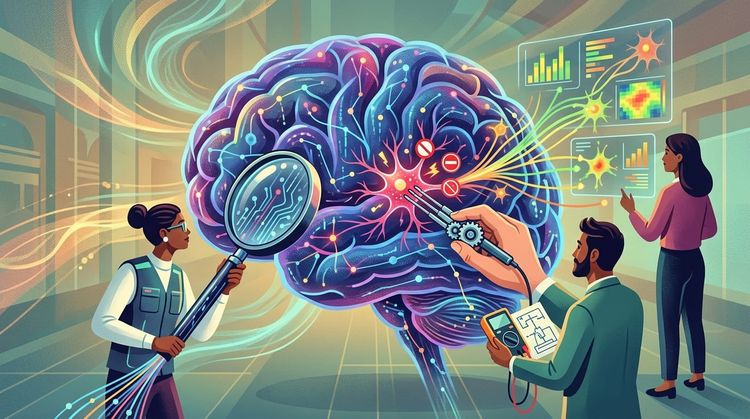
A preprint audit across five LLMs finds refusal lives in a redundant subspace — and trusted rank-stable methods can be the least causally valid.

MedPMC's 11M curated medical image-text pairs trained a CLIP model beating larger datasets by 7.1 points — 95% of its images are actually medical.

LLM hidden states hold richer confidence than models verbalise; a new method extracts it before generation finishes, affecting any AI system needing to know whe

Researchers propose SPELLSMITH, which rewrites MCP server tool descriptions to steer LLM agents away from taint-style vulnerabilities without code changes.

A new arXiv study finds ChatGPT sends users to external sites in just 5.2% of sessions, cutting Google search use 9.4% and reshaping the web's referral economy.

SciReasoner, a multimodal model for structural reasoning across proteins, molecules and crystals, matches frontier LLMs in 98% of expert reviews.

A new arXiv preprint reframes neural network training as optimal control, inserting layers where error is highest — but evidence is limited to scientific datase