

AWS Firecracker, the open-source microVM engine behind AWS Lambda and Fargate, surfaced on GitHub Trending this week with 36,443 stars and 30 added in a single day S¹. The repository was created in October 2017 P³, already runs production workloads inside Amazon [S1, S2], and keeps drawing developer attention to a layer of the stack most users never see.
My read: I've watched plenty of infrastructure projects spike on GitHub and fade. Firecracker is different because it is not a framework competing for mindshare. It is the hidden layer under serverless computing, and its steady traction tells me the demand for cheap, isolated, fast-booting compute is still growing. I don't buy the "fast" claim at face value yet, because the evidence pack contains zero benchmark data to back it up. What I would watch is the next release, due within two to three months [S1, S2], for any changes to the boot path or resource model.
Why an eight-year-old project still trends
Firecracker was developed at Amazon Web Services to speed up services like AWS Lambda and AWS Fargate [S1, S2]. It runs workloads in lightweight virtual machines called microVMs, which combine the security of hardware virtualization with the speed and flexibility of containers [S1, S2]. The core is a virtual machine monitor built on the Linux Kernel Virtual Machine, or KVM, which creates and runs microVMs [S1, S2].
The project is written in Rust [S1, S2] and ships under Apache 2.0 [S1, S2, P3]. It consists of a single process that exposes an API endpoint specified in OpenAPI format [S1, S2]. New versions land every two or three months through the GitHub releases page [S1, S2].
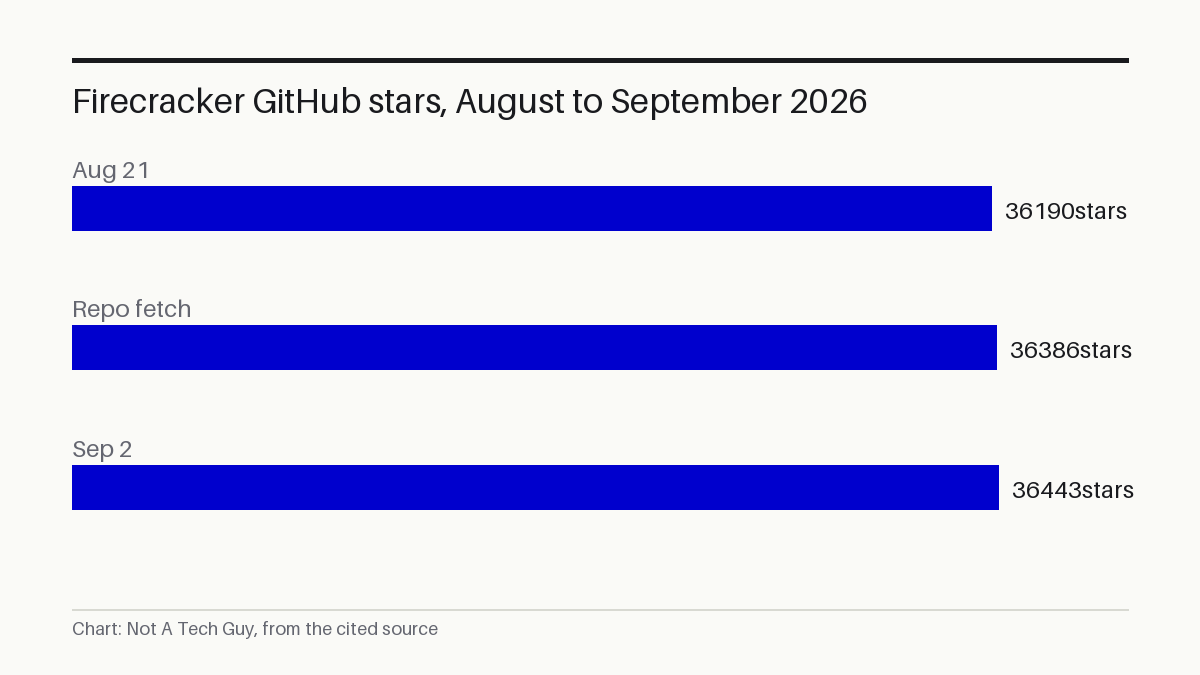
Two GitHub Trending snapshots frame the recent activity. On August 21, the repository sat at 36,190 stars with 25 added that day S². By September 2, it had reached 36,443 with 30 added S¹. A deep research fetch of the repository page confirms 36,386 stars, 2,588 forks, and 107 open issues P³.
What "secure and fast" actually means here
The README describes Firecracker as "secure and fast microVMs for serverless computing" [S1, S2]. The stated mission is to enable secure, multi-tenant, minimal-overhead execution of container and function workloads [S1, S2]. The design runs each workload in its own isolated virtual machine, rather than sharing a kernel across containers on the same host.
That matters for multi-tenant services where customers run code on shared infrastructure. AWS Lambda and Fargate, the two services Firecracker was built to accelerate [S1, S2], depend on this isolation to keep tenant workloads separate.
But the evidence pack contains no benchmark data or specific performance metrics to independently verify the "fast" claim. The project's own documentation notes that overall security depends on a well-configured Linux host operating system [S1, S2]. Firecracker isolates workloads from each other, but it does not secure the host itself.
Firecracker has been integrated into container runtimes including Kata Containers and Flintlock [S1, S2], and is already running production workloads within AWS [S1, S2]. These are self-reported claims from the maintainers, not findings from an independent technical review.
What to do about it
For a team building a platform where multiple customers run code on shared infrastructure, Firecracker offers a model worth understanding. Instead of choosing between containers, which are fast but share a kernel, and full virtual machines, which are isolated but slow to boot, microVMs attempt both.
Consider a small Australian fintech that lets customers upload custom data-processing scripts. Running those scripts in plain containers means all tenants share a single kernel, which raises the stakes if one customer's code is compromised. Running them in full VMs means paying a boot-time and memory penalty that kills the economics. Firecracker through Kata Containers [S1, S2] offers a middle path: each customer gets hardware-level isolation, and the microVM design keeps resource overhead low compared to a traditional virtual machine.
If you want to evaluate this, check the Firecracker GitHub releases page for the latest version, read the OpenAPI spec to understand the management API surface, and audit your Linux host configuration before relying on the isolation model. The security boundary is only as strong as the host it runs on.
What we don't know yet
We have no independent benchmarks confirming Firecracker's speed claims. We don't know what specifically drove the recent uptick in GitHub stars. The project releases every two to three months [S1, S2], so the next version should appear on the GitHub releases page within that window. We'll check whether it brings changes to the microVM boot path or resource isolation model, and whether AWS publishes any performance data alongside it.
If serverless infrastructure is where your compute costs live, subscribe to keep reading as we track the next release.
Sources: S1 — firecracker-microvm/firecracker: Secure and fast microVMs for serverle · S2 — firecracker-microvm/firecracker: Secure and fast microVMs for serverle · P3 — firecracker-microvm/firecracker · P4 — AtharvaDomale/Daily-HuggingFace-AI-Papers · P5 — Announcing the Firecracker Open Source Technology: Secure and Fast mic · P6 — skills/huggingface-paper-publisher/SKILL.md
More from Not A Tech Guy
- Synthetic data privacy is a claim, not a guarantee, researchers warn
- DiaSentinel AI agents screen diabetes risk on-premise
- OpenAI's Astra hits Critical cybersecurity threshold
Generated from an audited evidence pack with primary-source research. Social-media items are discussion signals, not verified facts. Nothing here is financial, legal or medical advice.