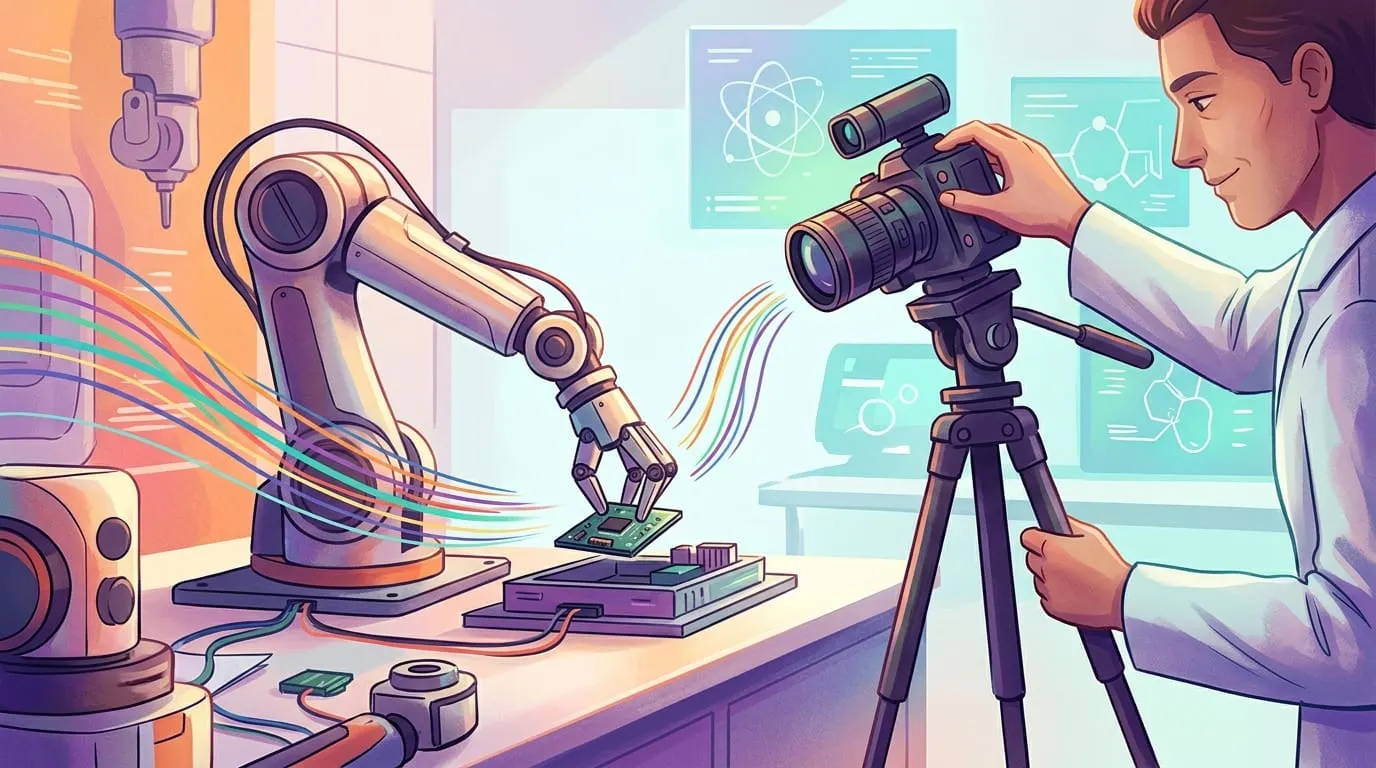
A robot arm that keeps working after you shove its camera sideways, swap it for a cheaper one, or mount it somewhere entirely new — no recalibration, no depth sensor, no second angle. That is the promise of CamVLA, a Vision-Language-Action model posted on arXiv on 7 July by researchers from Nanyang Technological University and Alibaba's DAMO Academy [S1]. The catch: it is a preprint, not peer-reviewed, and every performance claim is self-reported. But if the mechanism holds up, it quietly removes one of the most stubborn friction points in deploying robots outside the lab.
The calibration tax
Today's vision-driven robots are brittle in a specific, frustrating way. Move the camera — bump it, remount it, replace it — and the whole system loses its bearings. Current view-tolerant VLA policies can cope with camera repositioning, but only when you supply them with the camera extrinsics: the exact mathematical relationship between where the camera sits and where the robot's base is [S1]. In practice, that means recalibration every time something shifts. On a factory floor, a knocked camera can mean hours of downtime before the arm trusts its eyes again.
This is not a niche problem. It is the gap between a robot that works in a pristine demo and one that survives a real workspace where things get bumped, reconfigured, and replaced. The broader research community has been circling this challenge — related efforts include AnyCamVLA, which targets zero-shot camera adaptation for viewpoint-robust VLA models [P4], and RoboUniView, which pursues unified view representations for robotics [P5]. CamVLA's contribution is to attack the problem without requiring any camera geometry information at deployment time.
Two predictions, one action
CamVLA's approach is to stop requiring the robot to know where its camera is. Instead, it generates two outputs from a single monocular RGB image and a task instruction [S1].
First, a camera-centric action — where the robot's end-effector should move, expressed in the camera's own local frame of reference. Think of it as the robot describing movements in the language of what it sees, not where it physically stands.
Second, a 6-DoF hand-eye matrix — the six-degree-of-freedom relationship (three for position, three for orientation) between the camera and the robot's base. This is the translation layer the system normally demands you provide manually.
A fixed geometric transformation then combines these two outputs into one robot base-frame action [S1]. No learned fusion network, no probabilistic guesswork — just geometry applied to two neural outputs. The result is a policy that needs no calibration, no depth data, and only one view: one ordinary colour photo plus a text instruction, and the robot works out both what to do and where its camera sits relative to its body [S1].
What it means
The real shift here is conceptual. Most robot vision systems treat camera calibration as a prerequisite — something you solve before the robot can do anything useful. CamVLA treats it as something the model can infer on the fly, from the same image it is already using to decide what action to take.
For a field where deployment cost and complexity often dwarf the price of the robot itself, that matters. Depth sensors add expense. Multi-camera rigs add wiring and failure points. Calibration routines add time and demand expertise. Strip all three away and you lower the barrier to putting a robot in a messy, real-world environment where the camera might not stay perfectly fixed.
The authors report that CamVLA boosts task completion rates across a range of camera angles the model was not trained on, tested in both simulation and on real-world robot data [S1]. But the preprint does not disclose specific success-rate percentages, datasets, or robot platforms — so the magnitude of the improvement remains unclear.
What it means for business
Consider a small warehouse running a single robot arm for pick-and-place. Today, if a forklift clips the overhead camera mount, the options are: recalibrate, which may require a technician and a calibration target, or shut down the line. A system like CamVLA, if it holds up under independent testing, could turn that incident from a half-day outage into a non-event — the arm keeps working from the shifted angle because it infers the new camera position from the image itself.
For integrators and robotics startups, the appeal is simpler deployments: no depth sensor to spec, no multi-camera sync to debug, no calibration step to document in the user manual. A two-person robotics firm could ship a system that works with a single off-the-shelf webcam, mounted wherever is convenient, and the customer can reposition it without calling support.
That is the upside. The caveat — and it is a real one — is that every performance claim here is self-reported in a non-peer-reviewed preprint [S1]. The abstract does not name the specific robot platforms, datasets, or failure modes. A warehouse manager reading this should treat it as a promising direction, not a product they can buy next quarter.
What we don't know yet
Several critical questions remain unanswered:
- How much better? The paper says it improves success rates but does not publish specific percentages or benchmark scores [S1]. Without numbers, it is impossible to compare CamVLA against AnyCamVLA [P4] or other approaches on equal footing.
- What platforms? The abstract mentions both simulation and real-world evaluation but does not specify which robot arms, which tasks, or how many real-world trials were conducted.
- Where does it fail? No failure modes are described. A model that works across unseen viewpoints may still break in edge cases — extreme angles, poor lighting, occlusions — that matter in real deployment.
- Independent validation? No third party has corroborated the real-world experiments. Self-reported benchmarks in AI research have a track record of not surviving independent scrutiny.
The next concrete signal to watch: peer review or conference acceptance, which would subject the claims to independent examination. The project page is live at alibaba-damo-academy.github.io/CamVLA [S1], and the full HTML version of the paper is available on arXiv [P2] — both worth monitoring for updated results or a code release.
If the mechanism holds, CamVLA could be the kind of unglamorous fix that quietly makes robots easier to deploy in the messy real world. Subscribe to follow what happens when independent labs get their hands on it.
Sources: [S1] arXiv preprint, "From Fixed to Free Cameras: Calibration-Free View-Robust Vision-Language-Action Model," 7 July 2026. [P2] Full HTML version, arxiv.org. [P4] AnyCamVLA, arxiv.org. [P5] RoboUniview, github.com.
Sources
- [S1] From Fixed to Free Cameras: Calibration-Free View-Robust Vision-Language-Action Model — arXiv preprint (cs.AI, cs.LG) (attributed)
- [P2] From Fixed to Free Cameras: Calibration-Free View-Robust Vision-Language-Action Model — From Fixed to Free Cameras: Calibration-Free View-Robust Vision-Language-Action Model (attributed)
- [P3] Stability-AI/stable-virtual-camera — Stability-AI/stable-virtual-camera (attributed)
- [P4] AnyCamVLA: Zero-Shot Camera Adaptation for Viewpoint Robust Vision-Language-Action Models — AnyCamVLA: Zero-Shot Camera Adaptation for Viewpoint Robust Vision-Language-Action Models (attributed)
- [P5] liufanfanlff/RoboUniview — liufanfanlff/RoboUniview (attributed)
More from Not A Tech Guy
- Agentic Data Environments: turning data into agent guardrails
- LLM personality traits mapped and controlled in weight space
- Encrypted AI inference: layer-parallel cuts bootstraps 2.65×
Generated from an audited evidence pack with primary-source research. Social-media items are discussion signals, not verified facts. Nothing here is financial, legal or medical advice.