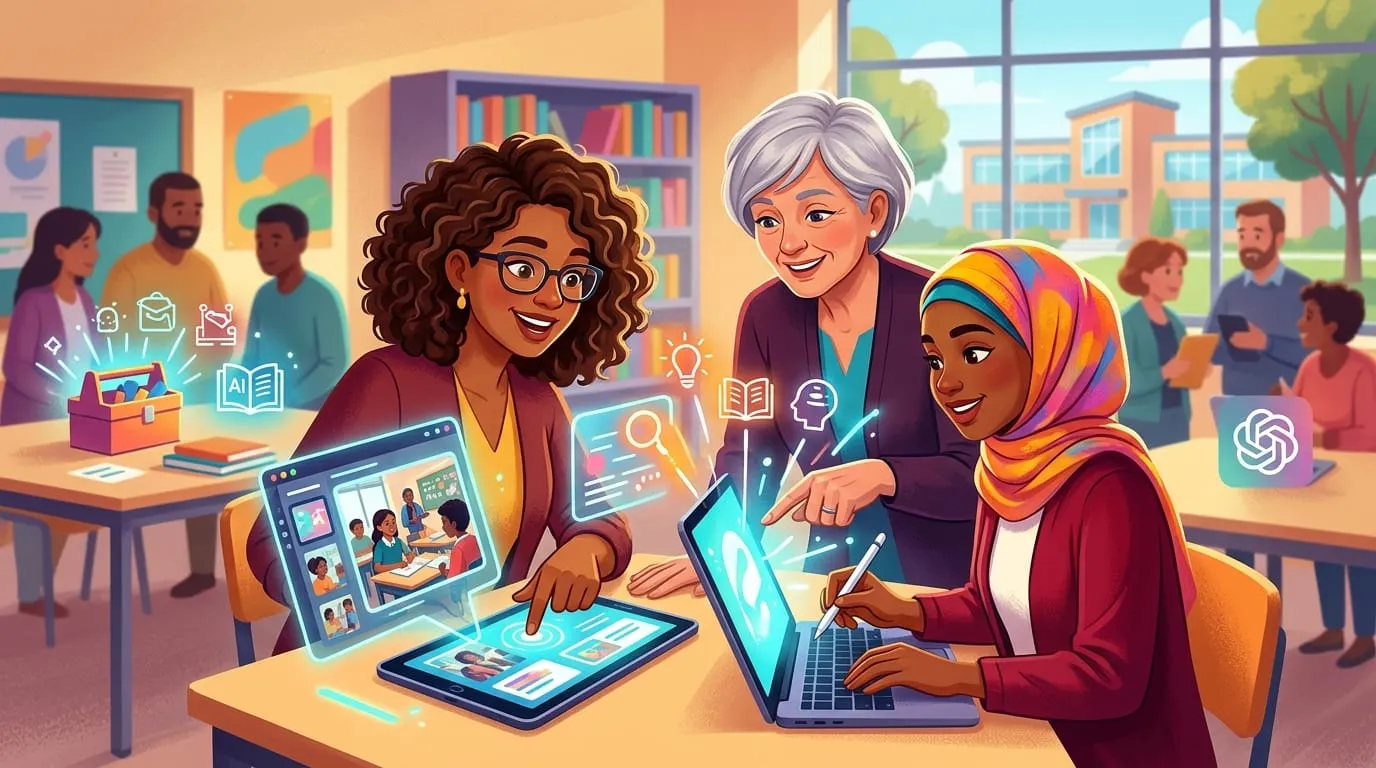
OpenAI Academy and the Walton Family Foundation are launching hands-on "AI Skills Jams" designed to help K–12 educators build practical AI skills for the classroom [S1]. It is a brief announcement — a few lines on OpenAI's news page — but it lands in the middle of a much bigger scramble: two of the largest AI companies in the world are now racing to train the people who train everyone else. The question is whether these programs reach the teacher who needs them most, or just the ones already ahead.
Three moves that only make sense together
Read the announcement alone and it sounds like a one-off workshop. Zoom out and a pattern emerges.
In July 2025, OpenAI joined the American Federation of Teachers to launch the National Academy for AI Instruction, a partnership aimed at working with 400,000 teachers to shape how AI shows up in schools [P4]. That was a top-down, union-scale play — institutional, slow, designed to build consensus across a massive workforce.
Now comes the Skills Jams announcement with the Walton Family Foundation [S1] — a different flavour entirely. The Walton Foundation has a long history of funding K–12 education reform in the United States, which hints at a domestic focus, though the announcement itself does not explicitly confirm geography. The word "jams" suggests something hands-on and practical, not a policy summit: teachers trying tools, building lesson plans, leaving with something they can use on Monday morning.
And then there is Google. Its AI Educator Series, created with ISTE+ASCD, went live with more than 20 sessions and is free to all 6 million K–12 and higher education teachers across the US [P2]. Google's program is already running, already scaled, and already free — which raises the competitive stakes for OpenAI's offering before a single session has been described.
Three separate moves. One unmistakable signal: the biggest AI companies have decided that teachers are the bottleneck.
What it means
The logic is simple. AI tools are landing in classrooms faster than teachers can evaluate them. A teacher who has never used a language model cannot judge whether a student's essay was written by one. A teacher who has never prompted an AI assistant cannot design an assignment that accounts for it. The skills gap is not hypothetical — it is already in the room.
OpenAI's Skills Jams aim to close that gap by giving educators "practical AI skills for the classroom" [S1] — the everyday competence to use these tools, understand their limits, and integrate them without surrendering pedagogy to a chatbot. The earlier AFT partnership frames AI as "a powerful ally, helping free up more time for the truly human work of teaching" [P4], which is the same pitch Google makes: fit the training into a teacher's already-busy schedule [P2].
For a teacher who has watched students paste essay prompts into ChatGPT and hit submit, this matters. The question is whether a hands-on jam — presumably shorter, more tactile, less institutional than the National Academy — can deliver enough depth to actually change practice, or whether it becomes a feel-good introduction that never reaches the hard parts: assessment design, academic integrity, bias in AI-generated content.
What it means for business
The immediate audience is not business — it is schools. But the ripple effects touch operators far beyond the classroom.
Edtech vendors should pay attention. When 400,000 teachers move through an OpenAI-backed training pipeline [P4] and 6 million have access to Google's free series [P2], the default tools teachers learn on become the default tools they recommend, purchase, and build lessons around. A two-person edtech startup building an AI tutoring product now competes not just on features but against the gravitational pull of whichever platform teachers were trained on.
School administrators and procurement teams face a new variable. If teachers arrive at professional development already comfortable with OpenAI's tools — or Google's — purchasing decisions may follow that familiarity rather than an independent evaluation. The training program becomes a customer-acquisition channel, whether or not anyone calls it that.
Tutoring and coaching businesses that serve K–12 should expect pressure. If a teacher can generate a differentiated reading passage in 30 seconds with an AI assistant they learned to use in a Skills Jam, the market for outsourced content creation shrinks. The businesses that survive will be the ones selling judgment, not output — the human review layer that AI cannot provide.
What we don't know yet
The announcement is thin on operational detail, and several critical questions remain unanswered:
- When and where? No dates, timeline, or duration for the Skills Jams are provided [S1].
- How many educators? The target participant count and capacity are not specified.
- What is the curriculum? Specific tools, platforms, or content to be taught are not described.
- Is it free? The announcement does not say whether participation costs anything — Google's competing series is explicitly free [P2], which sets a benchmark.
- Geography? The Walton Family Foundation's US-focused history suggests a domestic program, but the announcement does not confirm this. Do not assume.
- Credentialing? No information on whether teachers receive professional development credit, certification, or any formal credential.
The next concrete signal to watch: whether OpenAI publishes a session schedule, curriculum outline, or registration page — and whether the Walton Family Foundation issues its own announcement with the operational details that OpenAI's page omits. Until then, this is a direction sign, not a map.
If you want to follow where AI meets the classroom next, subscribe — we will be tracking the details as they land.
Sources: [S1] OpenAI news, "Helping K–12 educators build practical AI skills," openai.com. [P2] Google blog, "Google's new AI Educator series available for K-12, higher education," blog.google. [P4] OpenAI, "Working with 400,000 teachers to shape the future of AI in schools," openai.com.
Sources
- [S1] Helping K–12 educators build practical AI skills — OpenAI news (primary)
- [P2] Google’s new AI Educator series available for K-12, higher education — Google’s new AI Educator series available for K-12, higher education (primary)
- [P3] shsjxzh/K-Token-Merging — shsjxzh/K-Token-Merging (attributed)
- [P4] Working with 400,000 teachers to shape the future of AI in schools | OpenAI — Working with 400,000 teachers to shape the future of AI in schools | OpenAI (primary)
- [P5] openai/weak-to-strong — openai/weak-to-strong (attributed)
Related reading
- Cortex framework chains 32 robot skills for long-horizon tasks — our technology desk, 2026-07-07
Generated from an audited evidence pack with primary-source research. Social-media items are discussion signals, not verified facts. Nothing here is financial, legal or medical advice.