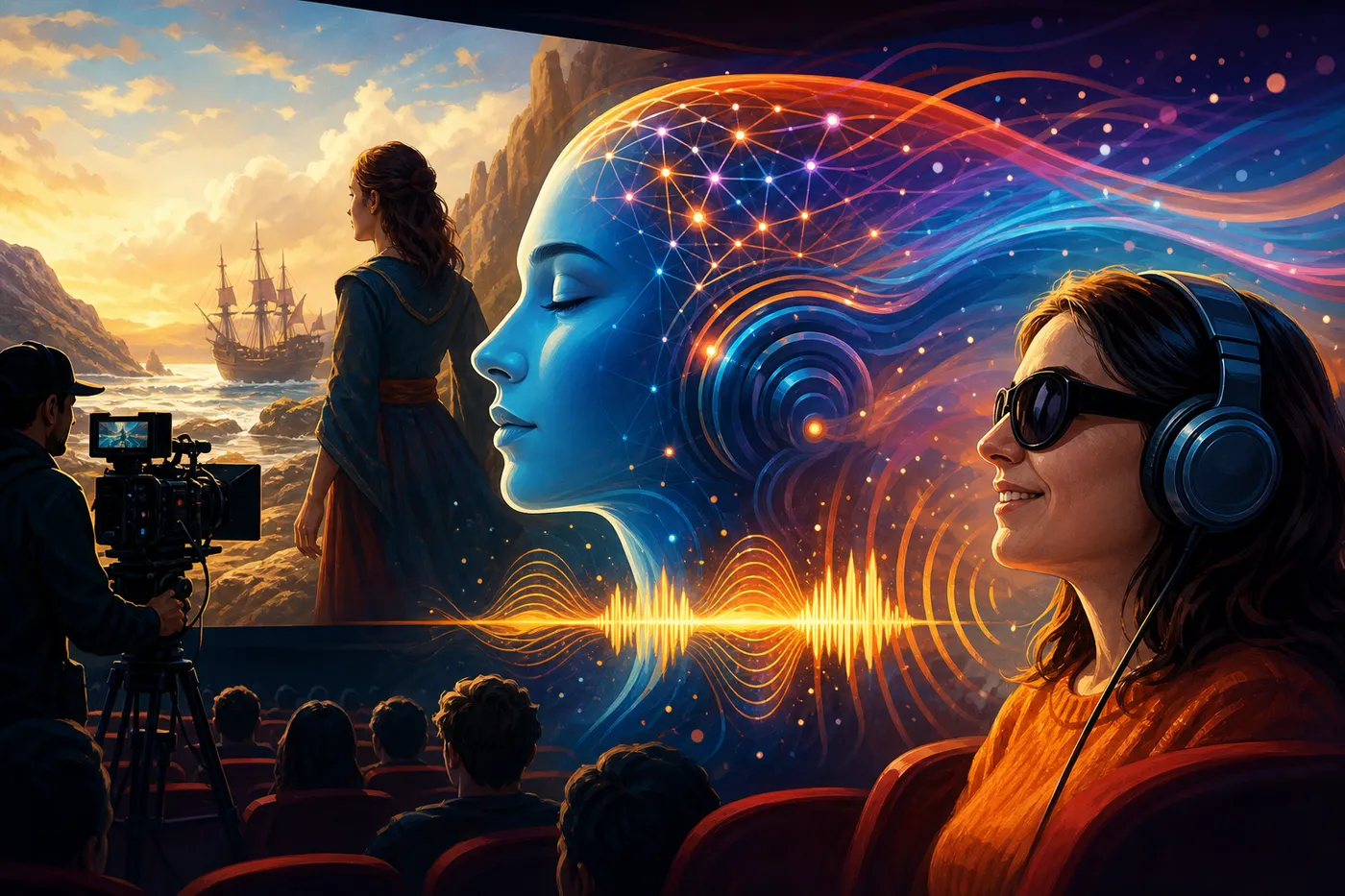
An arXiv preprint posted on 14 July introduces StoryTeller, a new system that creates context-aware audio descriptions for lengthy videos without relying on subtitles, scripts, or model fine-tuning [S1]. The problem it targets has resisted fixing: today's video-language models describe each scene in isolation, losing track of who characters are and why events matter. For blind and low-vision audiences, that means audio descriptions that narrate actions but miss the story. How StoryTeller keeps that story intact across a full film is the part worth reading on for.
Why scene-by-scene AI fails at long-form film
Modern video-language models, the AI systems that watch a video clip and describe what is happening, are good at short clips. Feed them a 10-second segment and they will tell you a person is walking through a door. Feed them a two-hour film and they fall apart. Each scene gets described as if the previous one never happened. The woman who was the protagonist in scene three becomes "a woman" in scene seven. A confrontation that sets up the climax gets described as "two people talking" because the model has no memory of why they are arguing [S1].
This is the core challenge of long-form audio description, the narration track that lets blind and low-vision audiences follow a film. To be effective, audio description must maintain an understanding of characters, events, relationships, and overall story context as a film progresses, instead of just narrating what is visible on screen [S1]. Without that continuity, the description is a list of events with no narrative thread.
How the verified narrative memory works
StoryTeller's central mechanism is what the authors call a "verified narrative memory," a running store of story-relevant facts that carries forward from scene to scene [S1]. The system does not accumulate everything it sees. It accepts only facts that are supported by the video itself, using semantic filtering and a second-pass check by the underlying video-language model to weed out hallucinations [S1].
The input requirements are deliberately minimal. When provided with just unedited video and a film's title, the system can optionally pull public movie metadata to figure out character names and plot details [S1]. The system operates without requiring subtitles, scripts, existing description transcripts, aligned captions, pre-built character databases, precomputed facial recognition data, or any task-specific model training [S1]. That last point matters: the expense of fine-tuning AI models remains a significant concern. StoryTeller sidesteps that cost entirely by relying on pre-trained video-language models and adding its memory and verification layer on top.
The "training-free" label has a specific meaning here. It means no task-specific fine-tuning or labelled datasets. The framework still depends on underlying pre-trained video-language models to do the actual watching and describing [S1].
A new way to test whether descriptions make sense
The researchers also created StoryAD-QA, a new benchmark that evaluates if a language model can correctly answer plot-related questions based solely on the generated audio descriptions [S1]. The idea is clever: if the audio description is good, a separate language model reading only those descriptions should be able to answer questions about plot and character relationships. If the description is just a list of actions, the model will fail.
According to the preprint, StoryTeller outperformed robust baseline models in terms of narrative consistency, factual accuracy, and overall plot understanding when tested through automated methods, question-answering tasks, and human reviews [S1]. The abstract does not include specific numerical metrics, so the size of those improvements remains unclear without reading the full paper.
What it means
For blind and low-vision audiences, the promise is audio description that actually tells a story rather than narrating a sequence of images. The difference is between hearing "a man enters a room and picks up a photograph" and hearing "the son enters his late father's study and picks up the photograph he could not find at the funeral." The second version requires memory and context, along with character identity, exactly what current systems lose.
StoryTeller's approach also matters for the broader field of video AI. The verified narrative memory is a general mechanism for any task that requires maintaining context across a long video, beyond audio description alone. Surveillance analysis and sports commentary face the same scene-by-scene amnesia, as does educational video summarisation. A memory layer that only accepts verified facts is a template that could apply beyond film.
What it means for business
For accessibility services and content platforms, a training-free system that requires only raw video and a title could lower the cost barrier to producing audio description at scale. Today, professional audio description for a single film can cost thousands of dollars and take weeks of human labour. A system that generates a coherent first draft from raw video, even one that still needs human review, changes the economics.
A small accessibility agency could use StoryTeller to produce draft descriptions for clients' video content faster, then refine them. A streaming platform could generate audio description tracks for back-catalogue titles that currently have none. A two-person production company making training videos could add accessible narration without hiring a specialist.
The catch is that this is an unreviewed preprint with no independent replication, no published metrics in the abstract, and no commercial deployment [S1]. Any operator considering it would need to wait for the full paper, check the numbers, and likely wait for an open-source release. The field is already crowded: DANTE-AD, a dual-vision attention network for long-term audio description, was presented at a CVPR workshop in 2025 [P5], and a separate system also called StoryTeller, focused on character identification in long videos, appeared on arXiv in 2024 [P4]. Which approach wins will depend on replicated benchmarks, not preprint claims.
What we don't know yet
The abstract reports no specific numerical results. The full paper may contain benchmark scores, but until they are checked and independently replicated, the magnitude of StoryTeller's improvements over baselines is unknown.
The system has not been peer-reviewed. All experimental findings are provisional [S1].
The evaluations were conducted by the authors themselves. No third party has tested StoryTeller on independent data or compared it against the related systems already in the field [P4, P5].
The next concrete event to watch for is either the release of the full paper with detailed metrics, or an open-source code release that would let other researchers run the system on their own video. Until then, StoryTeller is a promising mechanism in search of proof.
Sources
- [S1] StoryTeller: Training-Free Narrative Grounding for Long-Form Audio Description — arXiv preprint (cs.AI, cs.LG) (attributed)
- [P2] MM-Narrator: Narrating Long-form Videos with Multimodal In-Context Learning — MM-Narrator: Narrating Long-form Videos with Multimodal In-Context Learning (attributed)
- [P3] minghangz/TFVTG — minghangz/TFVTG (attributed)
- [P4] StoryTeller: Improving Long Video Description through Global Audio-Visual Character Identification — StoryTeller: Improving Long Video Description through Global Audio-Visual Character Identification (attributed)
- [P5] AdrienneDeganutti/DANTE-AD — AdrienneDeganutti/DANTE-AD (attributed)
More from Not A Tech Guy
- Transformer learning dynamics reduced to few coordinates
- LLM temperature setting steers ideological bias in RAG answers
- GPT-5.5 scores 66 on doctoral math proof benchmark
Generated from an audited evidence pack with primary-source research. Social-media items are discussion signals, not verified facts. Nothing here is financial, legal or medical advice.