

On October 7, 2026, arXiv's cs.AI feed listed a new submission from authors who claim a content-extraction system scoring 97.4 out of 100 on a 180-document enterprise corpus S¹. The authors argue that extraction is not a preprocessing step but a lifecycle stage in its own right, because language models cannot reason over text mangled at the boundary between heterogeneous document formats and the model S¹. Nobody outside the authors' lab has checked those numbers: the paper is not peer-reviewed, the test corpus is author-assembled, and no code or dataset has been released.
My read: This is the first paper I've seen that frames document extraction not as plumbing but as the 'perception layer' of enterprise agents, the way vision is the perception layer for robots. I don't buy the 'production-ready' label yet, because the authors provide no operational evidence of deployment, and their retrieval metrics come from machine-generated questions on an author-assembled corpus, not real user queries. What I find genuinely interesting is the design principle 'never mutate what you measure.' That is a disciplined stance most extraction pipelines violate silently. I would watch for whether the authors release the corpus and scorer; without those, the 97.4 is a self-graded exam.
The problem at the format boundary
Enterprise documents arrive as PDFs, scans, spreadsheets, and HTML, often mixed in the same workflow. When a retrieval system or language model receives text that was extracted poorly, a table flattened into a single line or a column shifted by one cell, the model does not know the text is wrong. It reasons over the garbage as if it were clean and produces answers that look confident and are completely off S¹. The authors call this the interface between heterogeneous enterprise document formats and the model, and they argue it is where most enterprise AI pipelines silently fail S¹.
The stakes rise as agents take on multi-step tasks. Yichao Yuan, Ankita Nayak, Souvik Kundu and Nishil Talati examine agentic AI workload characteristics in a separate arXiv paper P³, one of several recent studies on how agents compound errors across steps. If the input to step one is garbled, every downstream step inherits the damage.
What the system actually does
The paper describes four components working together S¹.
Selective OCR routing sends only pages that need optical character recognition to the OCR engine, rather than running every page through it. This is a cost decision: OCR is expensive, and most enterprise pages are digital-native text. The approach echoes a broader industry push. Tencent's HunyuanOCR project, which describes itself as making lightweight OCR models faster and better, has 2,030 stars on GitHub P⁴. Routing only when needed is the complementary move: do not call the expensive model unless you have to.
The scarcity-first curation engine pairs with a reference-based extraction scorer that measures character accuracy, word accuracy, and table-structure accuracy S¹. The scorer gives a number to what most pipelines leave to eyeballing.
A deterministic structure-aware parent-child chunker splits documents into chunks that respect the document's structure S¹. It preserves headers, sections, and tables rather than cutting at arbitrary character counts. Most retrieval systems chunk by fixed token limits, which can sever a table from its caption or split a paragraph mid-sentence.
The read-only retrieval evaluator generates grounded questions from every page and reports Hit@k, mean reciprocal rank, and latency S¹. Mean reciprocal rank, or MRR, measures how high the correct answer appears in the ranked list of results, on a scale from 0 to 1.
The numbers, and what would have to hold
On a 180-document corpus, the authors' best extractor scored 97.4 on their 100-point scale S¹. Table structure similarity reached 0.995, so tables come through almost intact S¹.
Those are strong figures, but they carry caveats the paper does not resolve. The corpus is author-assembled, not an industry standard. The questions used to test retrieval are machine-generated from the documents, not real user queries. A system that scores well on questions derived from its own documents may perform differently when users ask things the documents were never designed to answer. The authors report no error bars or confidence intervals S¹. Nobody outside the lab has replicated the results, and no code or dataset has been released.
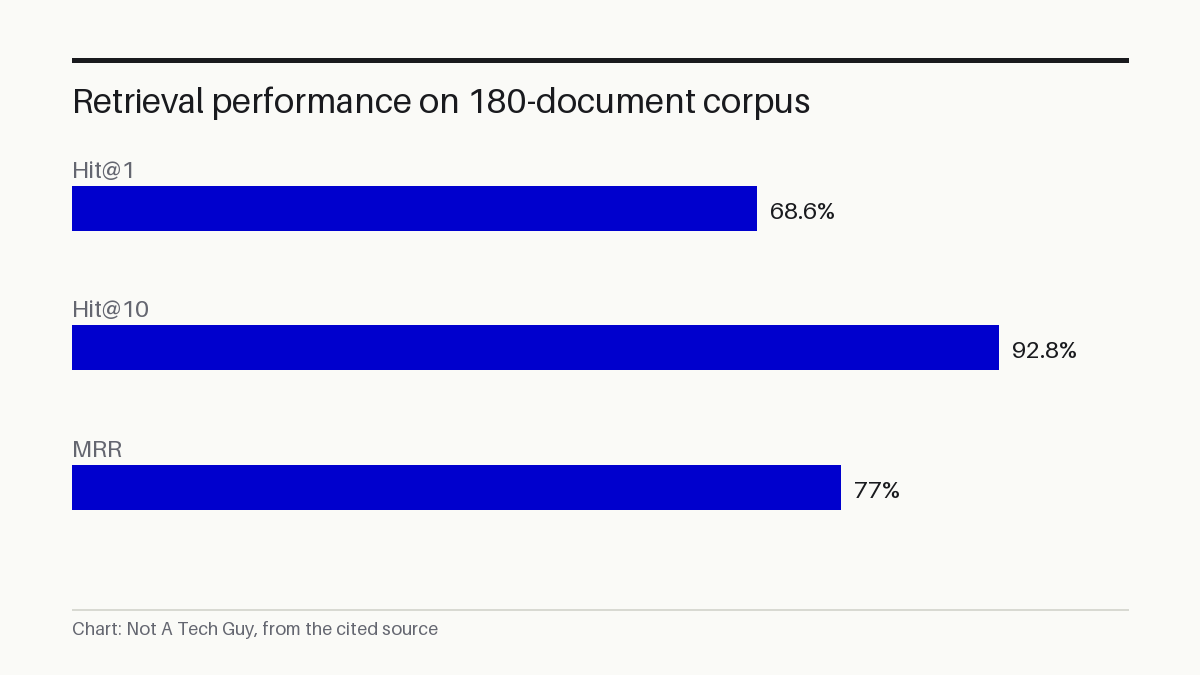
The retrieval results tell a separate story. Across 25,050 machine-generated questions on the same corpus, the chunker reached hit@1 of 68.6% S¹. That means the correct passage appeared first about two times in three. Hit@10 reached 92.8%, and mean reciprocal rank came in at 0.77 S¹.
For these results to matter beyond the paper, three things need to happen. The code and evaluation corpus need to be released so others can replicate the score. The 'production-ready' claim, which the authors make in the abstract S¹, needs operational evidence: deployment logs, throughput numbers, error rates in live use. And the retrieval metrics need testing against real user query distributions, not machine-generated questions.
None of these has happened yet. The authors distil three design principles: structure before semantics, never mutate what you measure, and budget your labels S¹. These are process commitments, not proof of deployment.
A team building a retrieval-augmented generation system for legal contracts or financial filings would feel this pain first. In a legal workflow, a table of clause references flattened into prose means the agent returns the wrong clause number. In a financial workflow, a balance sheet where columns shift means the model reads liabilities as assets. The structure-aware chunker and table-structure scorer address exactly these failure modes.
The next checkpoint is whether the authors release the corpus and code. Without that, the 97.4 stays a claim on a self-graded exam, and the 'perception layer' framing stays an argument, not a verified result.
Sources: S1 — Smart Content Ingestion for Generative AI Workloads · P2 — stevemurr/windex · P3 — [2605.26297] Agentic AI Workload Characteristics · P4 — Tencent-Hunyuan/HunyuanOCR
Written from 4 sourced items, 3 of them primary.