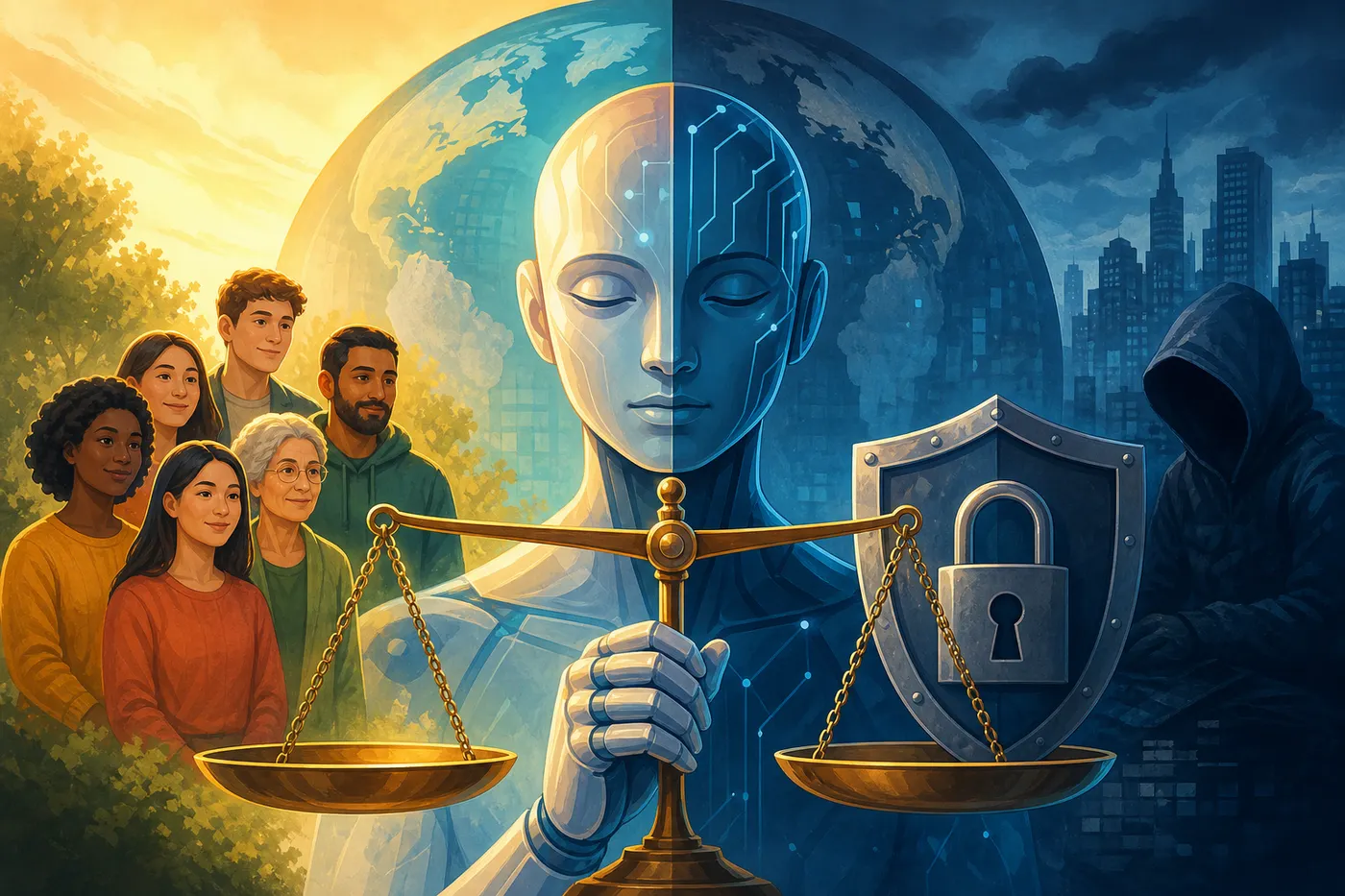
A July 20 arXiv paper [S1] analysed the full catalogue of AI trust tools tracked by the OECD and found a field fixed on fairness and transparency while barely touching digital security or environmental sustainability. The asymmetries run deeper than missing topics. They map to the exact stages where AI systems fail real people, and they help explain why a decade of ethics principles has produced so little practical protection. What the researchers found in the data, and what it would take to fix it, changes how any operator should read the next "trustworthy AI" badge.
The gaps the trust frameworks leave open
The paper, posted to arXiv as 2607.15480v1 on July 20 [S1], draws on what the authors describe as a comprehensive dataset from the OECD to map the range of tools and trust mark frameworks, the certification-style badges meant to signal that an AI system is trustworthy. Their method is empirical mapping and descriptive comparative analysis [S1]. The findings are provisional: the paper is an arXiv preprint that has not been peer-reviewed, and only the abstract was available for review.
What the abstract shows is a field with lopsided priorities. Fairness, transparency, and robustness dominate the trust tool ecosystem. Explainability, digital security, and environmental sustainability receive comparatively little attention [S1]. The distinction matters. Fairness tools check whether a model discriminates. Transparency tools reveal how decisions are made. Robustness tools test whether a model holds up under stress. Explainability, the harder cousin of transparency, requires making a model's reasoning intelligible to humans, a step beyond auditability. Digital security covers adversarial attacks and model theft. Environmental sustainability tracks the energy and water cost of training and running models. All three are thin.
The gaps extend across the AI lifecycle. Most tools and certifications concentrate on post-development stages, the testing and auditing that happens after a model is built. Early design and data collection, the phases where many harms are baked in, get limited guidance [S1]. Educational initiatives and policy engagement are notably underdeveloped [S1]. The entire effort is dominated by technical and procedural measures within industry contexts [S1], which means the people most affected by AI systems have the least voice in how trust is defined.
What it means
For a reader with no background in AI governance, the paper's findings translate to a simple problem. The industry has spent years building tools to check AI systems for bias and to document how they work. It has built almost nothing to check whether those systems can be hacked, whether their reasoning can be explained to the people they affect, or what they cost the planet to run. And it has built those tools mostly for the end of the development pipeline, not the beginning.
The OECD dataset the researchers used is not a small sample. The OECD has been cataloguing AI policy and trust initiatives from governments and industry worldwide, and the paper's claim to draw on a comprehensive dataset from that catalogue suggests the asymmetries are systemic, not anecdotal [S1]. The researchers do not argue that fairness and transparency are over-served. They argue that the narrow focus leaves other dimensions under-protected, and that the gap between published AI principles and actual practice persists because the tools to bridge it are incomplete [S1].
The broader ecosystem of trust-related tools illustrates the pattern. MarkLLM, a watermarking toolkit from Tsinghua University presented at EMNLP 2024 with over 1,000 GitHub stars [P5], addresses provenance and transparency. The declare-lab/trust-align project, created in September 2024, measures trustworthiness in retrieval-augmented generation through grounded attributions [P3]. CriticEval, a NeurIPS 2024 benchmark, evaluates the critique ability of large language models [P2]. These are serious, useful tools. But they cluster around the same dimensions the paper flags as over-served: transparency, evaluation, procedural checks. The agentic-trust-framework, a Zero Trust governance specification for autonomous AI agents released as a v0.9.0 public review draft in April 2026 [P4], is rarer. It addresses governance of agent behaviour rather than model properties. It is the kind of tool the paper's authors might point to as an exception that proves the rule.
What it means for business
A two-person AI consultancy building tools for clients faces a practical consequence. The trust certifications and frameworks available to them, the badges they might put on a proposal or a product page, are weighted toward fairness audits and transparency documentation. If a client asks for evidence that their AI system is secure against adversarial attacks, or that its energy use is measured and disclosed, the consultancy will find far fewer off-the-shelf tools to point to.
For a suburban agency deploying AI for customer service or hiring screening, the lifecycle gap matters concretely. The tools available to audit a deployed model for bias are relatively mature. The tools to guide decisions about what data to collect in the first place, or whether to build the system at all, are scarce. A cafe using an AI-powered inventory or scheduling tool has almost no way to assess its environmental footprint, because the frameworks that would measure that barely exist in the current ecosystem.
The paper's recommendation, that bridging the gap requires expanding ethical objectives, embedding ethics across the AI lifecycle, and broader multi-stakeholder participation [S1], is prescriptive rather than empirically tested. For operators, it points to a near-term reality: the trust infrastructure they can buy or adopt today is incomplete, and the gaps are in the places where failures are most expensive.
What we don't know yet
The paper is an arXiv preprint. It has not been peer-reviewed, and only the abstract was available at the time of writing [S1]. The full methodology, the exact scope of the OECD dataset, and the specific tools analysed are not visible. The recommendations the authors make are arguments, not findings validated by experiment.
Several questions remain open. How many tools are in the OECD dataset, and what proportion address the under-served dimensions? Are the asymmetries the result of deliberate prioritisation, or simply the path of least resistance, where fairness and transparency tools are easier to build than explainability or security tools? Does the OECD itself view these gaps the same way? The researchers drew on OECD data, but the OECD did not produce or endorse the study's conclusions.
The next concrete event to watch is whether the paper passes peer review and what the full methodology reveals about the dataset's scope. Until then, the findings are a signal worth taking seriously, drawn from the most comprehensive catalogue of AI trust tools available, but provisional.
If this kind of analysis helps you see past the hype, subscribe to keep reading.
Sources
- [S1] A Critical Analysis of Trustworthy AI Tools, Mark Frameworks, and the Implementation Chasms — arXiv cs.AI new (official RSS) (attributed)
- [P2] open-compass/CriticEval — open-compass/CriticEval (attributed)
- [P3] declare-lab/trust-align — declare-lab/trust-align (attributed)
- [P4] v0.9.0: Public Review Draft — v0.9.0: Public Review Draft (attributed)
- [P5] THU-BPM/MarkLLM — THU-BPM/MarkLLM (attributed)
Related reading
- NVIDIA connects AI agents to creative tools via MCP at SIGGRAPH — our technology desk, 2026-07-20
- Malaika AI framework uses tri-grounded reasoning for malware analysis — our technology desk, 2026-07-13
- AutoSynthesis automates meta-analysis end-to-end with AI agents — our technology desk, 2026-07-17
Generated from an audited evidence pack with primary-source research. Social-media items are discussion signals, not verified facts. Nothing here is financial, legal or medical advice.