

Ansible, the open-source IT automation platform, landed on GitHub's daily trending list on October 30, picking up 22 new stars to reach 71,157 total S¹. That a Python project older than most of today's cloud-native stack is still drawing daily attention says something about what survives when the hype moves on.
My read: This is the kind of trend that looks unremarkable until you sit with it. Ansible has been around long enough that "radically simple" is the maintainers' own pitch, not a reviewer's verdict S¹ — a vendor characterization that has not been independently tested here, and 22 stars in a day is modest by GitHub's standards. But the deep-research snapshots show steady growth from 69,027 to 71,088 stars across recent fetches P²P⁵ (no error bars or collection methodology disclosed for these snapshots), before the trending list recorded 71,157 S¹. That means people are still adopting it for real use, not bookmarking and moving on. I would watch whether the trend correlates with a specific release or feature drop, because the evidence pack does not name one.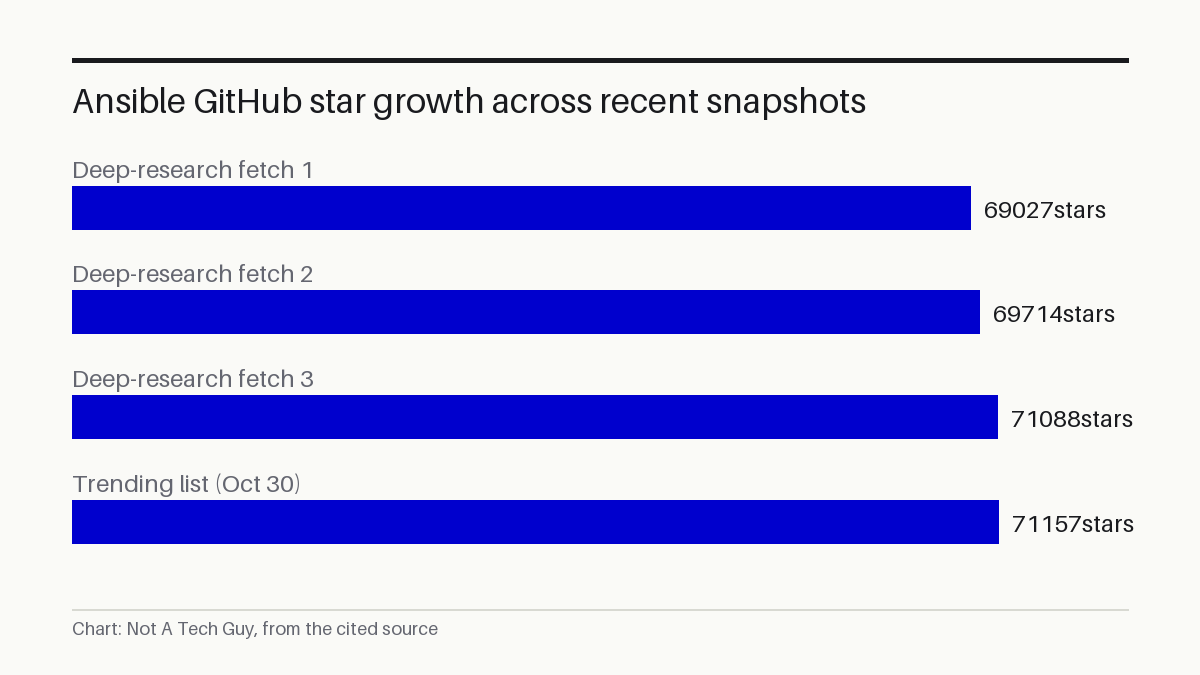
According to its maintainers, Ansible covers configuration management, application deployment, cloud provisioning, ad-hoc task execution, network automation, and multi-node orchestration S¹. That list covers most of what an infrastructure team does on a given Tuesday. The design choice that sets it apart is agentless operation: Ansible talks to remote machines through their existing SSH daemon, so there is no custom software to install on the target and no extra port to open S¹. For a network engineer managing 400 switches that already speak SSH, that is the difference between a tool that deploys in an afternoon and one that takes a quarter. A site reliability engineer who already reaches production boxes over SSH can run a first playbook from their laptop without provisioning a single agent endpoint or opening an additional firewall port S¹.
Agentless operation removes a whole class of maintenance work
The agentless model trades a centralised control plane for a simpler trust boundary. You do not maintain a fleet of background processes on every server. You do not patch those agents when they have vulnerabilities. You do not debug why an agent stopped reporting. The cost is that SSH connections are slower for large-scale concurrent execution than a persistent agent with a gRPC channel, which is why tools like Salt and Chef took the agent route. Ansible's answer is that for most teams, the operational overhead of managing agents outweighs the performance penalty of SSH.
A released version installs through pip or a system package manager S¹. The devel branch carries the latest features and fixes but, as the maintainers warn, carries a higher chance of breaking changes S¹. That is standard open-source hygiene: stable for production, devel for contributors and power users.
YAML playbooks align with how AI agents now consume infrastructure code
Ansible's continued relevance comes at a moment when AI coding agents are reaching into infrastructure code. The appeal of Ansible's YAML-based playbooks, which the maintainers say approach everyday language P² — the maintainers' own assessment, not independently measured, is that they are easy for a language model to read and generate. A playbook is a list of tasks in a declarative format. That is precisely the kind of structured text an AI agent can produce, verify, and execute without understanding a complex runtime.
For a platform team evaluating automation tooling, the practical check is simple: count the machines you manage that already have SSH access enabled. If the answer is "most of them," Ansible's setup cost approaches zero. If you are running containerised workloads at scale where SSH is not the primary access method, the calculus shifts.
The GitHub trending snapshot is a single day's data recorded October 30 S¹. The checkpoint is whether Ansible's star count holds above 71,157 through the November release cycle.
Sources: S1 — ansible/ansible: Ansible is a radically simple IT automation platform · P2 — ansible/ansible · P3 — ansible/ansible · P4 — labrat-0/ai-ml-scraper · P5 — ansible/ansible
Written from 5 sourced items, 4 of them primary.