Anthropic's open Agent Skills specification crossed 26,583 GitHub stars today, landing on GitHub's daily trending list with 53 new stars S¹. The format tries to solve a problem every agent builder hits: models are smart but lack the procedural knowledge and organizational context to do real work P².
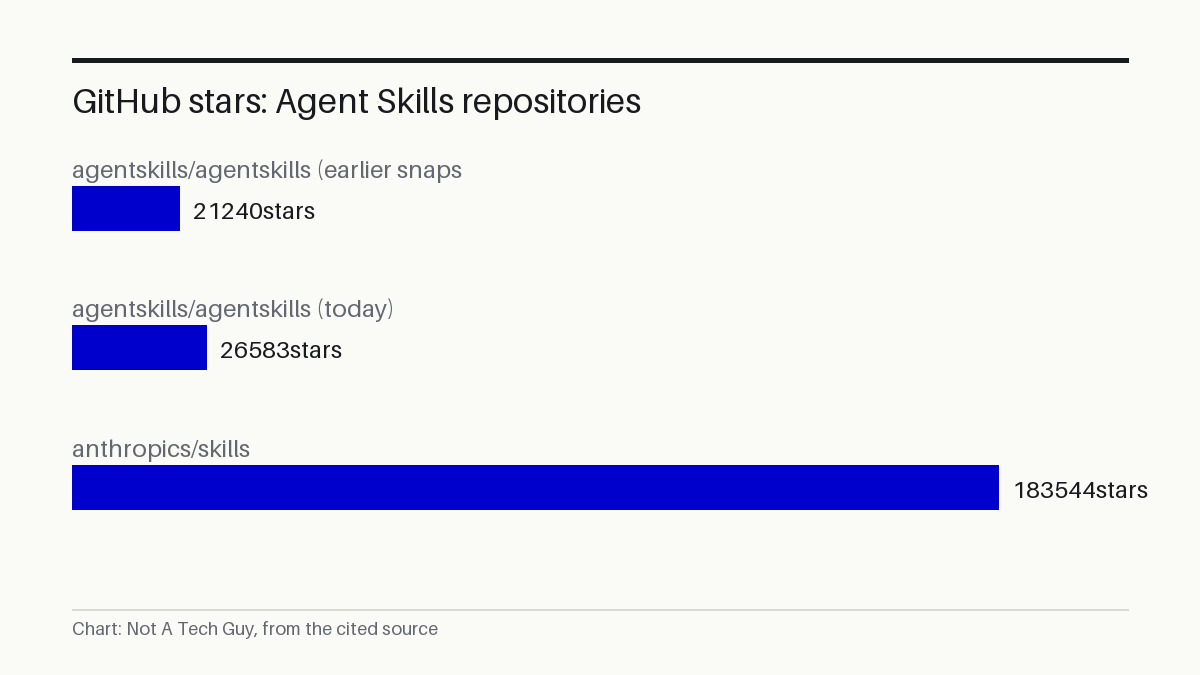
My read: This is the first open standard I've seen that treats agent capabilities as plain files and folders rather than API plugins or model fine-tuning. The simplicity is the bet. I'm skeptical of the "growing number of agent products" adoption claim because the repository names no specific third-party adopters, and the "open standard" label is self-asserted with no standards body behind it — GitHub star counts are platform-reported figures with no independent audit, and neither adoption claim has been verified outside the maintainers' own repository. What I'd watch is whether the spec repo, which has grown from roughly 21,240 stars in an earlier snapshot to 26,583 today P⁴S¹, keeps pulling developers toward the original anthropics/skills repo, which already sits at 183,544 stars P³.
A folder, a markdown file, and three steps
Under the spec, a skill lives in a directory that holds a SKILL.md file — carrying at minimum a name, a description, and the steps the agent should take, alongside any scripts, templates, or reference files the task requires S¹. There is no API integration and no model retraining; the agent simply reads the directory, grasps what the skill does, and acts on it.
Skills load through three stages the spec calls progressive disclosure: Discovery, where the agent sees what skills exist; Activation, where it loads the relevant skill's details; and Execution, where it follows the instructions S¹. This staged approach means an agent does not need every skill's full content in its context window up front, only what it needs when it needs it.
Anthropic originally developed the format and released it as an open standard for cross-platform use S¹P². The original anthropics/skills repository, created on September 22, 2025, has grown to 183,544 stars and 21,728 forks P³. The separate agentskills/agentskills specification repository, created on December 16, 2025, houses the standard itself P⁴. Its top contributor is Jonathan Hefner with 74 contributions, followed by Eric Harmeling with 10 P⁴. Code is Apache 2.0 licensed. Documentation is CC-BY-4.0 S¹.
The repository claims Agent Skills are supported by a large number of AI tools and agentic clients S¹, though it names no specific third-party products — this adoption claim has not been independently verified. The "open standard" designation is the maintainers' own description, not ratified by any independent standards body.
A common denominator for fragmented plugin formats
The timing lines up with a surge in open-source agent tooling. Developer interest in agent infrastructure is climbing fast — Cline's open-source coding agent hit 70,000 GitHub stars recently. But giving agents capabilities has been ad hoc. Each platform invents its own plugin format. Agent Skills proposes a common denominator: a markdown file in a folder, portable across any client that implements the spec.
The security surface is real. Loading external instructions into an agent creates an attack vector — Huawei researchers evaded AI agent skill scanners 97% of the time, and a malicious SKILL.md could steer an agent toward unintended actions. The spec's progressive disclosure helps with context management but does not address prompt injection through skill content.
A developer building an internal support agent could package a company's refund policy and ticket templates as a single skill folder. The agent discovers the skill when a customer asks about returns, loads the refund instructions, and follows them. No code changes to the agent, just a new folder in the skills directory. A similar pattern, packaging domain logic as a standalone module, helped a solo developer's AI trading agent reach GitHub trending in September.
For a platform engineer running a fleet of customer-support agents, the change is concrete: instead of writing and maintaining a custom API plugin for each new policy or workflow, they drop a markdown file into a skills directory and the agent picks it up at runtime S¹.
The specification repository at agentskills.io P⁴ currently lists 58 open issues P⁴, compared with 1,437 in the original anthropics/skills repo P³.
Sources: S1 — agentskills/agentskills: Specification and documentation for Agent Ski · P2 — Equipping agents for the real world with Agent Skills \ Anthropic · P3 — anthropics/skills · P4 — agentskills/agentskills · P5 — huggingface/transformers
Written from 5 sourced items, 4 of them primary.