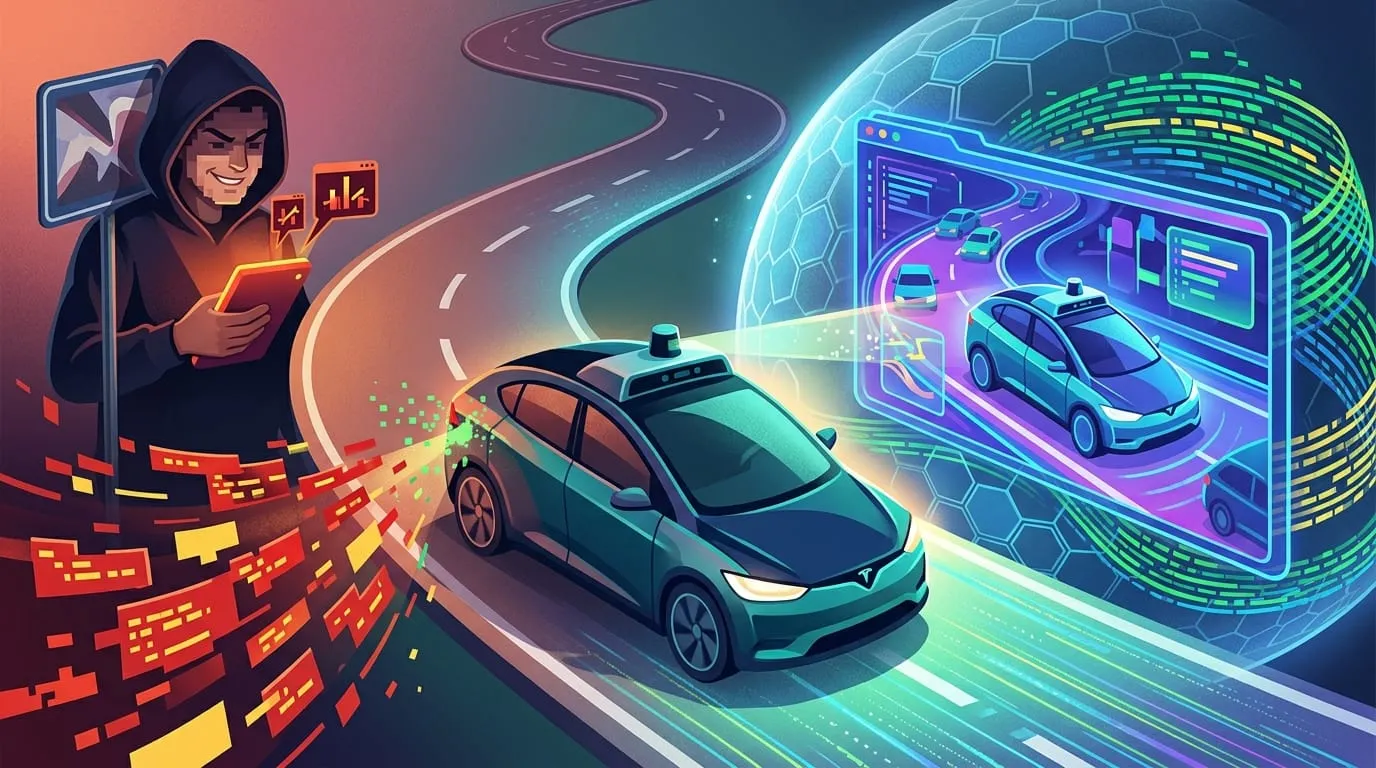
A 10 July 2026 arXiv preprint identifies a largely unexplored vulnerability in how autonomous vehicle fleets learn collaboratively — and proposes a defence built on digital twins, the virtual replicas of physical environments that let cars rehearse before they act [S1]. The vulnerability matters because the learning method at stake, federated reinforcement learning, is the same architecture that lets a fleet of self-driving cars share driving insights without ever transmitting raw sensor data. Poison one car's updates, and the whole fleet can inherit corrupted behaviour. The paper offers a fix — but the fix has only been tested in simulation, and the gap between a digital highway and a real one is where the story gets uncomfortable.
The attack hiding in the aggregation
Federated reinforcement learning, or FRL, works like a study group where nobody shares their notes — only their conclusions. Each vehicle trains locally on its own driving data, then sends model parameters (the learned weights that shape its decisions) to a central aggregator, which combines them into an improved global model beamed back to every car [S1]. The appeal is obvious: privacy stays intact, and the fleet learns faster than any single vehicle could alone.
The problem is that this design trusts every participant. A poisoning attack — where a compromised or malicious agent injects corrupted parameters into the aggregation — can subtly compromise the global control model that governs braking, steering, and lane-keeping [S1]. The paper's authors note that this vulnerability in safety-critical autonomous driving has remained largely unexplored, despite poisoning attacks being a recognised threat to FRL systems generally [S1].
The mechanism is quiet, not dramatic. No flashing warning. A malicious agent doesn't crash the system; it nudges the model's parameters slightly off course, degrading control quality in ways that might only surface in edge cases — exactly the scenarios where autonomous vehicles need to be most reliable.
Virtual rehearsal as a filter
The authors' proposed defence — which they describe as Secure Aggregation with poisoning-prevention and historical reinforcement — works in two layers [S1].
First, it uses digital twins: high-fidelity virtual replicas of realistic highway environments where incoming model updates can be rehearsed before they're trusted [S1]. Think of it as a flight simulator for driving policies — you fly the new parameters through a synthetic highway and watch whether they produce safe behaviour or something erratic.
Second, the framework leverages historical aggregated model parameters and a selected central gradient to ensure that only benign data makes it into the global model, effectively mitigating the influence of malicious agents [S1]. The system doesn't just check whether an update looks reasonable in isolation; it checks whether it's consistent with the fleet's accumulated learning history. An update that diverges sharply from the established trajectory gets filtered out.
The authors provide theoretical convergence guarantees — mathematical proof that the framework's learning process remains stable even when poisoning attacks are active [S1]. They validated the approach using digital twins that model realistic highway environments, evaluating autonomous vehicle control under adversarial conditions [S1].
What it means
The core insight is that the autonomous vehicle industry's enthusiasm for federated learning — training across fleets without centralising data — has outpaced its attention to the security of that training pipeline. If a single compromised vehicle can poison the global model, then the privacy advantage of federated learning becomes a liability: you can't inspect the raw data to check for tampering because, by design, you never see it.
The digital-twin defence is elegant because it turns the simulation environment — something autonomous vehicle developers already build for testing — into a security checkpoint. The same virtual highway that trains a car to handle merge lanes can also screen that car's updates for sabotage. For a smart reader with no background in the field, the takeaway is simple: the cars learn from each other, and now there's a proposal to make them rehearse what they've learned before sharing it.
What it means for business
For autonomous vehicle developers and fleet operators, this research flags a concrete gap in the federated learning stack. A mid-size AV company running federated training across a few hundred test vehicles may need to audit its aggregation pipeline for poisoning resistance — not just data privacy compliance.
For the broader ecosystem of companies building digital twins — from logistics firms simulating warehouse robotics to suburban agencies modelling traffic flow — the paper suggests a second use case for their existing simulation infrastructure: security screening, not just training. The open-source landscape is already moving in this direction; a GitHub project called fed-twin offers a federated learning framework for distributed digital twins on Kubernetes, combining PyTorch and Flower for exactly this kind of collaborative policy training [P4]. Meanwhile, SafeAuto, an ICML 2025 project on knowledge-enhanced safe autonomous driving with multimodal foundation models, signals growing academic interest in safety-layered AV systems [P3].
A two-person robotics firm experimenting with federated learning for warehouse vehicles should note: the cost of adding poisoning-prevention isn't just a security line item — it's an extension of the simulation budget you're already paying for. The framework's reliance on historical parameters also means you need to retain and version your aggregated models, which has storage and compute implications.
What we don't know yet
The framework has been validated only in digital-twin simulation, not on physical vehicles or live traffic [S1]. Theoretical convergence guarantees — mathematical proof that learning stabilises under attack — do not equate to proven real-world safety or hazard prevention [S1]. The paper is an unpeer-reviewed arXiv preprint; all technical and performance claims are author-attributed without independent verification [S1].
Several questions remain open:
- How does the defence perform against adaptive attackers who know the filtering mechanism and craft poisoning updates subtle enough to pass the historical-consistency check?
- What is the computational overhead of running every incoming update through a digital-twin rehearsal, and does it scale to fleets of thousands of vehicles updating in near real-time?
- Does the framework generalise beyond highway environments to urban driving, intersections, and pedestrian-heavy scenarios where the parameter space is far more complex?
- The paper appears under both cs.CR (cryptography and security) and q-fin.GN (general finance) — an unusual categorisation that may reflect an interdisciplinary framing worth clarifying [S1].
The next concrete signal to watch: whether this work surfaces at a peer-reviewed venue with independent replication, or whether a major AV developer adopts digital-twin-based poisoning screening in a production training pipeline. Until then, it's a promising idea rehearsed in a virtual world — waiting for a real road.
Subscribe to keep reading stories that decode what actually changed, why it matters, and what we don't know yet.
Sources: [S1] arXiv preprint, "Securing Autonomous Vehicle Systems via Twin-Aware Federated Reinforcement Learning," 10 July 2026. [P3] AI-secure/SafeAuto, GitHub, ICML 2025. [P4] supat-roong/fed-twin, GitHub, 2026.
Sources
- [S1] Securing Autonomous Vehicle Systems via Twin-Aware Federated Reinforcement Learning — arXiv preprint (cs.CR, q-fin.GN) (attributed)
- [P2] Integration of Digital Twin and Federated Learning for Securing Vehicular Internet of Things — Integration of Digital Twin and Federated Learning for Securing Vehicular Internet of Things (attributed)
- [P3] AI-secure/SafeAuto — AI-secure/SafeAuto (attributed)
- [P4] supat-roong/fed-twin — supat-roong/fed-twin (attributed)
- [P5] [2204.11010] GFCL: A GRU-based Federated Continual Learning Framework against Data Poisoning Attacks in IoV — [2204.11010] GFCL: A GRU-based Federated Continual Learning Framework against Data Poisoning Attacks in IoV (attributed)
More from Not A Tech Guy
- TokenWall cuts AI agent attack rate to 12.5%
- ProjAgent hits 41% on REPOCOD with procedural code retrieval
- Quantized LLMs behave differently despite matching accuracy
Generated from an audited evidence pack with primary-source research. Social-media items are discussion signals, not verified facts. Nothing here is financial, legal or medical advice.