

Circles, a telecom operator, says it lifted average revenue per user by 22% and cut churn by 9% after building personalised customer experiences on OpenAI's API and Codex coding agent S¹. For an industry where single-digit ARPU growth is the norm, those figures would rewrite the economics of telecom personalisation. Whether they hold up depends on details the announcement does not provide.
My read: This is the first telco case study I've seen from OpenAI that pairs hard commercial metrics, ARPU and churn, with a named product stack. The 22% ARPU figure is the one that makes me lean in, because telecom ARPU is famously sticky; moving it by double digits usually requires a price rise or a major product shift. But I don't buy the numbers at face value yet, because every figure traces back to OpenAI's own news page about its own technology. There is no third-party audit, no disclosed measurement window, and no baseline. The "improved development efficiency" claim is even softer, with no number attached at all S¹.
What the numbers do and don't tell us
The OpenAI announcement, published on 3 August 2026, describes two pieces of OpenAI technology that Circles adopted: the OpenAI API, which Circles used to create what it calls "AI-native telco experiences," and Codex, OpenAI's terminal-based coding agent, which Circles used to speed up software development S¹. Codex is a real, widely used tool. Its open-source repository on GitHub has 103,630 stars and 15,646 forks P⁴. That adoption level puts it among the most used coding agents available. The OpenAI Python library that underpins the API has its own following, with 31,288 stars P².
The commercial claims are where the evidence thins. The 22% ARPU increase and 9% churn reduction appear in the announcement without any accompanying detail: no measurement period, no comparison baseline, no sample size, no mention of whether the figures are per-market or company-wide S¹. The "improving development efficiency" claim is stated without a number S¹.
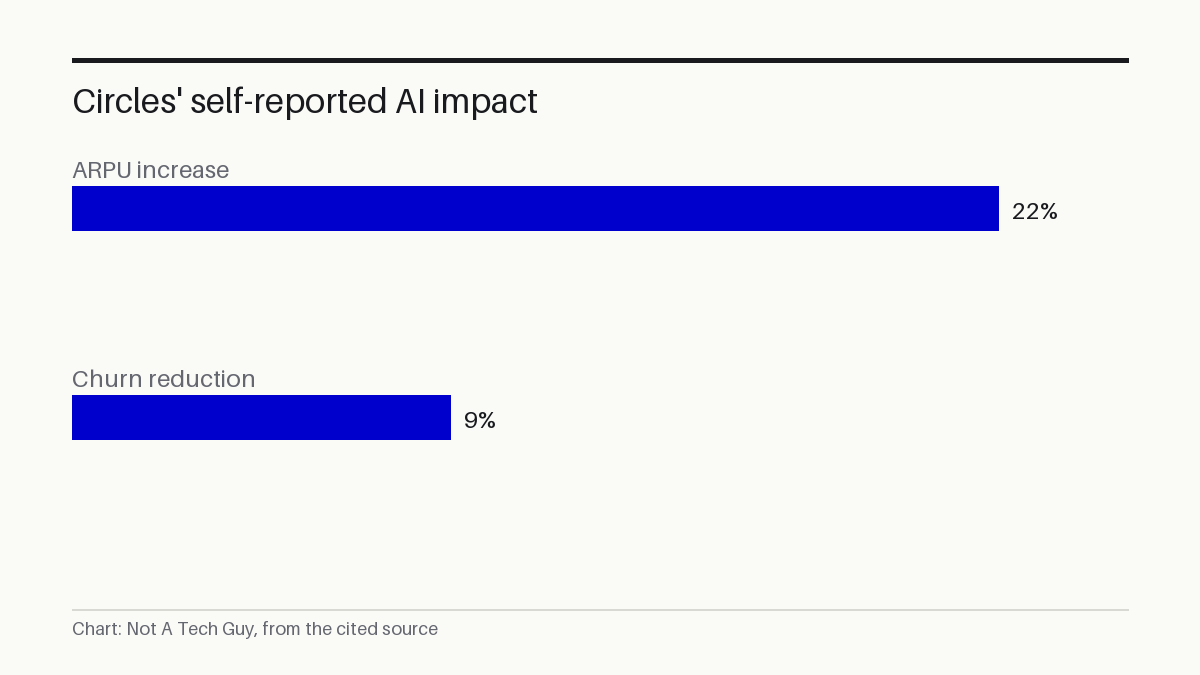
This matters because telco metrics are easy to flatter. ARPU can rise if higher-value customers stay while lower-value ones leave, even if total revenue is flat. Churn can fall because of contract lock-ins rather than satisfaction. Without knowing what Circles measured and over what period, the figures tell us something happened, but not precisely what.
Why a telco would bet on this stack
Telecom operators have been slow to adopt AI for customer-facing personalisation compared with retail or finance. The reasons are structural: thin margins, legacy billing systems, and regulatory constraints on how customer data can be used. Circles, which operates as a mobile virtual network operator in multiple markets, appears to be using OpenAI's API to generate personalised offers and service recommendations, and Codex to accelerate the software development behind those features S¹.
The combination addresses two telco pain points at once: the cost of building and maintaining customer software, and the revenue lift from making each customer feel like the service was built for them. If the 22% ARPU figure holds up under scrutiny, it would suggest that AI-driven personalisation in telecom is producing returns closer to what fintech and e-commerce have seen, not the modest gains telcos have historically managed.
OpenAI has been publishing field reports from sectors including genomics research, where AI agents accelerated specific workflows. The Circles announcement follows the same pattern: a named customer, a specific product stack, and headline metrics. The difference is that genomics research outcomes are measurable in a way that commercial metrics like ARPU are not, because revenue figures depend on pricing decisions, market conditions, and competitive dynamics that have nothing to do with AI.
What to do about it
For a telecom product team evaluating AI personalisation, the Circles case is a signal, not a proof point. The practical move is to test the stack Circles used, the OpenAI API for inference and Codex for development, against your own baseline with a defined measurement window before committing to a rollout.
Consider a regional mobile virtual network operator in Western Australia, serving 80,000 prepaid customers across mining towns and coastal communities. Their product team could use the OpenAI API to build a recommendation engine that suggests plan upgrades based on usage patterns, when a customer's data spikes during a fly-in fly-out rotation, for instance, and use Codex to prototype the feature in days rather than months. The key is to measure ARPU and churn against a control group over at least one full billing cycle before scaling. The Circles announcement does not tell us whether Circles did this.
One thing to check this week: the OpenAI API pricing page, to estimate what the inference cost of running personalised recommendations for your customer base would be at current rates. If the cost per user per month is a fraction of the ARPU lift you are targeting, the economics may work. If it is close to or above the expected lift, the model needs to be cheaper or the personalisation needs to drive more than plan upgrades.
What we don't know yet
The Circles announcement leaves several questions open. We do not know the timeframe over which the 22% ARPU increase and 9% churn reduction were measured, whether those figures were sustained or represented a peak, or whether they were measured against a control group or a historical baseline S¹. We do not know which markets Circles measured, or whether the results reflect a single product line or the entire customer base. The "improved development efficiency" claim has no number attached, making it impossible to assess S¹. No third party has verified any of the reported metrics.
We also do not know whether the results are specific to Circles' business model as a mobile virtual network operator, or whether they would transfer to a traditional carrier with owned infrastructure and different cost structures.
The next signal: OpenAI's next quarterly customer field report, likely in October or November 2026, may include additional telco case studies or updated metrics from Circles. We will check whether the 22% ARPU figure is repeated, revised, or quietly dropped.
If this was useful, subscribe for the next one. We read the vendor announcements so you get the signal without the spin.
Sources: S1 — Circles powers telco personalization with OpenAI technology · P2 — openai/openai-python · P3 — MAXNORM8650/papercircle · P4 — openai/codex
More from Not A Tech Guy
- AI agent evaluation ignores time: this preprint fixes it
- SkillBoost stops AI agents forgetting old skills
- EvoPINN: AI agent invents new neural network for physics
Generated from an audited evidence pack with primary-source research. Social-media items are discussion signals, not verified facts. Nothing here is financial, legal or medical advice.


