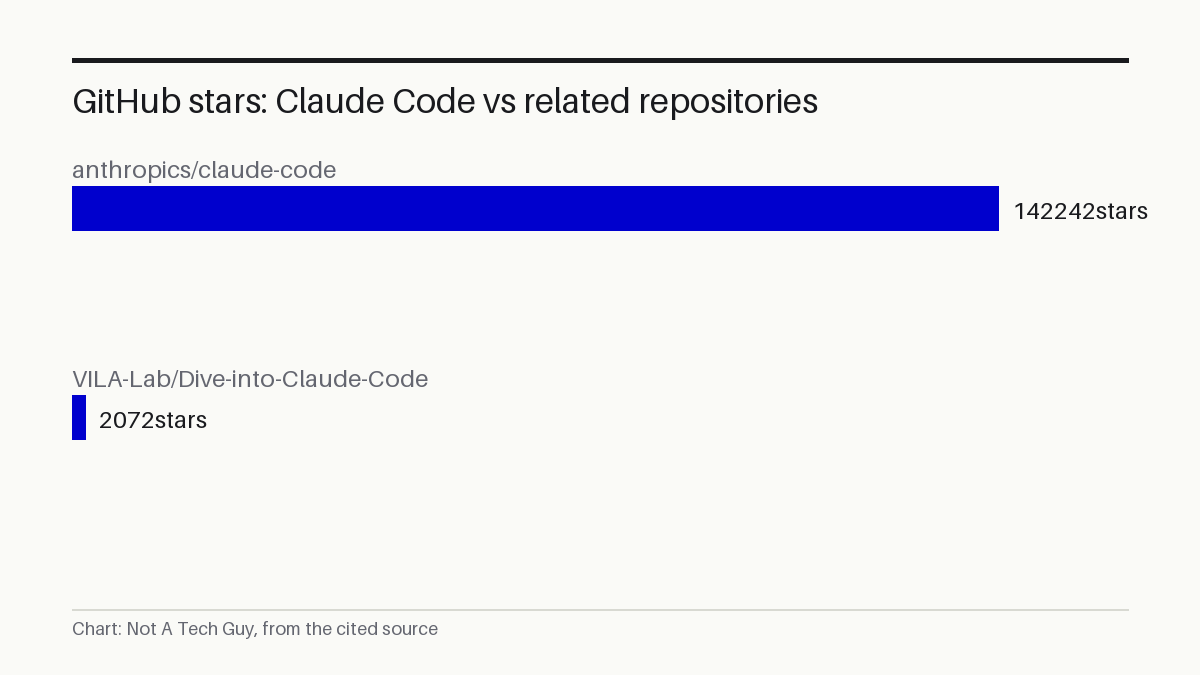

Claude Code shipped version 2.1.239 on 21 August, and the release notes include a line about cost estimates that now factor in a 1.1x premium for US-only inference tied to data-residency settings P⁴. The same day, the repository appeared on GitHub's daily trending list with 142,242 total stars S¹. A 10% surcharge for keeping inference traffic inside US borders sounds small until you consider what it implies about who pays for compliance, and what the tool sends to Anthropic's servers to process in the first place.
My read: The 1.1x premium is the first concrete number I have seen attached to data-residency inference for a coding agent. It tells me Anthropic can isolate where your prompts run, but it costs 10% more. What I do not buy yet is the comfort level: the tool collects code acceptance and rejection data, conversation logs, and /bug submissions S¹, and the safeguards are all self-reported. The cost tracking is a welcome transparency move. The privacy story is still Anthropic grading its own homework.
What changed in v2.1.239
The release, pushed by Anthropic engineer ashwin-ant on 21 August, adds cost estimates across three surfaces: the /cost command, the status line, and the --max-budget-usd flag P⁴. The notable addition is that these estimates now include the 1.1x premium applied when users select US-only inference for data-residency purposes. A developer who needs codebase queries to stay within US data centres pays 10% more per token than one using default routing.
The repository also confirms npm installation is deprecated S¹, pushing users toward whatever Anthropic now considers the primary install path. The repo includes several plugins that extend the tool with custom commands and agents S¹. The project appears to be moving from a single tool toward something closer to a platform.
What the tool actually collects
By Anthropic's own description, Claude Code is an agentic coding tool that runs in your terminal, reads your codebase, and handles git workflows through natural language commands S¹. To do that, it sends your code to Anthropic's servers for inference, the process of running the model against your input. The repository states the tool collects usage data including whether you accept or reject its code suggestions, the associated conversation data, and user feedback submitted through the /bug command S¹.
Anthropic says it has safeguards: limited retention periods for sensitive information, restricted access to user session data, and a policy against using feedback for model training S¹. These are self-reported. No independent audit appears in the evidence.
Why academics are paying attention
A separate repository, VILA-Lab/Dive-into-Claude-Code, has collected 2,072 stars since its creation in April 2026 P³. It describes itself as a systematic analysis of Claude Code for designing current and future AI agent systems, and links to an arXiv paper P³. Researchers building academic analysis around a single commercial coding agent signals the tool has crossed from developer novelty to research subject.
The main repository itself shows the scale of engagement: 142,235 stars, 22,805 forks, and 14,894 open issues in a deep-research snapshot P². That issue count is worth pausing on. Fourteen thousand open issues on a tool that reads your codebase and sends it to a third party for processing is a lot of unresolved edge cases.
What to do about it
For a team running Claude Code in a regulated industry, consider a fintech in Sydney whose compliance team requires all inference to stay within approved jurisdictions. The 1.1x premium is now a budget line item. A development team spending $5,000 a month on Claude Code inference would pay $5,500 for the data-residency guarantee. That is not catastrophic, but it needs to be in the budget before the compliance team asks where the data goes.
The practical step this week: if you are already running Claude Code, check whether your team has the --max-budget-usd flag set. The v2.1.239 release means cost estimates now include the residency premium, so the numbers in /cost should reflect what you actually pay. If they do not match your bill, that is worth a /bug report.
What we don't know yet
The evidence does not tell us what the primary installation method is now that npm is deprecated. It does not clarify whether the data-residency premium applies to all inference or only specific model tiers. The 14,894 open issues P² suggest a tool under active strain, but the evidence cannot tell us how many relate to cost or privacy features.
The safeguards Anthropic describes are self-reported. Whether an independent audit exists, or whether the retention and access policies have been verified by a third party, is not in this evidence.
The next signal: watch the releases page for a version tag beyond the 2.1.x series. We will check whether the cost tracking and data-residency features survive into that version unchanged.
Sources: S1 — anthropics/claude-code: Claude Code is an agentic coding tool that liv · P2 — anthropics/claude-code · P3 — VILA-Lab/Dive-into-Claude-Code · P4 — Releases · anthropics/claude-code · GitHub · P5 — IllDepence/unarXive
More from Not A Tech Guy
- FedLNS catches rogue clients in federated LLM training
- GxP-Agent hits 100% on clinical trial coding benchmark
- DeAR: AI agents reason peer-to-peer without a central boss
Generated from an audited evidence pack with primary-source research. Social-media items are discussion signals, not verified facts. Nothing here is financial, legal or medical advice.