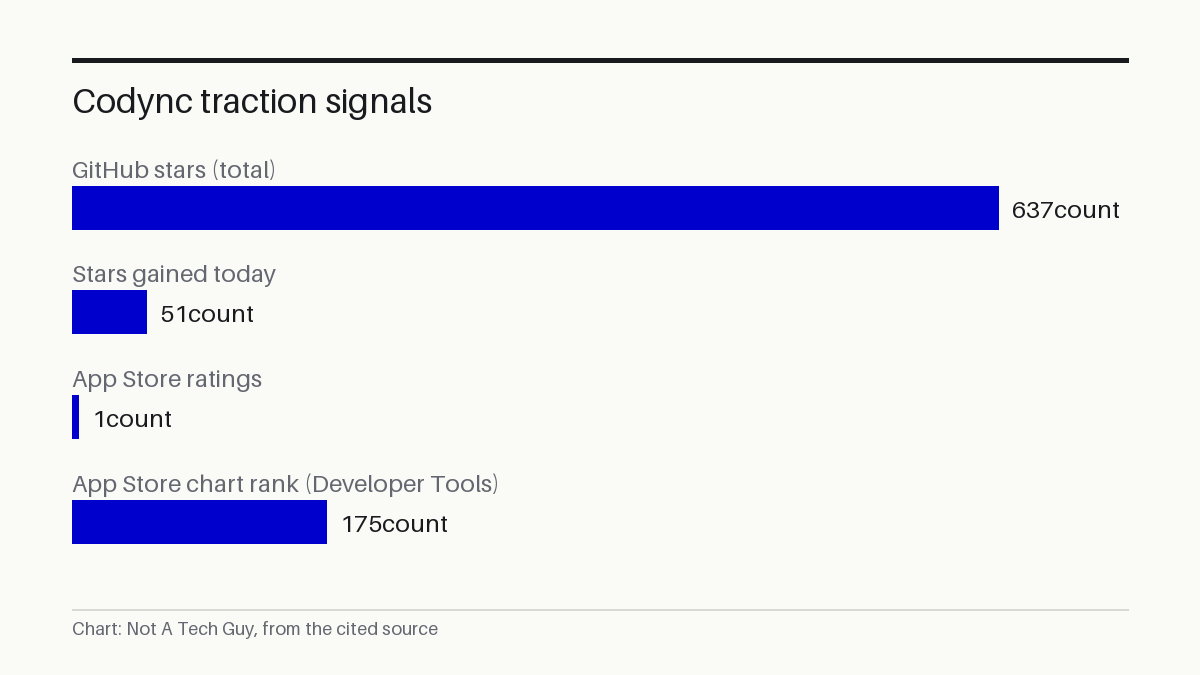

Developer Pokai Lee built Codync, a free tool that landed on GitHub's daily trending chart today with 51 new stars, bringing its total to 637 S¹. The project claims to turn Claude Code, Codex, Cursor, Gemini and roughly 40 other coding agents into bots you can message from an iPhone, though every feature and security claim is self-reported with no independent review S¹.
My read: This is the first project I've seen that tries to make every coding agent on your machine reachable from a phone, rather than a single vendor's. I don't buy the end-to-end encryption claim yet, because the README states it but nobody outside the project has audited it. What I would watch is whether the multi-agent group chat actually works in practice, or whether bots talking to bots degrades into noise.
The App Store listing, a primary source, confirms the iPhone app exists. It is free, weighs 34.2 MB, and sits at number 175 on the Developer Tools chart with a single five-star rating P². The developer is listed as Pokai Lee P².
On the desktop side, the README describes a single Rust binary called codync-host that runs on macOS, Windows and Linux and drives every agent S¹. The phone app uses native SwiftUI, the desktop app is Electron, and a terminal UI covers SSH sessions S¹. A hosted Cloudflare relay is included at no cost, with traffic described as end-to-end encrypted between phone and computer. That encryption claim has not been independently verified S¹.
What the group chat actually does
The standout idea is multi-agent group chat. The maintainers say you can put several bots in one conversation and they answer in turn, with a Claude bot able to ask a Codex bot for a code review S¹. This echoes the direction OpenAI described when it said coding agents reshape its own AI research, and it lines up with findings that agents can learn team standards up to 20.9% better when they share context.
The project positions itself as an alternative to Grok Bot, Muse and Dots S¹. A separate repo, Z4YT0N/OpenGrokBot, takes a similar approach with MIT licensing and 7 stars, suggesting the open-source Grok Bot alternative space is just forming P³.
What is verified and what is not
Every feature, platform and security claim comes from the maintainers' README, not from independent testing S¹. The project uses multiple third-party trademarks, including Claude, Codex, Cursor, Gemini, Grok, Copilot, Muse and Dots, without evidence of affiliation with their owners. The ACP registry, which Codync says it uses to support 40+ agents, is referenced in the README but its scope and reliability are self-reported S¹.
For a developer who already runs Claude Code or Codex locally, the practical check is simple. Install the iPhone app from the App Store P², run codync-host on your machine, and try messaging one agent from your phone. If the relay connects and the agent responds, the core claim holds. If not, the README's promises outpace the code.
The project is early. 637 stars and one App Store rating are curiosity, not adoption. The next checkpoint is whether the star count sustains past the trending spike or flattens once the initial attention fades.
Sources: S1 — leepokai/Codync: The open-source Grok Bot alternative: message Claude · P2 — Codync App - App Store · P3 — Z4YT0N/OpenGrokBot · P4 — Al.
Related reading
- OpenAI says coding agents reshape its own AI research — our technology desk, 2026-09-06
- AI agents learn your standards, up to 20.9% better — our technology desk, 2026-09-05
Written from 4 sourced items, 3 of them primary.