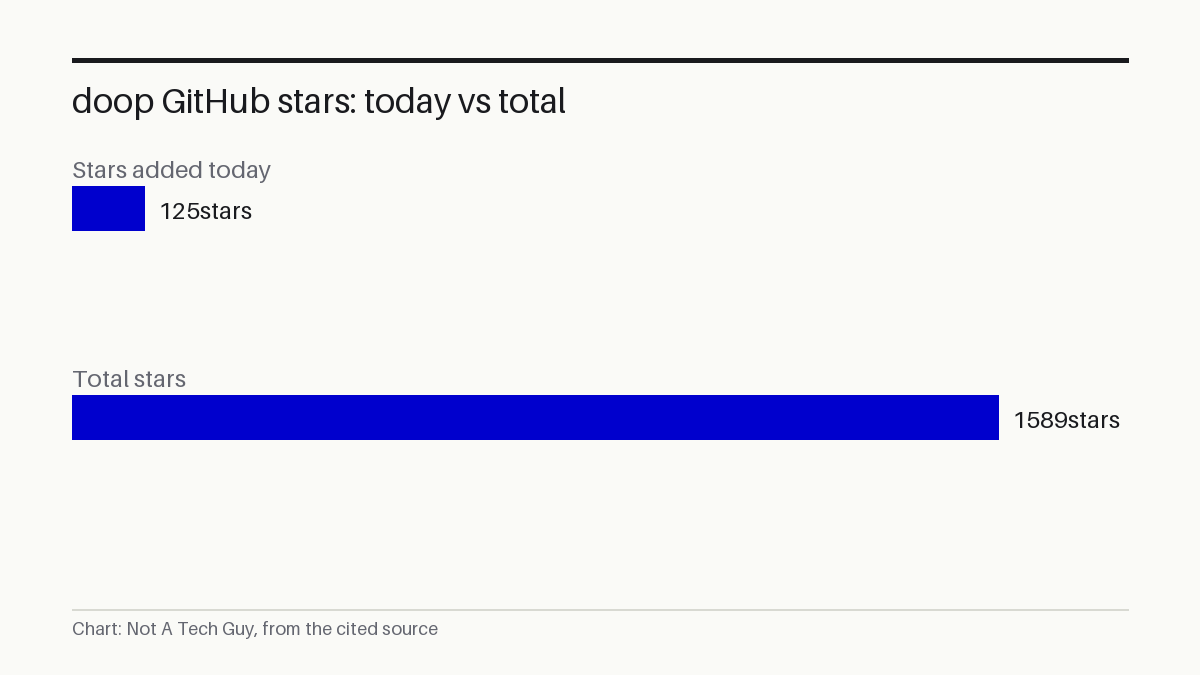

Developer kgoedecke published doop, an open-source design tool that landed on GitHub's daily trending list today with 1,589 total stars, 125 of them added in the last 24 hours S¹ — figures that are point-in-time and shift quickly. The maintainers position it as a free, self-hosted alternative to Paper.design, built around a premise most design tools still avoid: AI agents and humans editing the same canvas at the same time, live S¹. The "alternative to Paper.design" framing is the maintainers' own positioning, not an independent market classification S¹.
Agents and humans share one live canvas
Each design occupies a shareable canvas divided into frames, which display live HTML rendered within sandboxed iframes S¹. A built-in MCP server allows AI agents to write edits directly into those frames and broadcast their progress as it happens, so a human collaborator sees the agent's changes appear in real time S¹. The iframe sandboxing and MCP server access controls are described only in the project README and have not been independently audited S¹.
The bundled Doop Agent works with six model families: GPT, Claude, Gemini, DeepSeek, Kimi, and Qwen S¹. Multiplayer runs through a single WebSocket room that handles live cursors, presence, follow mode, per-frame editing indicators, undo and redo, threaded comments, and an activity feed S¹. The project defaults to private access, with collaboration gated by email invites or shareable links restricted to view, comment, or edit permissions S¹.
Self-hosting with zero external services
The maintainers state that one docker compose up or bun run dev command launches the tool with no configuration, relying on an embedded Postgres database and no external services S¹ — a claim that has not been tested outside the project. The codebase is written in TypeScript S¹. The first public release, v0.1.0, shipped on 22 August P², and the project has since pushed 383 commits to main P². A desktop build, v0.11.0, was released on 1 November with 14 platform assets including RPM and signed packages P⁴.
For a frontend lead at a small product team, doop would replace a manual handoff step: instead of exporting mockups to a separate tool, the designer and an AI agent could work on the same HTML frames simultaneously, with the agent's edits visible live on the canvas S¹. The practical question is whether the iframe sandboxing actually isolates agent-generated HTML from the parent application — the single claim that, if it fails, makes the tool unsafe to run with untrusted model output.
The desktop v0.11.0 build shipped on 1 November P⁴ is the most recent artefact, and the 383 commits since the August v0.1.0 release P² are the fastest way to gauge whether development is sustained.
Sources: S1 — kgoedecke/doop: The open-source alternative to Paper.design. A multipl · P2 — Release doop v0.1.0 — initial open-source release · kgoedecke/doop · G · P3 — Trending repositories on GitHub today · GitHub · P4 — Releases · kgoedecke/doop · GitHub · P5 — GitHub - huggingface/paperswithcode: This repository hosts the code of
Written from 5 sourced items, 4 of them primary.