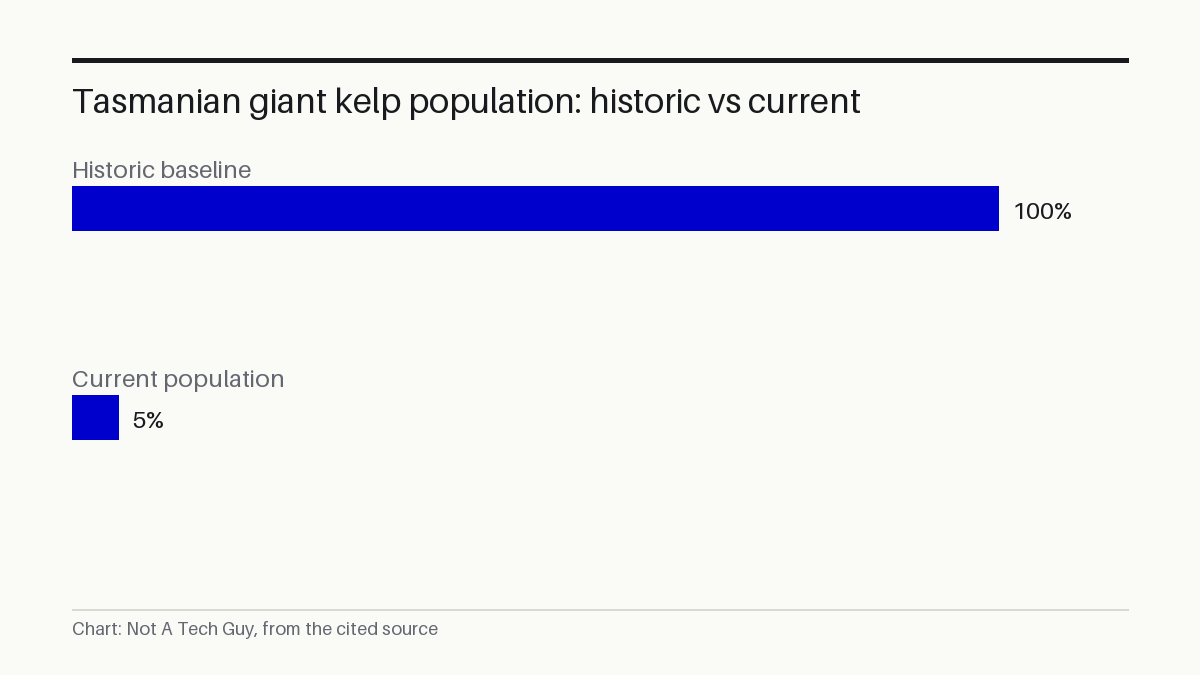
Google and CSIRO researchers have sequenced 600 wild giant kelp specimens from 40 Tasmanian coastal sites, working with a population now reduced to 5% of historic numbers S¹. That 5% figure is a vendor's own number with no error bars and no baseline year stated in Google's post, so it functions as a directional indicator rather than a precise count. No kelp has been replanted. The genetic analysis and cross-breeding studies described in Google's 12 November announcement are groundwork for future restoration with heat-tolerant specimens, not a completed rescue S¹.
Google's human-genome AI repurposed for kelp
DeepVariant is Google's open-source tool originally built to find genetic variants in human genomes. Researchers trained a version of it to analyse giant kelp DNA instead S¹, repurposing a human-genome tool for a species with a fundamentally different genetic structure.
The team recently published two high-quality reference genomes for Australian giant kelp S¹. A reference genome is the baseline map against which individual specimens are compared, letting scientists identify which populations carry traits that might survive warmer waters. Google's blog says the genomes have been published but names no journal and provides no citation S¹; no one outside the CSIRO-Google partnership has independently verified the sequencing results.
The 600 specimens from 40 Tasmanian sites give researchers a population-level view of genetic diversity. That diversity is what restoration depends on: finding heat-tolerant individuals and cross-breeding them, not planting any surviving kelp and hoping for the best.
This effort sits inside Google Australia's Digital Futures Initiative S¹, a program that expanded the company's research collaboration with CSIRO. Google deepened that partnership in August 2024 P⁴.
From genetic maps to seabed restoration
Google timed its announcement as COP31 kicks off this week S¹, framing the work around climate-driven ecosystem collapse. Giant kelp forests are vanishing globally as warming waters remove the underwater canopies that once protected coastlines and sustained marine species S¹. Tasmania is among the most visible collapse sites.
The distance between sequencing DNA and restoring a forest is considerable. Genetic analysis identifies which specimens carry heat-tolerant traits. Lab-based cross-breeding studies, conducted by CSIRO's partners, test whether those traits hold when specimens are combined S¹. Actual replanting in Tasmanian waters has not begun, and Google's post does not claim it has.
For marine restoration operators in Tasmania, the 600-specimen dataset means they can now screen which local populations carry heat-tolerant traits before selecting broodstock for trial plantings — work that previously had no genetic map to guide it.
The practical checkpoint for marine scientists and coastal restoration groups is whether the two reference genomes and the 600-specimen dataset appear in a peer-reviewed journal with full methodology. The next step CSIRO and Google name is moving from lab-based cross-breeding studies to real-world replanting trials S¹. No date for those trials appears in the announcement.
Sources: S1 — Scientists are using Google AI to help restore giant kelp forests. · P2 — How Google AI is helping restore Australia’s giant kelp forests · P3 — google (Google) · P4 — Google Australia and CSIRO Deepen Collaboration to Boost AI in Austral · P5 — SakanaAI/AI-Scientist
Written from 5 sourced items, 5 of them primary.