Google began rolling out a feature this week that lets U.S. users connect third-party apps directly inside Search's AI Mode, so a query about dinner can drop ingredients into an Instacart cart and a request for a playlist can save straight to YouTube Music [S1]. The move folds a job that used to take three or four app switches into a single chat. What it doesn't do, and where the checkout actually happens, is the part worth reading for.
From search box to shopping cart
According to a 16 July 2026 Google blog post, this update builds on existing functionality. While individuals have previously been able to link certain preferred services within the Gemini app [S1], this same capability is now expanding into Search's AI Mode, which is Google's experimental conversational interface layered over its standard search results [S1].
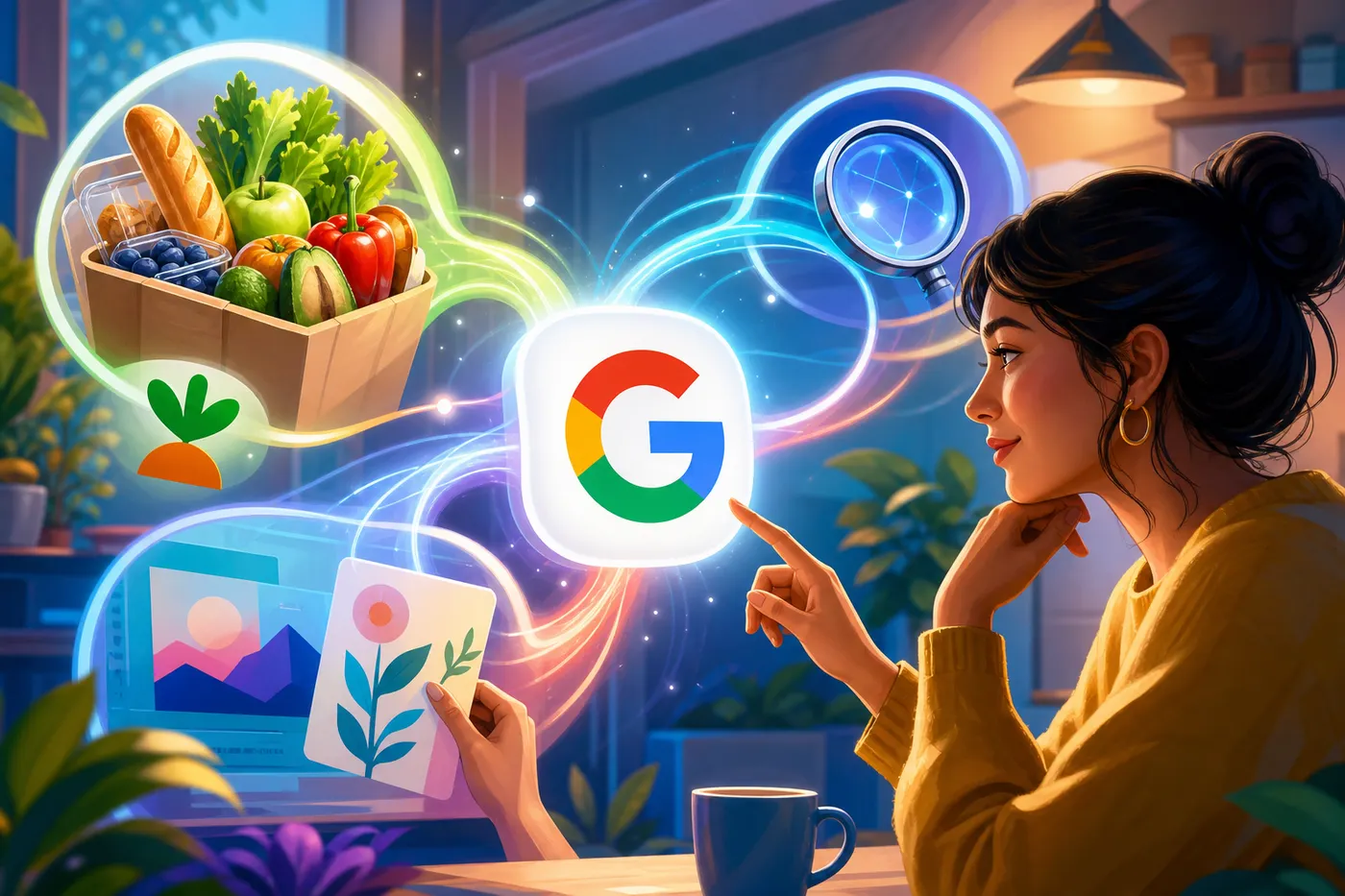
The mechanics are straightforward. You link a supported service the way you would link a calendar or a music account to any other app. Once connected, AI Mode can interact with that service on your behalf. The technology powering this is dubbed "Personal Intelligence" by the company, which claims that integrating these applications allows Search to deliver highly customized answers [S1].
Three integrations are named in the announcement, each showing a different kind of action:
- Instacart: By requesting a recipe from AI Mode, individuals can automatically populate their Instacart cart with the necessary items [S1].
- Canva: When seeking design assistance, Canva can display template choices directly within the Search dialogue [S1].
- YouTube Music: Users can request that AI Mode compile a playlist, which can then be immediately added to their YouTube Music collection [S1].
These are not passive suggestions. The connected app receives the request and performs an action, which is a step beyond what a standard search result does. It is closer to what an agent does, and it echoes the broader industry push toward AI that acts rather than merely answers.
What it means
The shift here is small in scope but large in implication. Google Search has spent 25 years as a directory: you type words, it gives you links. AI Mode already changed that by generating conversational answers. Connected apps change it again by letting those answers reach into other software and do something.
For a regular person, the difference is between reading a recipe and having the ingredients loaded into your cart. Between seeing a list of song recommendations and having a playlist saved to your library. Between browsing Canva templates in a separate tab and seeing them surface inside the conversation where you asked for them.
The limitation to keep in mind: Although the company states that users can link these platforms safely [S1], this assertion is promotional and lacks independent verification. The connection works inside AI Mode only, not in the standard Search results page most people still use. And the rollout is phased, described as beginning to reach American users this week [S1], which means many individuals will not see it immediately.
What it means for business
A small food blog or recipe site that depends on search traffic should pay attention. If a user can ask AI Mode for a dinner plan and have ingredients sent to Instacart without ever clicking through to a recipe page, the value of ranking on that query drops. The traffic that used to flow to food publishers could be intercepted at the Search layer.
For a two-person design studio, the Canva integration means a potential client could ask AI Mode for a flyer concept, see templates, and start a project without visiting the studio's site or even Canva's homepage. That cuts out a step in the discovery funnel.
A suburban real estate agency that uses YouTube Music for open-house playlists, or a cafe that builds weekly Spotify-style mixes, might find the playlist curation handy as a time-saver. But the bigger signal is structural: Google is positioning Search as the front door to other apps, replacing its old role as a signpost pointing to them. Any business whose workflow starts with a Google search should consider how that search process changes when the search result can act on what it finds.
Retailers and service providers whose apps are not yet on the supported list should watch which partners Google adds next. The announcement names only three integrations, and the full list of supported apps is not provided [S1]. Being early to a Google integration cycle can mean early access to a new traffic source. Being late can mean competitors capture that attention first.
What we don't know yet
Several questions remain open after the announcement:
- Which apps are supported beyond Instacart, Canva and YouTube Music? Google names three examples but does not publish a full list. The supported catalogue will determine how broadly useful this feature is.
- When does it reach users outside the U.S.? The rollout is U.S.-only at launch [S1]. No timeline for other markets is given.
- Does the action complete inside Search or bounce to the partner app? Google's wording suggests the interaction happens in AI Mode, but for Instacart specifically, checkout still occurs on the partner's app or website, not natively within Search. The boundary between what Search can do and what requires a handoff to the partner is unclear.
- How does data flow between Google and the connected app? The word "securely" appears in the blog post [S1] but no technical detail on encryption, data retention, or what Google can see about your activity in a connected app is provided.
- Does this work alongside the Gemini app connections, or replace them? Google says users can already connect services to the Gemini app [S1] and is now enabling connections in Search. The relationship between the two is not spelled out.
The next concrete signal to watch is the expansion of the supported-app list and any international rollout announcement, likely in the coming weeks as Google gauges uptake from the initial U.S. phase.
If this kind of reporting is what you want in your inbox, subscribe to keep reading.
Sources
- [S1] Connect more of your apps to Search — Google — The Keyword (AI) (primary)
- [P2] EnidPinxit/cuteeterminal-01 — EnidPinxit/cuteeterminal-01 (attributed)
- [P3] chen-bowen/Instacart_Next_Order_Recommendation — chen-bowen/Instacart_Next_Order_Recommendation (attributed)
- [P4] allenai/artifact-linker — allenai/artifact-linker (attributed)
More from Not A Tech Guy
- GPT-4o audit finds 66% of solved problems have flawed reasoning
- AI agent harness evolution may not beat simple search
- Item response theory for AI benchmarks gives unreliable rankings
Generated from an audited evidence pack with primary-source research. Social-media items are discussion signals, not verified facts. Nothing here is financial, legal or medical advice.