
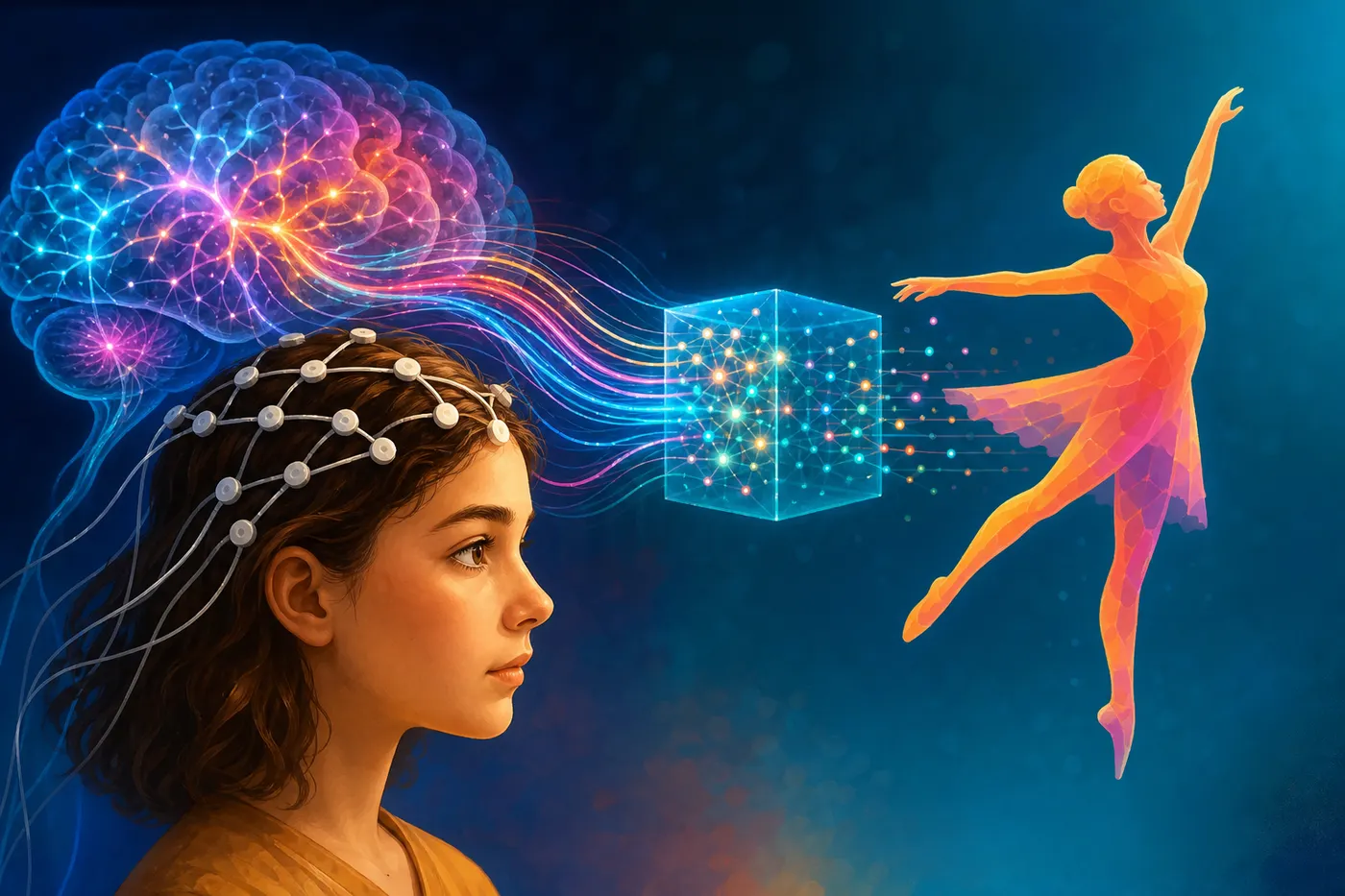
A July 2026 arXiv preprint from researchers at Mila and the Université de Montréal introduces MOJO, a training framework that teaches AI models to decode brain activity by learning from unlabelled neural recordings [S1]. The method, detailed in a paper posted on 16 July, outperforms standard approaches especially when labelled data is thin. But the gap it targets, why decoding brain signals is so hard in the first place, and what it would take to move from lab bench to clinical use, is where the real story sits [S1].
Why decoding brains is a data problem
Neural decoding is the task of reading electrical activity from the brain and translating it into something useful: the direction a monkey's arm is reaching, the image a mouse is seeing, the word a person is trying to say. The models that do this translation need examples. Lots of them. And each example needs a label, a record of what the subject was actually doing at that moment [S1].
Here is the bottleneck. Every time a researcher opens a new recording session, even with the same animal, the specific neurons being recorded are different. The model trained on yesterday's neurons cannot simply reuse today's data. So you need fresh labelled examples for every new session. Labelling them is slow, expensive, and sometimes impossible if the task is complex. Unlabelled recordings, by contrast, are cheap and abundant. You just record the brain doing its thing and save the file [S1].
MOJO, which stands for Masked autOencoder-based JOint training, attacks this gap by combining two learning strategies in one training run [S1].
How MOJO works
The first strategy is self-supervised learning through masked autoencoding. The model takes a chunk of neural activity, hides parts of it, and tries to reconstruct what was hidden. No labels needed. The model learns the statistical structure of brain signals on its own, the way a language model learns grammar by guessing missing words in a sentence [S1].
The second strategy is standard supervised learning. The model also sees labelled examples and learns to map brain activity to behaviour. MOJO trains both objectives together, so the model builds a general understanding of neural patterns from unlabelled data while also learning the specific decoding task from labelled examples [S1].
The payoff comes when labelled data is scarce. In few-shot fine-tuning, where a new recording session provides only a small handful of labelled examples, MOJO's advantage over purely supervised models is most pronounced [S1]. The self-supervised pre-training gives the model a head start, so it needs fewer labelled examples to reach good performance.
What the researchers tested
The team evaluated MOJO on three spiking datasets: monkey motor cortex during reaching tasks, and multi-regional mouse recordings during vision and decision-making tasks [S1]. Across these, they report that MOJO beats models trained with supervised learning alone [S1].
They also found that the self-supervised component produced more interpretable neuronal representations, meaning the internal patterns the model learned corresponded more cleanly to identifiable brain signals [S1]. Without being explicitly trained for it, MOJO also improved at brain region classification and spike-statistics prediction [S1].
The framework then crossed a species and modality boundary. On human electrocorticography, or ECoG, recorded during speech, MOJO continued to outperform purely supervised models and matched the performance of neuro-foundation models built specifically for continuous signals [S1]. ECoG uses electrodes placed directly on the surface of the brain, and the signals are continuous rather than discrete spikes. That MOJO, designed around spiking data, transferred to this different signal type is one of the paper's more striking claims.
What it means
For a field that has been bottlenecked by the cost of labelling, MOJO offers a straightforward proposition: use the mountain of unlabelled neural data you already have to make your labelled data go further. The mechanism is not exotic. Self-supervised learning has transformed language and vision. Applying it to neural decoding, where the label scarcity problem is arguably worse than in any other domain, is a natural and overdue step.
The few-shot result matters most in practice. A brain-computer interface researcher who records a new session with a patient gets a handful of labelled trials before fatigue or time constraints set in. If a model can reach usable decoding accuracy from those few trials because it was pre-trained on unlabelled recordings, the path to practical, session-adaptive brain decoders gets shorter.
The cross-modality result, if it holds under independent testing, suggests the approach is not wedded to one type of brain signal. That matters because the neuroscience world is fragmented across recording technologies, each with its own data format and community.
What it means for business
No clinical or commercial deployment exists today, and the paper is explicit about being a preprint [S1]. For neurotechnology companies and brain-computer interface startups, the relevant signal is architectural: combining self-supervised pre-training with supervised fine-tuning on neural data is now a demonstrated approach, not a theory.
A two-person neural decoding lab that previously needed thousands of labelled trials per session might, if this approach holds up, reduce that to dozens. That changes the economics of data collection, which is often the dominant cost in BCI research. For companies building neural interfaces, the ability to pre-train on existing unlabelled corpora and fine-tune per patient session could lower the barrier to adaptive, personalised decoders.
The interpretable representations claim, if verified, also matters for regulatory pathways. Models whose internal features map to identifiable neural signals are easier to audit than black-box decoders, which is a property regulators care about.
What we don't know yet
The paper is a preprint and has not been peer-reviewed [S1]. Every performance and generalisation claim is self-reported by the authors against their own chosen baselines. Independent validation on separate datasets, and by separate labs, has not happened.
The evaluations cover three specific spiking datasets and one ECoG dataset. Whether MOJO generalises to other neural modalities, such as EEG or fMRI, or to other behavioural tasks beyond reaching, vision, decision-making, and speech, is an open question the paper does not claim to answer [S1].
The comparison to neuro-foundation models reflects the authors' own benchmark setup. What those models are, how they were configured, and whether the comparison was on equal footing will need scrutiny during peer review.
The next concrete event to watch is whether this preprint enters formal peer review at a venue such as NeurIPS or ICLR, and whether independent groups reproduce the few-shot and cross-modality results on their own data. Until then, MOJO is a promising method paper, not a validated tool.
Sources
- [S1] Leveraging unlabelled data for generalizable neural population decoding — arXiv preprint (cs.AI, cs.LG) (attributed)
- [P2] Leveraging unlabelled data for generalizable neural population decoding — Leveraging unlabelled data for generalizable neural population decoding (attributed)
- [P3] mraihan-gmu/MojoBench — mraihan-gmu/MojoBench (attributed)
- [P4] Population Transformer: Learning Population-level Representations of Intracranial Activity | OpenReview — Population Transformer: Learning Population-level Representations of Intracranial Activity | OpenReview (attributed)
- [P5] labrat-0/ai-ml-scraper — labrat-0/ai-ml-scraper (attributed)
Related reading
- Geospatial AI paper maps path from satellite data to agents — our technology desk, 2026-07-16
- TopoBrick forecasts building sensors without training data — our technology desk, 2026-07-11
- SurvFM-RMST lets tabular AI models handle censored survival data — our technology desk, 2026-07-14
Generated from an audited evidence pack with primary-source research. Social-media items are discussion signals, not verified facts. Nothing here is financial, legal or medical advice.