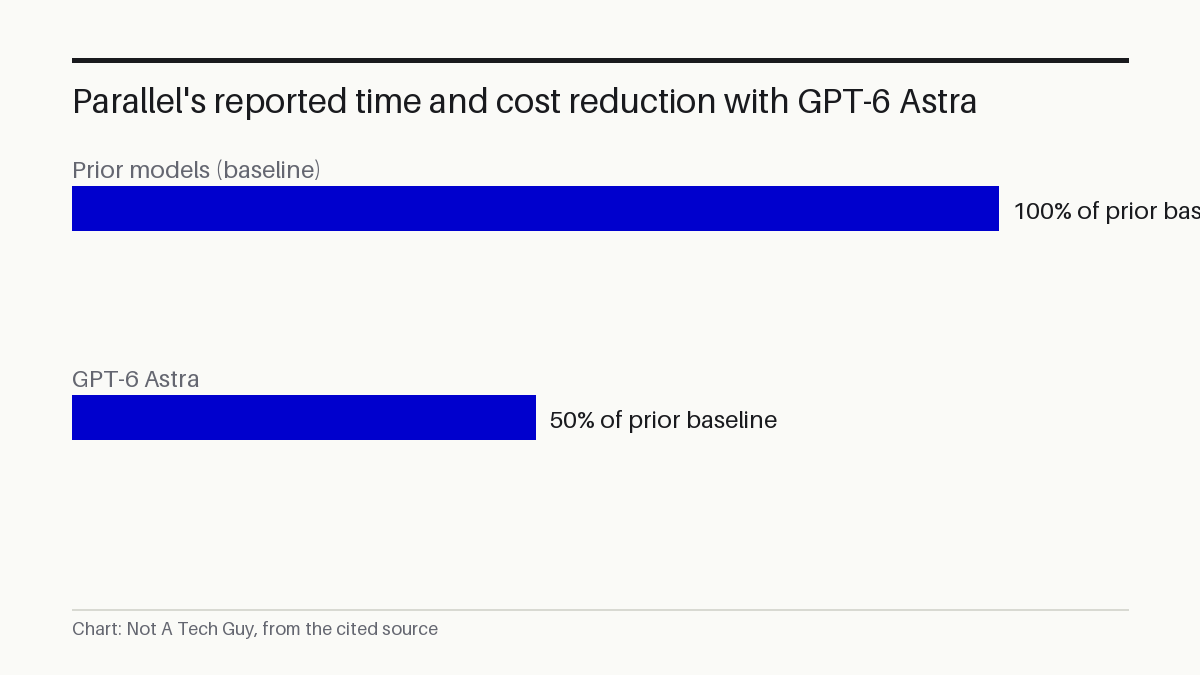
OpenAI reported on 22 September 2026 that Parallel halved its AI research time and cost by moving its agents to GPT-6 Astra S¹. The claim arrives with no disclosed methodology, no named baseline model, and no independent verification.
My read: This is the first customer case study for GPT-6 Astra since its launch earlier this month, and the "half the time, half the cost" framing is the kind of clean, round-number claim that warrants caution. OpenAI has every commercial reason to promote its newest model, and the absence of absolute figures — no dollar amounts, no minute counts, no named prior model, means nobody can reproduce the comparison. What I'd watch for is whether Parallel or any other customer publishes their own numbers with real baselines, because until then this is a marketing page, not evidence.
GPT-6 Astra debuted on 9 September 2026 as OpenAI's most capable model for business work P⁴, with a separate launch page touting it as the company's peak model for both intelligence and alignment P². The Parallel case study, posted on OpenAI's own news page thirteen days later, is the company's first published customer result for the model S¹.
According to the case study, Parallel's agents use GPT-6 Astra to gather and compile labour-market data, and the switch from prior models cut both processing time and cost by 50% S¹. Unchecked: OpenAI did not disclose which models Parallel previously used, how time was measured, what the absolute costs were, or whether any third party reviewed the results. The 50% figure is a vendor's own claim with no error bars, no released code, and no peer review.
A 50% cut means little without a starting point
The 50% figure is relative, not absolute. A claim of "half the time" means little without knowing whether the prior baseline was ten minutes or ten hours. "Half the cost" is equally opaque without a dollar figure or a token-count comparison. The case study also does not state whether GPT-6 Astra is publicly available or generally released, leaving open the question of whether other firms could replicate the result.
This matters because GPT-6 Astra arrived with its own security questions. Earlier this month, the model became OpenAI's first to cross the company's Critical cybersecurity threshold P⁴. A model capable enough to trigger heightened safety scrutiny is also one where performance claims deserve extra scrutiny.
For a recruitment analytics operator who currently spends a full morning compiling wage and employment trend reports, a verified 50% cut would free that time for client-facing analysis instead of data gathering — but only if their baseline workload and model stack match Parallel's undisclosed setup. Any team evaluating GPT-6 Astra on this basis should demand the same baseline disclosure that OpenAI's case study omits: which model you're switching from, what your current per-report cost is, and how you'll measure the change.
OpenAI's promotion of GPT-6 Astra extends beyond performance case studies. The company also recently announced a $5 million grant for research on AI and teenagers, part of a broader push to position the model across both enterprise and societal contexts.
The next checkable milestone is whether Parallel or another named customer publishes independently verified benchmarks with absolute figures. Until then the 50% claim remains a vendor-reported result, not a tested outcome.
Sources: S1 — Parallel cut research time and cost in half with GPT‑6 Astra · P2 — GPT-6 Astra: A new generation of intelligence | OpenAI · P3 — bigcode/astraios-parallel · Hugging Face · P4 — GPT-6 Astra: The next generation in intelligence for work | OpenAI · P5 — adityawakharkar/AstraGPTCoder-7B · Hugging Face
Written from 5 sourced items, 5 of them primary.