

Hugging Face's sentence-transformers library now ships a MultiVectorEncoder that brings ColBERT-style late interaction retrieval into the same API developers already use for dense and sparse embeddings S¹. The pull request, merged on 11 August after touching 250 files, adds 21,000 lines of code to the library P². What that changes is the trade-off between retrieval accuracy and speed that every search system has been forced to make, and for one class of problem, it removes the compromise entirely.
My read: This is the first time I've seen late interaction treated as a peer to dense and sparse retrieval in a mainstream library, not a separate tool you have to learn and wire up. The PyLate project (874 stars on GitHub P⁵) and Stanford's original ColBERT have been around for years, but they lived in their own ecosystems. Folding them into sentence-transformers means a developer who already has a working dense retrieval pipeline can swap one class name and test whether multi-vector buys them enough accuracy to justify the bigger index. I don't buy the "state of the art" claim for visual document retrieval yet, because it's the blog author's assessment, not a benchmark result S¹, but the colpali-engine integration alone is worth trying if you're searching PDFs.
Why one vector loses information
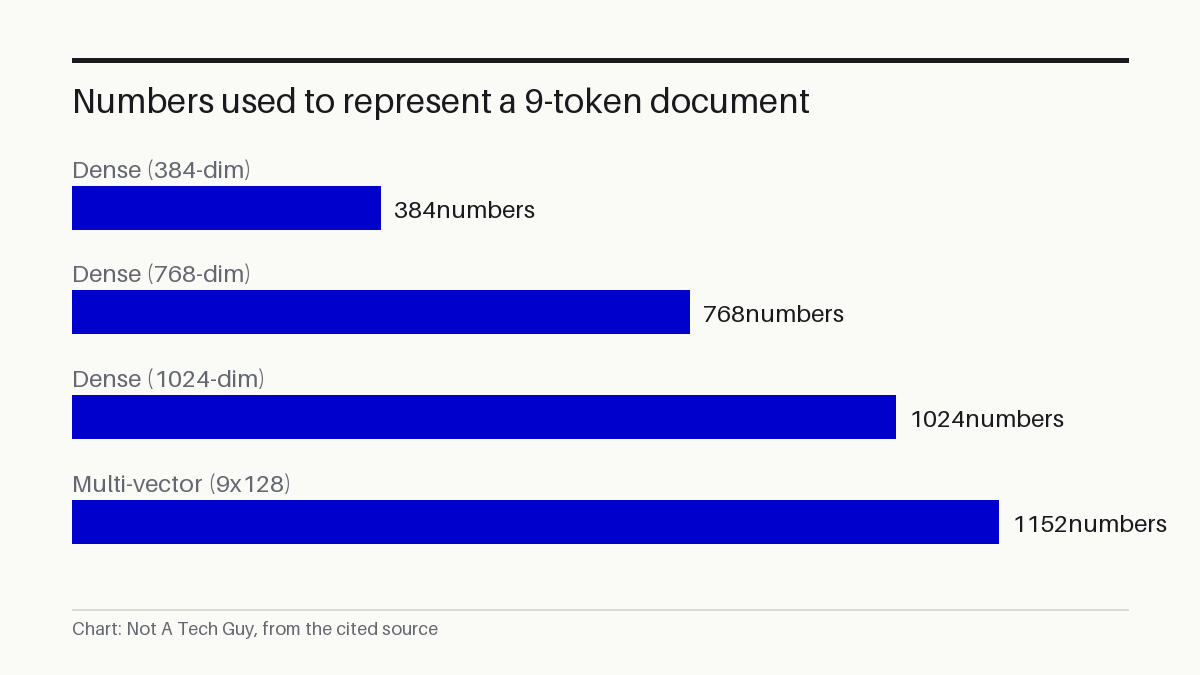
Traditional dense models compress an entire passage into a single array of fixed dimensions, often 384, 768, or 1024 values S¹. All semantic details captured by the model must be squeezed into this one array, and comparing two passages simply requires calculating the dot product of these two compressed representations S¹. That is fast and simple. It is also lossy: if a 200-word contract clause mentions "indemnification" in paragraph three and "governing law" in paragraph seven, a single vector has to average both concepts into the same fixed-size summary.
A multi-vector model takes a different path. Rather than condensing all tokens into a solitary vector, a multi-vector approach reduces each token's representation to a compact size, usually 128 dimensions, while retaining them all S¹. Consequently, a document containing nine tokens is represented as a 9x128 matrix instead of a single 1x128 array S¹. The token-level matching information that a single vector has to average away is preserved, which usually means stronger retrieval at the cost of a bigger index S¹.
Where late interaction sits
The retrieval world has two extremes. A cross-encoder evaluates both texts simultaneously, offering high accuracy but preventing any precomputation because the system must re-encode every document whenever a new search is performed S¹. Conversely, a bi-encoder involves minimal interaction, relying on a single dot product between two pre-calculated vectors, which allows developers to encode a dataset just once and execute rapid searches S¹.
Late interaction sits in between S¹. With late interaction, documents are processed on their own and indexed ahead of time, similar to a bi-encoder S¹. However, during the scoring phase, the system evaluates every token in the query against every token in the document S¹. The MaxSim scoring technique works by finding the best matching document token for each query token, calculating their similarity, and then adding up those maximum scores for the entire query S¹. You get cross-encoder-like attention to individual word matches without re-encoding the corpus for every search.
Visual retrieval without OCR
According to the announcement, multi-vector architectures represent the leading approach for visual document retrieval, allowing users to match text searches directly against images of pages without relying on optical character recognition S¹. For this specific use case, the MultiVectorEncoder is compatible with colpali-engine models, utilizing the identical interface already available for dense, sparse, and reranking systems S¹. The claim is uncorroborated by benchmark data in the post, but the mechanism is sound: if each token-level vector can capture visual patches on a page image, you skip the lossy OCR-to-text step that throws away layout, tables, and figures.
What to do about it
Users can access all of these features simply by updating their package via pip install -U sentence-transformers S¹. Because the new encoder can load checkpoints from both PyLate and Stanford-NLP's ColBERT S¹, developers can use their current models without needing to train new ones.
Consider a legal tech team that searches thousands of scanned contract PDFs. Their current pipeline runs OCR on every page, chunks the text, and embeds it with a dense model. Queries for "force majeure clause" return pages that mention the term, but the ranking often misses pages where the clause is buried in a table or formatted differently. With colpali-engine models through MultiVectorEncoder, they could embed page images directly and query with text, skipping OCR entirely. The index will be larger, since each page produces a matrix of token vectors rather than a single vector, but for a corpus measured in thousands rather than millions of pages, the storage cost is manageable.
One practical step this week: install the updated library, load a PyLate ColBERT checkpoint, and run a side-by-side comparison on 100 of your own documents. Measure whether the retrieval results are more relevant than your current dense model. The API is the same, so the test takes an afternoon, not a rewrite.
What we don't know yet
The announcement lacks performance benchmarks, latency measurements, and comparisons of storage requirements S¹. The assertion that this is the leading method for visual document retrieval reflects the writer's opinion rather than data from formal evaluations S¹. Although headers within the publication reference retrieving audio and video content, the provided text excerpt contains no details to back this up S¹. Additionally, the provided source material cuts off before finishing a sentence, meaning there could be further caveats regarding token-level mechanics that we cannot see S¹.
A separate project, LEMUR, claims to reduce multi-vector retrieval for late interaction models into regular single-vector retrieval P³, which could address the bigger-index problem. It has 29 stars on GitHub and no published benchmarks in the evidence we have P³.
The next signal: watch for benchmark results from the PyLate team or independent evaluations on standard retrieval datasets like BEIR or MTEB. If multi-vector retrieval through sentence-transformers posts competitive scores on those leaderboards, the adoption curve will be worth tracking. We'll check this claim against the next MTEB update.
Sources: S1 — Multi-Vector (Late Interaction) Embedding Models with Sentence Transfo · P2 — [v6] Add support for MultiVectorEncoder models · P3 — ejaasaari/lemur · P4 — lightonai/pylate · P5 — lightonai/pylate
More from Not A Tech Guy
- Euclid-Omni: AI for Olympiad geometry with far less compute
- EU, US and China AI rules diverge, new study warns
- AI lock-in is already happening, researchers warn
Generated from an audited evidence pack with primary-source research. Social-media items are discussion signals, not verified facts. Nothing here is financial, legal or medical advice.


