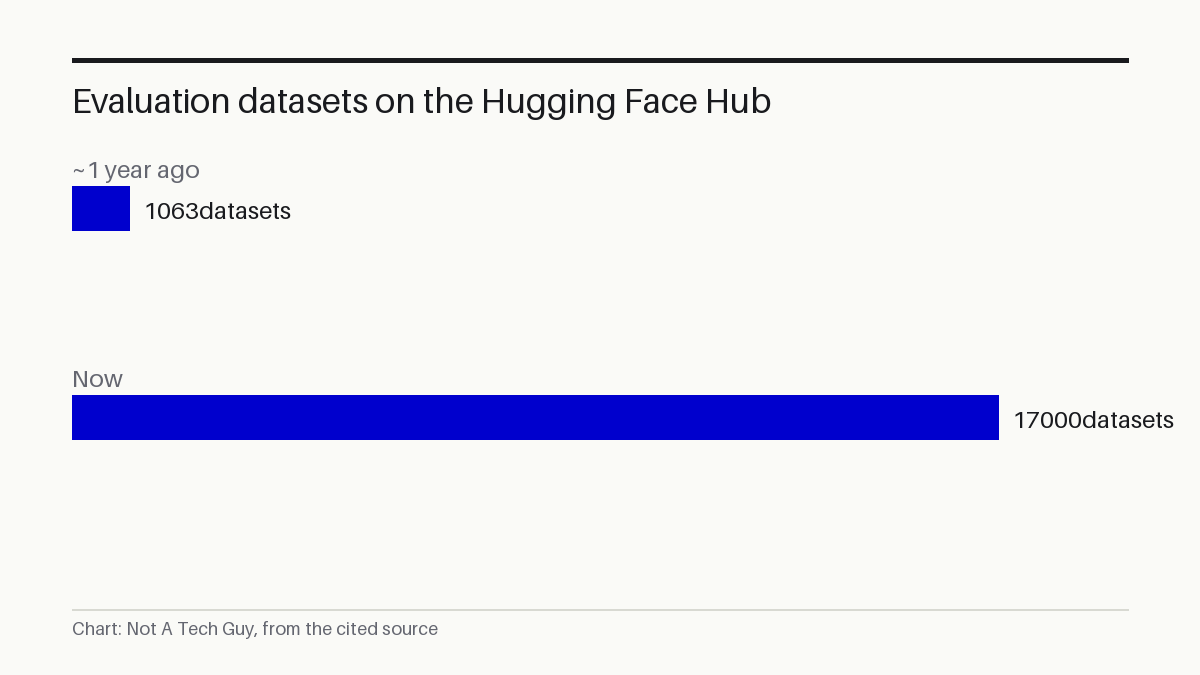

Hugging Face published a guide to building and maintaining agentic evaluations on November 23, as evaluation datasets on its hub grew roughly 16-fold in the past year to about 17,000 S¹. That count is Hugging Face's own platform figure and has not been independently audited. The guide arrives as the field shifts from testing what models know to testing what they can actually do, yet cautions that benchmark tasks and graders frequently contain mistakes — without providing error bars, released validation code, or any specific error rates S¹.
My read: The 16x growth figure is self-reported and serves Hugging Face's own platform interests, so I would treat it as directional rather than audited. What I find more telling is the guide's honesty about benchmark errors being widespread while offering no quantified rates. If grader errors are as common as the guide implies, the 3,500 leaderboards on the hub likely contain an unknown fraction of misleading results, and the guide does not explain how to detect that fraction at scale.
The hub currently hosts about 3,500 evaluation leaderboards S¹. Hugging Face recently added support for agentic abstractions relevant to evaluation, including Traces (records of agent actions), Benchmarks, and Environments S¹. The guide covers four topics: the three eras of evaluation, the steps in building an agentic evaluation, when benchmarks go wrong, and what to open strategically S¹.
Evaluation has shifted from knowledge tests to agent tasks, but grader flaws persist
The guide frames AI evaluation as having moved through three forms S¹. Question-answer benchmarks like MMLU (2020) and GPQA (2023) measure knowledge and reasoning through the answers models produce S¹. Agentic benchmarks like SWE-bench and WebArena expanded the scope to resolving software issues and completing tasks on websites S¹. Research on multi-agent systems has begun adding another dimension: how agents coordinate and what they accomplish together S¹.
Hugging Face acknowledges that evaluation terminology is "notoriously inconsistent," so the three-era framework is the blog's own analytical construct rather than an industry-standard taxonomy S¹.
The problem cutting across all three eras: flawed tasks and scoring scripts can produce misleading results S¹. A benchmark with a broken grader might certify a model as capable when it is not, or dock points for a correct answer that the scoring logic misclassifies. The guide provides no specific error rates or named examples of benchmarks found to be wrong.
Open-source evaluation infrastructure is gaining traction among independent projects
The guide argues that open source offers a way to build stronger, more frequently updated, and more comparable evaluations and the infrastructure around them S¹. This argument conveniently positions Hugging Face's own hub as the natural home for that infrastructure, and the guide provides no comparative evidence that open-source evaluations outperform proprietary alternatives.
Independent projects are already moving in this direction. Groq's openbench, a provider-agnostic, open-source evaluation infrastructure for language models, has 833 stars on GitHub and an MIT licence P⁵. Anthropic published its own guide, "Demystifying evals for AI agents," on January 9, 2026, arguing that good evaluations help teams ship AI agents more confidently and avoid reactive loops where issues surface only in production P².
For an evaluation engineer at an AI startup, the guide changes what lands on their desk: before trusting any leaderboard score, they now need to verify that the benchmark's grader code and task definitions are published openly. If the grader is a black box, a high score may not mean what they think it means. The Hugging Face guide references a full technical walkthrough with commands in its appendix S¹.
Sources: S1 — How to build and maintain an agentic evaluation · P2 — Demystifying evals for AI agents \ Anthropic · P3 — huggingface/huggingface_hub · P4 — KnowledgeXLab/KG-TRACES · P5 — groq/openbench
Written from 5 sourced items, 5 of them primary.