On August 10, OpenAI announced that Model ML, a finance-focused tool, now runs on GPT-5.6 Sol to carry work from research and analysis through to editable, traceable PowerPoint decks and Excel workbooks S¹. The claim is "more efficiently" S¹. The source does not include a single number to back that up: no benchmark or baseline, nothing quantified. What it does include, though, is a detail buried in the output format that tells you more about where this is going than any efficiency metric would.
My read: This is the third GPT-5.6 Sol story in five weeks, and the pattern is clear. OpenAI is pushing its flagship model into vertical workflows where the output has to be something a human can sign off on. The "more efficiently" language is marketing without a number behind it, and I don't buy it yet. What I do find interesting is "traceable." Finance work lives or dies on audit trails. If Model ML can actually link each number in a deck back to its source data, that is a real workflow shift, not a speed bump. But we have one source, no independent testing, and no pricing. Treat this as a product roadmap signal, not a proven capability.
Why the output format is the real story
The announcement says Model ML carries finance work "from research and analysis through editable, traceable PowerPoint decks and Excel workbooks" S¹. Read that sentence carefully. The pipeline does not end at a text box or a chat window. It ends at a .pptx and a .xlsx, files a managing director can open, redline, and forward to a client.
That matters because finance teams spend a disproportionate share of their time not on analysis but on formatting. Moving a valuation model from a Python notebook into an Excel workbook, then pasting charts into a deck, then checking that every footnote matches. If Model ML handles that translation step, the time savings come from eliminating the handoff, not from faster reasoning.
The word "traceable" does the heavy lifting. In finance, every number in a presentation needs a source. A model that generates a deck without showing where each figure came from is a compliance problem. OpenAI's claim that these outputs are traceable S¹ suggests each figure links back to underlying data, but the announcement does not explain how that works in practice.
Where GPT-5.6 Sol sits in the lineup
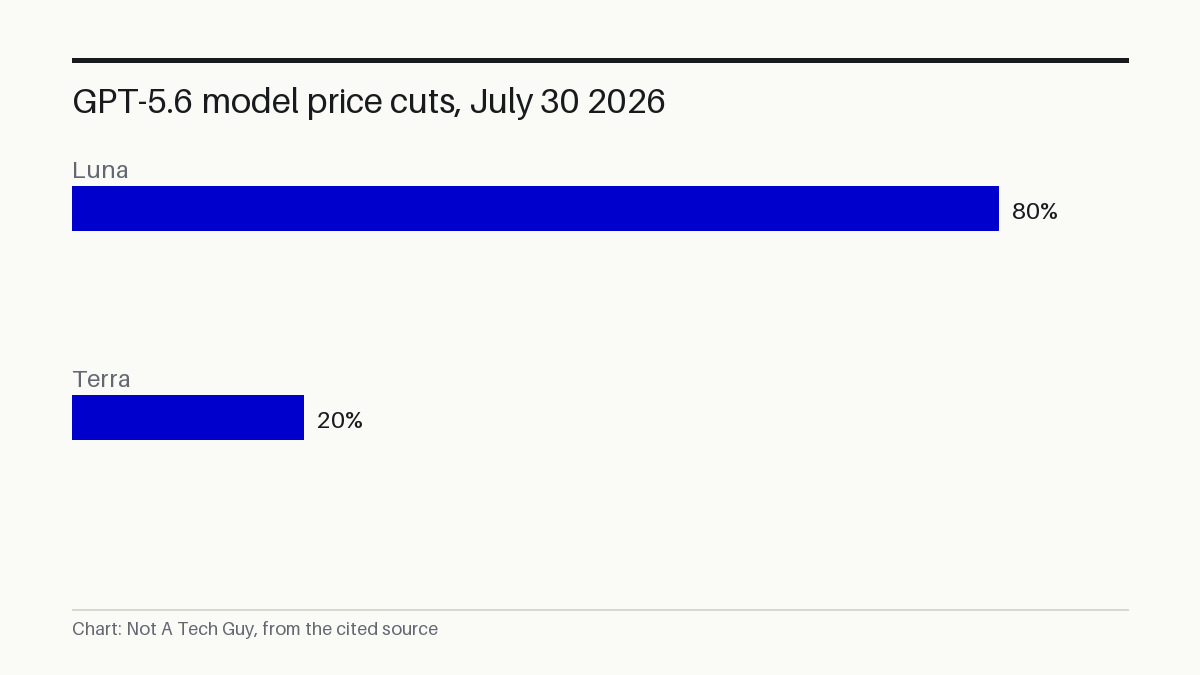
GPT-5.6 Sol is OpenAI's flagship model, previewed on June 26 as part of a three-model series P². Sol is the top tier; Terra is the balanced everyday model; Luna is the fast, affordable option P². The full GPT-5.6 launch came July 9 P⁴, and OpenAI cut prices on July 30: Luna down 80%, Terra down 20% P⁴. Sol's price was not mentioned in that update.
GPT-5.6 launched on July 9 with the Sol, Terra and Luna trio P⁴. The Model ML announcement on August 10 S¹ is the first specific vertical application of Sol that OpenAI has detailed since the launch.
What to do about it
If you run a finance team at a mid-tier advisory firm, here is what this changes in practice. Your analysts currently spend hours after the analysis is done: building the deck and formatting the Excel model, then checking that every number in the PowerPoint matches the spreadsheet. Model ML's pitch is that GPT-5.6 Sol handles that last mile. Research goes in, editable Office files come out S¹.
The practical question is whether "traceable" means what auditors need it to mean. Before trusting any AI-generated deck in a client deliverable, check whether each figure in the output links to an identifiable source cell or document. If it does, the compliance team can sign off. If "traceable" just means the model remembers what it wrote, that is not enough.
One thing you can do this week: read the GPT-5.6 Sol API documentation at developers.openai.com P⁵ and check whether the response format supports structured file output. If it does, the pipeline is buildable. If it does not, Model ML is doing something custom on top of the API, and you are dependent on OpenAI's product roadmap rather than your own.
What we don't know yet
The announcement raises more questions than it answers. OpenAI has not published any efficiency metric: no time-saved figure, no cost comparison, no benchmark against a human analyst or a previous model S¹. There is no information on availability, pricing, or who gets access to Model ML S¹. No third party has independently tested the product. The word "traceable" is undefined in the source.
We also do not know whether Model ML is a standalone product, a ChatGPT feature, or an API-based tool. The distinction matters. A standalone product means OpenAI controls the workflow end to end. An API tool means developers can build their own versions and compete.
The next signal: OpenAI has updated the GPT-5.6 line roughly every two weeks since the June 26 preview. Watch for the next announcement in late August or early September, where Model ML's pricing and access terms should appear. We'll check the efficiency claim against whatever numbers come with it.
If you want these debriefs the moment they land, subscribe to keep reading.
Sources: S1 — Model ML completes finance work more efficiently with GPT-5.6 Sol · P2 — Previewing GPT-5.6 Sol: a next-generation model | OpenAI · P3 — MoonshotAI/Kimi-K2 · P4 — GPT-5.6: Frontier intelligence that scales with your ambition | OpenAI · P5 — GPT-5.6 Sol Model | OpenAI API
More from Not A Tech Guy
- Self-evolving GUI agents improve click accuracy 7.4% after deployment
- AI models lose over 90% of safety signal in African languages
- Ephemeral coin tracing limits surveillance power in crypto
Generated from an audited evidence pack with primary-source research. Social-media items are discussion signals, not verified facts. Nothing here is financial, legal or medical advice.