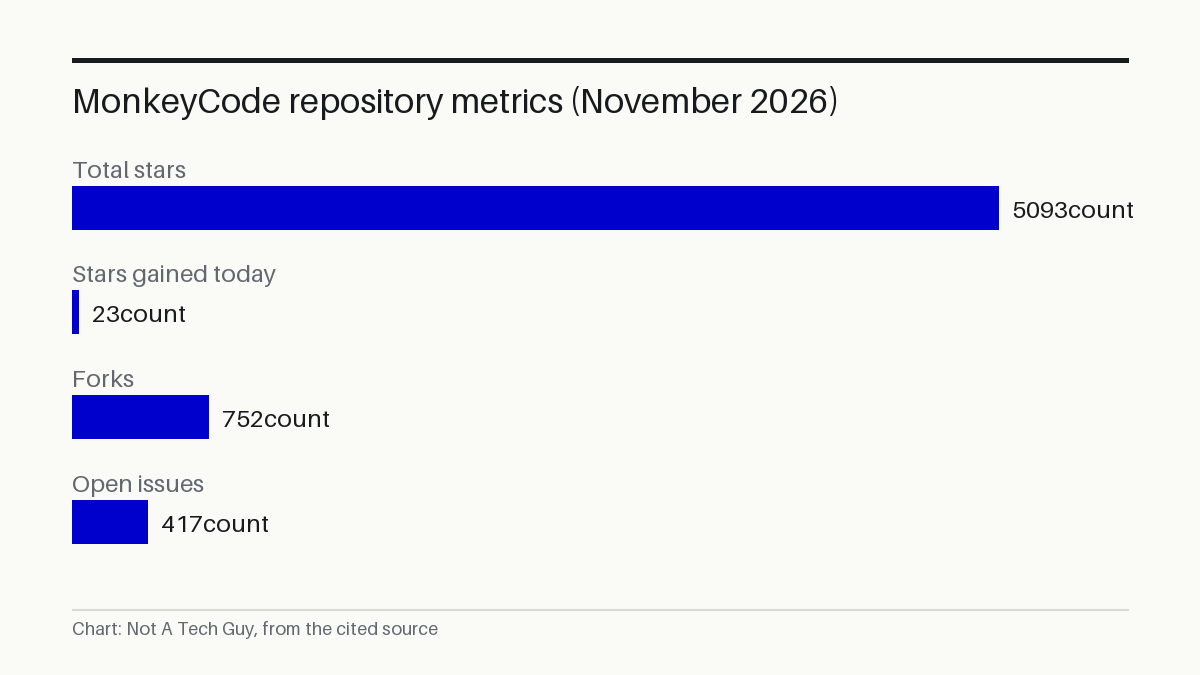

Chaitin pushed its MonkeyCode repository onto GitHub's daily trending list this week, accumulating 5,093 stars as an open-source enterprise AI workbench that accepts typed requests and returns finished work S¹S². The star count is GitHub's own public metric; the capability claims — generating presentations, writing documents, fixing bugs, come solely from the maintainers' README, with no benchmarks, no released test results, and no third-party review to confirm them. The project was created in June 2025 and has since accumulated 752 forks and 417 open issues P⁴.
My read: The feature list is ambitious: slide decks, documents, posters, code fixes, and short videos, all from a single typed sentence. That is broad surface area for one platform, and the evidence pack contains no benchmark, no user count, and no independent review. The number worth watching is the open-issue ratio: 417 open issues against roughly 4,931 stars on the deep-research fetch P⁴ is high for a project that is five months old. Either the community is actively engaged, or users are hitting rough edges fast.
MonkeyCode's stated scope spans office, code, and design tasks
The maintainers describe MonkeyCode, also branded Baizhi Office or MonkeyAI, as a team-oriented, open-source AI office platform P³. The workflow is straightforward: a user types a request in natural language, supplies relevant materials, and the AI is expected to return completed work across three categories P³.
Office tasks cover presentations, documents, spreadsheets, and file organisation. Programming tasks span architecture design, code writing, and bug fixing. Design tasks include posters, graphic design, interaction design, and short video production P³. All of these descriptions are the vendor's own; none have been independently tested.
The enterprise management panel is where the platform attempts to distinguish itself from a single-user chatbot. Administrators can manage AI resources, set access permissions, audit usage, and view team statistics P³. Teams can share large models, knowledge bases, skills, and MCP connectors — the protocol that lets the platform link to external model services and business tools P³. The maintainers state that in private deployments, all team data remains on the user's own server P³; this claim has not been independently verified.
Installer, clients, and demo are publicly available
The project ships with a one-command bash installer P³ and lists a minimum server requirement of 1 CPU core and 1 GB of RAM P³. Desktop clients are available now for Web, Windows x64, macOS in both Apple Silicon and Intel variants, and Linux x64 via AppImage P³. Android, iOS, Linux ARM64, and HarmonyOS clients are listed as coming soon P³.
A public demo is live at demo.work.baizhi.cloud, and the maintainers have published demo admin credentials directly in the README P³. The free tier supports up to 10 seats but excludes cloud computer access, technical support, and advanced built-in content; a paid tier is available by consultation P³.
The licence is GNU AGPL-3.0 P⁴, a strong copyleft licence that requires anyone who modifies and deploys the software over a network to publish their source code. For an enterprise tool, that is a real constraint. A company that builds proprietary extensions on top of MonkeyCode and serves them to employees over an internal network may be obligated to release those modifications.
Chinese-market signals and verification gaps
The signals point to a Chinese market focus. Community support runs through WeChat, and the HarmonyOS client roadmap signals a domestic audience P³. There is no evidence of an Australian presence, no verified user numbers, and no independent review of whether the natural-language-to-finished-product pipeline actually works as described.
A small software team evaluating this today could point the installer at a spare 1-core VM, connect their own model service through an MCP connector, and test one concrete workflow: ask it to produce a project status document from a set of meeting notes. If the output needs heavy manual correction, the direct-delivery promise is not yet real for that team.
The repository's code spans at least a dozen languages including Go, Rust, Python, TypeScript, and Astro P⁴, despite GitHub's trending page categorising it as TypeScript S². The next checkpoint is whether the Android and iOS clients ship on the promised timeline, which would signal whether the project can execute beyond its initial desktop release.
Sources: S1 — chaitin/MonkeyCode: 企业级 AI 办公工作台 · S2 — chaitin/MonkeyCode: 企业级 AI 办公工作台 · P3 — README.md · P4 — chaitin/MonkeyCode · P5 — readme.cn.md · P6 — huggingface/transformers
Written from 6 sourced items, 4 of them primary.