
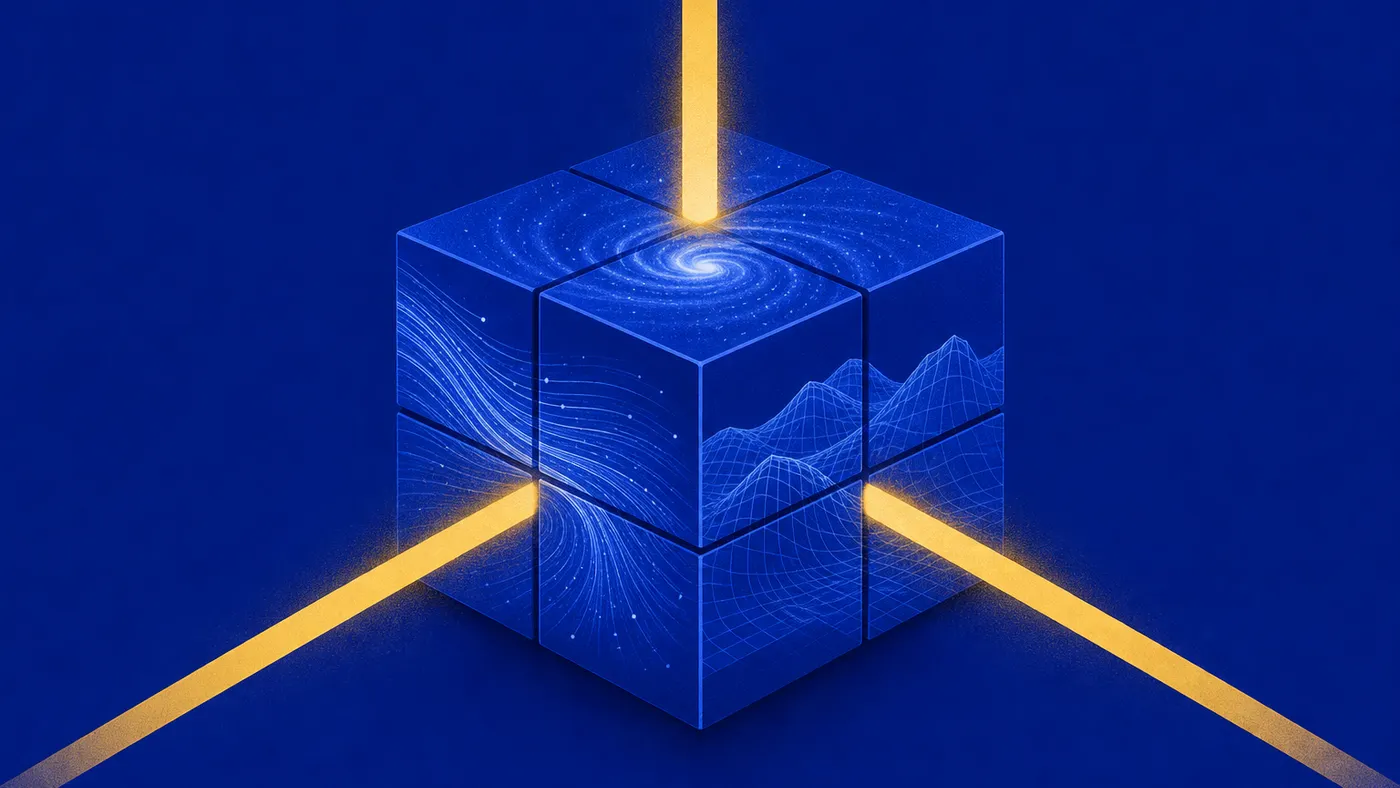
NVIDIA's August 6 blog post contends that the next phase of AI development will be defined by those who can simulate and predict the physical world, moving past purely text-based generation S¹. The vehicle is Cosmos 3, an open-weights model that integrates three capabilities, visual reasoning, world generation and action prediction, within one architecture S¹. If NVIDIA is right, the company selling the chips is also giving away the software that makes them indispensable, and the question is whether any of it actually works as advertised.
My read: This is a platform play dressed as an open-weights announcement. NVIDIA is arguing that physical AI, the systems that move through the real world, needs a fundamentally different kind of model. The open-weights framing is strategic: it positions NVIDIA as the ecosystem builder, a broader role than hardware vendor. What I am skeptical about is the "leading benchmark results" claim, which appears in the blog without a single named score or third-party validation S¹. The OpenMDW 1.1 licence is also worth scrutinising. It allows teams to fine-tune using their own datasets and infrastructure, which is genuinely useful, but it is an open-weights licence, not an OSI-approved open-source licence. Those are different promises, and teams with strict procurement rules will notice.
Why physical AI breaks the text-model playbook
A language model that invents a wrong fact is embarrassing. A robot that invents a wrong action is dangerous. Physical AI must grasp causality and anticipate outcomes, not just spot correlations S¹. That distinction drives everything about how Cosmos 3 is built and why NVIDIA thinks the market needs it.
The data problem is the other half. Building a robot or autonomous driving system demands training data showing how the physical world actually behaves, including unusual situations and edge cases that are costly or hazardous to recreate S¹. A world model captures the dynamics of physical environments, anticipating likely future states and identifying which actions are appropriate given the current situation S¹. It can produce training data anchored in physical reality and project future scenarios, giving developers a foundation they can adapt for a particular robot, vehicle or vision application S¹.
The concept of world models has been heavily debated in AI research, and NVIDIA is now trying to turn that academic discussion into a product category.
What the mixture-of-transformers architecture does
Cosmos 3 is built on what NVIDIA calls a mixture-of-transformers architecture S¹ P². Rather than one network doing everything, the model combines specialised components for three jobs: understanding what it sees, predicting what happens next, and deciding what to do about it S¹.
For a robotics team, that means one model can look at a cluttered warehouse shelf, predict how objects might shift if a gripper approaches from a certain angle, and suggest the action most likely to succeed. For an autonomous vehicle team, the same model can generate synthetic scenarios that would be dangerous to stage on a test track: a pedestrian stepping out from behind a truck in heavy rain S¹.
The model is available under the Linux Foundation's OpenMDW 1.1 licence, which allows teams to obtain the weights, adapt them with proprietary data, and deploy on their own infrastructure S¹. That matters because a general model has not seen a team's particular robot, sensors or operating environment. Closing that gap requires access to the weights and a licence that allows adaptation S¹.
The open-weights argument NVIDIA is making
In July, NVIDIA joined more than 200 companies in signing an open letter titled "Open Weights and American AI Leadership" S¹. The letter makes the case that AI leadership will depend less on any one frontier model and more on whether an open ecosystem spreads across every industry S¹.
This is not altruism. NVIDIA sells the GPUs that run these models. If open-weights physical AI becomes the standard, every team that downloads Cosmos 3 and fine-tunes it on their own infrastructure is also a candidate customer for more NVIDIA hardware. The Omniverse libraries, which are part of the NVIDIA Agent Toolkit, supply ready-made tools for constructing simulation-ready environments S¹ P⁴. OpenUSD, an open standard for assembling and sharing 3D data, connects the simulation components S¹. The more teams build on this stack, the deeper the hardware lock-in.
What to do about it
A small robotics startup building a pick-and-place arm for warehouse logistics faces exactly the data problem Cosmos 3 is designed to solve. Real-world training data is slow to collect, expensive to label, and thin on the edge cases that actually cause failures: a glass bottle sliding off a conveyor at an odd angle, a box arriving crushed and misshapen. With an open-weights world model, that team could generate thousands of synthetic variations of those scenarios, test their grasping policy against them in simulation, and only then deploy on the real arm. The licence permits it, and the architecture is built for it.
The practical step this week: download the Cosmos model weights from NVIDIA's repository and check the OpenMDW 1.1 licence terms against your company's legal requirements. Then run a single synthetic-data generation test on a scenario your team has struggled to reproduce in the real world. If the output is physically plausible, the workflow is worth investing in. If it is not, the benchmark claim needs more scrutiny than the blog provides.
What we don't know yet
The blog asserts "leading benchmark results" and "adoption across robotics, autonomous vehicles and vision AI" without naming a single benchmark, a single customer or a deployment metric S¹. The source is NVIDIA's own marketing, so every capability claim carries that bias. The OpenMDW 1.1 licence is an open-weights licence, not an OSI-approved open-source licence, and the distinction matters for teams with strict procurement rules.
What remains unclear is how Cosmos 3 compares on specific physical reasoning benchmarks against closed alternatives, or whether the mixture-of-transformers architecture actually produces better action predictions than running separate models for perception, prediction and planning. The architecture is novel, but novelty is not the same as proof.
The next signal: NVIDIA's next quarterly earnings release, which should show whether Cosmos and Omniverse appear in revenue breakdowns or go unmentioned. The adoption claims can be checked against whatever customer names and deployment numbers appear in that report. If you want to see whether the marketing survives contact with reality, subscribe to catch the follow-up.
Sources: S1 — Into the Omniverse: How Open World Models Push the Frontier of Physica · P2 — NVIDIA Launches Cosmos 3, the Open Frontier Foundation Model for Physi · P3 — Definition.md at main · Open-Weights/Definition · P4 — Develop Physical AI Applications | NVIDIA Omniverse · P5 — microsoft/Samba
More from Not A Tech Guy
- Voice input degrades LLM agents more than typing, study finds
- LLM interpreter explains outputs with no extra API calls
- Agentic AI bottleneck is the CPU, not GPU, study finds
Generated from an audited evidence pack with primary-source research. Social-media items are discussion signals, not verified facts. Nothing here is financial, legal or medical advice.