NVIDIA has joined the U.S. National Science Foundation's State and Regional AI Infrastructure Hubs program, an effort that launched on August 4 to expand AI computing, data and expertise across American universities S¹. The program builds on an earlier NSF pilot that gave researchers access to NVIDIA's hardware. The question now is whether a model proven at one Florida campus can scale to every region in the country.
My read: This is the third move I've seen from NVIDIA in the academic infrastructure space, and it's the one that most clearly signals where the company thinks the bottleneck actually sits. The first was the 2020 University of Florida partnership. The second was the NAIRR pilot. Both were about compute access. This program adds curriculum, credentials and workforce training, which tells me NVIDIA has concluded that shipping GPUs to campuses is necessary but nowhere near sufficient. The UF numbers are striking on paper, but they come entirely from NVIDIA's own promotional materials, and I would want independent verification before treating them as a proven model rather than a marketing case study.
The Florida experiment that became the template
In 2020, NVIDIA, its co-founder Chris Malachowsky, and the University of Florida formed a public-private partnership S¹. NVIDIA describes it as turning UF into the country's first true AI university and extending AI compute access to every public university in Florida S¹.
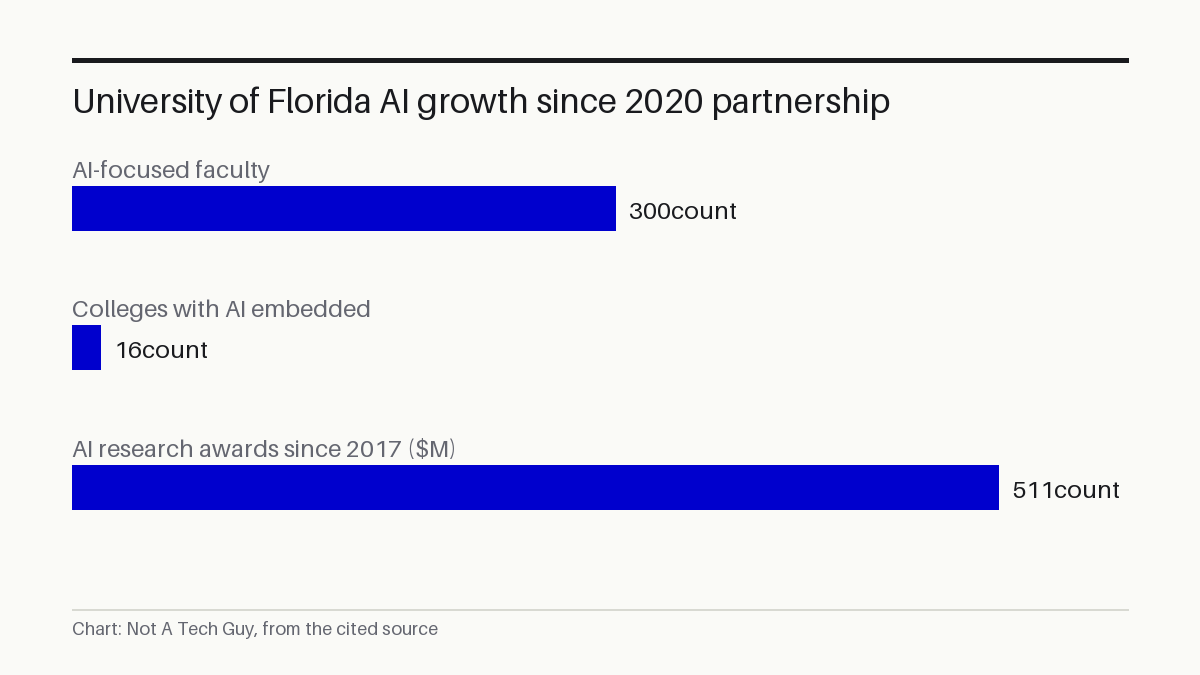
The reported results, all from NVIDIA's own account: UF now has more than 300 AI-focused faculty, AI education embedded across all 16 of its colleges, and more than $511 million in AI research awards since 2017 S¹. NVIDIA calls the initiative a national model S¹.
From one campus to a national program
The new State and Regional AI Infrastructure Hubs program takes that model and attempts to multiply it S¹. The program will support state and multistate groups of colleges and universities working together, in partnership with private industry, philanthropic organisations and state and local governments S¹.
The hubs will let institutions share AI computing resources, accelerate scientific discovery, and prepare students for the AI economy S¹. Consortia can use on-premises infrastructure, cloud computing, or a mix, designed around their regional needs and economic priorities S¹.
The announcement builds on the NSF-led National Artificial Intelligence Research Resource (NAIRR) pilot, where NVIDIA is a leading contributor S¹. The NAIRR pilot gave researchers access to computing resources from industry partners. The hubs program extends that idea from individual research projects to entire regional ecosystems. NVIDIA and the NSF have also partnered separately on developing multimodal AI models for scientific research P⁵, so this is a relationship with more than one thread.
Why hardware alone won't fix it
NVIDIA states plainly that AI infrastructure alone is not enough S¹. A successful national AI strategy must include workforce development, building people who can use advanced computing and AI tools in real scientific and industry settings S¹.
The program envisions universities, community colleges and regional partners creating degree programs, short-form certificates and stackable credentials that move learners from basic AI literacy into applied skills S¹. The target fields read like a list of where the US feels competitive pressure: physical AI and automation, healthcare, energy, agriculture, manufacturing, quantum computing and cybersecurity S¹.
What to do about it
For a mid-tier research university outside the usual tech corridors, this program changes the calculus on building an AI research capability. A materials science lab at a regional university in Nebraska that currently has no GPU cluster could join a consortium, access shared compute through the hub, and send graduate students through stackable credential programs without building a data centre from scratch.
For community colleges, the credential pathway is the most concrete opportunity. A welding instructor at a technical college could build a short-form certificate in AI-assisted manufacturing that counts toward a degree at a partner university, creating a pipeline from the shop floor to applied AI research.
The practical step this week: check whether your institution's research office or state higher education coordinating board has signalled interest in forming or joining a consortium. The NSF has not yet named specific states or regions that have joined, so the window to shape a consortium's design is still open.
What we don't know yet
The evidence pack has no funding figure for the program. The NSF has not disclosed a budget, and NVIDIA has not specified what products, hardware or software it will contribute to the hubs S¹.
No specific states, regions or consortia have been named as participants yet S¹. The UF statistics, including the $511 million figure and 300-faculty count, come from NVIDIA's promotional materials and have not been independently verified in the sources available S¹.
The program is described as consistent with the aims of the Genesis Mission, but what the Genesis Mission actually entails is not explained in the available sources S¹.
The next signal: the NSF typically publishes detailed program solicitations within weeks of an initial announcement. Watch for the official solicitation, which should name funding levels, application deadlines and eligibility criteria. We'll check the claim that this scales the UF model against whatever participation numbers the first round produces.
Sources: S1 — NVIDIA Joins NSF State and Regional AI Hubs Program to Expand AI Resea · S2 — NVIDIA Joins NSF State and Regional AI Hubs Program to Expand AI Resea · S3 — NVIDIA Joins NSF State and Regional AI Hubs Program to Expand AI Resea · P4 — NVIDIA and Partners Build in America, for America | NVIDIA Blog · P5 — NVIDIA, National Science Foundation Support Ai2 Development of Open AI · P6 — GENIA-Americas/multimodal-ai-americas · P7 — NEUIR/ExpandR
Related reading
- OpenAI research: ChatGPT users take on tasks across roles — our technology desk, 2026-07-27
- OpenAI field report: AI agents accelerate genomics research — our technology desk, 2026-07-28
- TrustX ARC rates AI agent risk across 12 dimensions — our technology desk, 2026-07-13
Generated from an audited evidence pack with primary-source research. Social-media items are discussion signals, not verified facts. Nothing here is financial, legal or medical advice.