
NVIDIA released four open-weight checkpoints for its Cosmos 3 model family on November 5, each carrying 16 billion trainable parameters, built to generate interactive driving and robotics simulations S¹. The release puts a commercial-use license on models that can synthesize synchronized video across up to 11 camera views, including fisheyes, a capability that has until now lived mostly inside closed proprietary systems S¹P³.
My read: The open-weight angle is the real story, not the parameter count. 16B is modest by 2026 standards. What matters is that NVIDIA is handing out a post-training recipe under terms that permit commercial use, which could let a mid-size autonomous-vehicle team build custom synthetic data pipelines without licensing a closed simulator. I am skeptical of the word "photorealistic," which appears in the blog but carries no independent benchmark behind it — NVIDIA has not released evaluation code or error bars for these claims, and that descriptor is the vendor's own characterization S¹. The number I would watch is how many teams successfully post-train Transfer-Auto on their own camera rigs, because that is the step where the recipe either proves out or stalls.
The four checkpoints, all post-trained from the Cosmos 3 Nano base, split into two families: offline generation and real-time streaming S¹. Cosmos3-Nano-Transfer-Auto is the offline workhorse, a bidirectional model for batch synthetic driving data S¹. It produces matched multi-view camera footage and LiDAR point clouds, letting developers set per-camera World Scenario Map parameters to define road layout and traffic behavior, while using text prompts to steer the look of each scene S¹. Users can shift weather and lighting, and supply optional starting RGB frames to pin down a scene's starting appearance S¹.
Streaming variant trades offline batches for frame-by-frame control
Cosmos3-Nano-Sim-Auto is the causally distilled streaming variant of Transfer-Auto, generating successive small chunks of synchronized camera video and LiDAR in a few denoising steps rather than producing a full sequence offline S¹. According to NVIDIA's Cosmos Lab page, the aim is interactive worlds that react to user input and stream in real time P⁴. The distinction matters: Transfer-Auto is for generating training data in batches, while Sim-Auto is for running a live simulation loop where each frame depends on the last.
The other two checkpoints step outside driving. Cosmos3-Nano-Sim-Transfer takes a physics simulator's controls and a text prompt and turns them into generated video observations S¹. Cosmos3-Nano-Sim-Bimanual predicts video from robot or camera actions, aimed at manipulation tasks where a robot needs to foresee the visual consequences of its own movements S¹.
NVIDIA's technical blog, authored by Pranjali Joshi, Aditya Mahajan, and colleagues at NVIDIA and dated November 2, frames the platform as serving physical AI across autonomous vehicles, robotics, and smart infrastructure P². All four models ship under the OpenMDW1.1 license, which NVIDIA says permits both commercial and non-commercial use S¹. The full license text is not reproduced in the release, so teams considering production deployment should read the actual terms before relying on that summary.
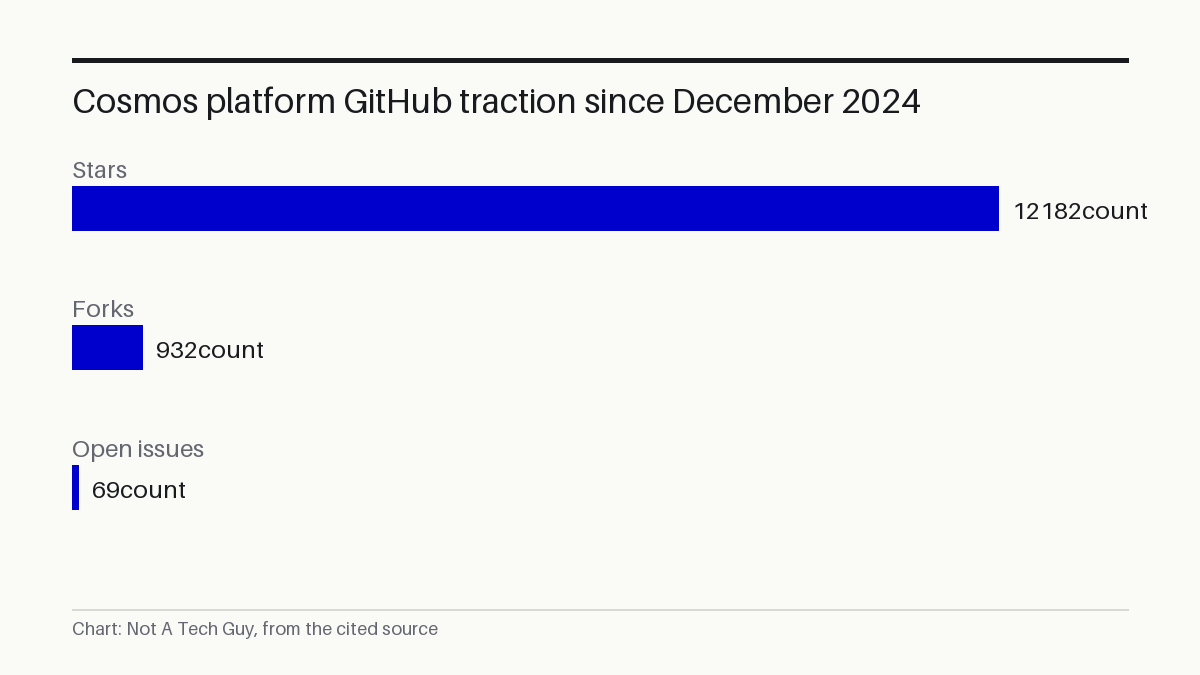
The GitHub repository for the broader Cosmos platform, created in December 2024, currently holds 12,182 stars and 69 open issues P⁵.
This lands in a competitive stretch for world models. Google DeepMind announced its Genie 4 world model on October 27, and the broader push to put frontier models on shared cloud infrastructure signals that the major labs are racing to own the simulation layer. NVIDIA's bet is different: give away the weights, let developers post-train on their own sensor data, and sell the GPUs that run the inference.
No one outside NVIDIA has independently measured the visual quality of these checkpoints, and the blog is partnership content hosted on Hugging Face, which may present capabilities uncritically S¹.
For an autonomous-vehicle team evaluating this release, the practical first step is to pull Transfer-Auto from Hugging Face, feed it a small set of your own multi-camera driving logs, and check whether the generated LiDAR point clouds align with your real sensor geometry. For a synthetic-data engineer at an AV company, the workflow shifts from negotiating a closed-simulator license to downloading weights, writing a post-training script, and running inference on NVIDIA GPUs they may already own. If the post-trained model cannot reproduce your camera layout's parallax, the streaming variants built on the same recipe will inherit the same gap.
Sources: S1 — New NVIDIA Cosmos 3 Open Models for Interactive World Simulation · P2 — Build World Models for Interactive Simulation with NVIDIA Cosmos | NVI · P3 — nvidia/Cosmos3-Nano-Transfer-Auto · Hugging Face · P4 — Interactive World Simulation with Cosmos for Physical AI — Cosmos Lab · P5 — NVIDIA/cosmos
Written from 5 sourced items, 5 of them primary.