
OpenAI released LifeVal on November 2, 2026, a benchmark intended to measure how well AI assists the billion-plus people using ChatGPT each week with routine tasks S¹P³. The announcement page includes no methodology, no scores, and no sign the benchmark is publicly available for anyone outside OpenAI to run P³. OpenAI has not released error bars, scoring code, or any independently verifiable result P³.
My read: What gives me pause is that OpenAI defines the tasks, runs the test, and decides what "good" looks like. Until LifeVal's methodology is public and a third party can reproduce the scores on models OpenAI doesn't sell, this is a marketing instrument with benchmark formatting. The detail I would watch is the task list: three examples — childcare, finances and paperwork, is a narrow frame for "everyday life." How broad the actual benchmark turns out to be will tell us whether it measures anything real.
LifeVal targets three high-stakes everyday domains
The LifeVal page, dated November 2, 2026, ties the benchmark to OpenAI's stated goal of creating AGI that serves humanity broadly P³. It points to the more than one billion weekly ChatGPT users as the population whose practical challenges the benchmark is meant to capture P³.
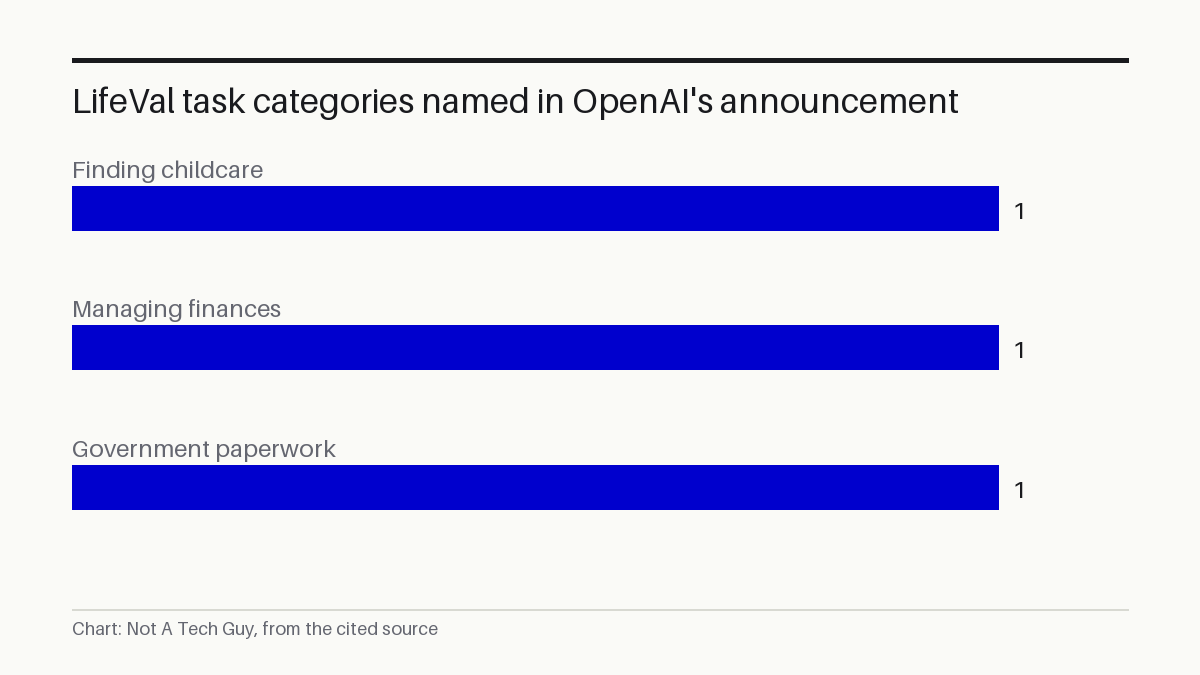
The three task categories named are concrete: locating childcare, handling personal money matters, and filling out government forms S¹. These are domains where wrong answers carry real costs — a mislisted subsidy eligibility, a miscalculated tax threshold, a missed enrolment deadline.
Beyond those three examples and the framing language, the page provides no technical detail. There is no description of how tasks are constructed, how responses are scored, how many tasks exist, or which models have been evaluated.
No scores, no methodology, no outside access
No results have been published. No model scores appear on the page, and there is no indication of whether LifeVal has been run against GPT models, competing systems, or both P³.
The benchmark's availability is unclear. The page does not state whether LifeVal is open-sourced, accessible via API, or restricted to internal use at OpenAI. Without public access, no outside researcher can verify any score OpenAI later reports.
No peer review is mentioned. The announcement is a product page, not a research paper, and no academic preprint accompanies it.
Consumer-assistant teams would need verifiable scoring
A team building a consumer-facing AI assistant for tasks like form-filling or applying for benefits would be the natural audience for a benchmark like this. If LifeVal becomes publicly available, the first thing to check is whether the task set extends beyond the three named categories and whether the scoring rubric rewards correctness over fluency. A benchmark that measures how confidently a model completes a government form, rather than whether the form is actually accepted, would tell a very different story.
For a product manager at a fintech startup integrating ChatGPT into a budgeting tool, LifeVal's existence changes nothing on their desk today: without released task data or a scoring rubric, they cannot run it against their own system or compare it to any alternative benchmark.
OpenAI has not announced a date for releasing LifeVal's methodology, task data, or initial results.
Sources: S1 — LifeVal · P2 — OpenAI 研究 | 刊物 | OpenAI · P3 — LifeVal | OpenAI
Written from 3 sourced items, 3 of them primary.