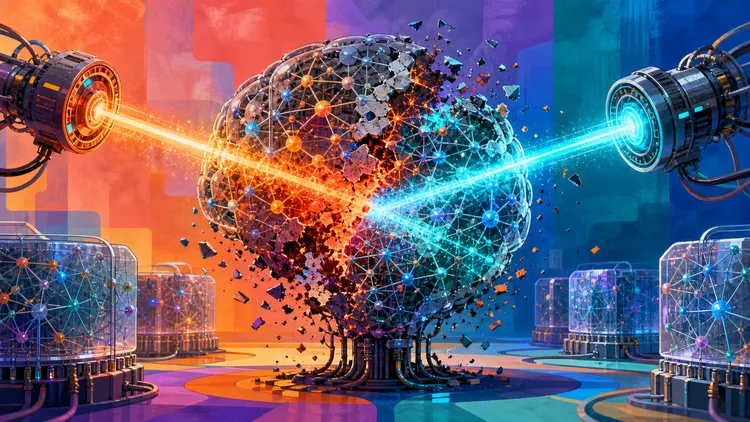

New EvoPolicyGym benchmark forces AI agents to improve policies under a tight feedback budget
Researchers measure whether agents can iteratively edit executable policies, with trajectory diagnostics replacing single final scores.

The top 0.01% of AI knowledge, and what it changes for your work
Researchers measure whether agents can iteratively edit executable policies, with trajectory diagnostics replacing single final scores.

Free briefing · the top 0.01% of AI knowledge
A practical briefing for business owners and professionals: what changed, where it could help, and what to check before you use it. Read a sample issue.
Telcos must now publish comparable 4G and 5G coverage maps, but broad geographical claims still sit outside the rules.
A new ICLR 2026 poster finds Masked Image Modeling outperforms contrastive learning when training AI across heterogeneous devices. Here's what changes.
Researchers have distilled 457 papers into the first unified map of the human, tech and organisational factors that make or break a breach response.
New CNeVA framework dials per-channel behaviour in traffic sims — no frozen cars, no reward hacking.
Old-school engineering constraints let a tiny AI reviewer catch nine in ten backdoors, using fewer tokens than agentic scaffolding.
Researchers can spot stripped safety layers in open-weight AI with 95% accuracy, but the fix has limits.
AgentFlow proposes framework-agnostic dependency graphs for auditing agent code, though its 238 flagged risks and superiority claims remain unverified by peer review.
The 0.8B-parameter constitutional classifier reportedly outperforms 27B rivals on seven benchmarks, though the paper awaits peer review