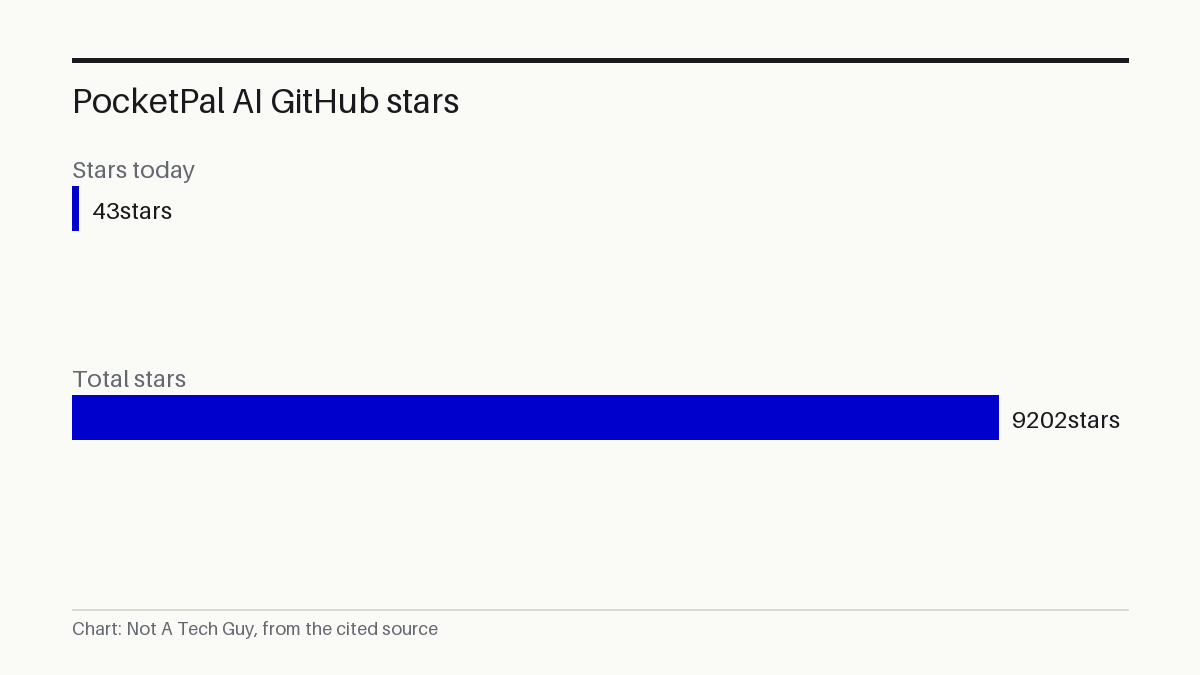

PocketPal AI's maintainers shipped version 1.23.0 on 10 November, landing the open-source project on GitHub's daily trending list with 9,202 stars and 43 new ones that day alone S¹P⁴. According to the project's README, the app executes Gemma, Qwen, Phi and Llama models locally on the handset, requiring neither an account nor a network connection for basic operation S¹. That positioning runs counter to the broader industry's two-year push toward remote inference in data centres. No independent test has confirmed that zero network traffic occurs during offline use; the claim rests solely on the maintainers' own documentation S¹.
My read: The privacy pitch is the whole story here, and it is entirely self-reported. The maintainers say chats stay on device unless you turn on an online feature, but no third party has audited that claim, no error bars accompany any performance assertion, and no external code review is cited. What I would watch is whether the hardware acceleration actually holds up on mid-range Android handsets, where the README itself qualifies NPU and GPU support with "on supported devices" and "graceful fallback" S¹. The star count tells you the developer community is curious, not that the app works well on a three-year-old phone.
v1.23.0 ships maintenance fixes, not new features
The release, published by the project's automated build system on 10 November, fixes two bugs: an iOS issue where the chat input box stayed enlarged after sending a multi-line message, and a problem where downloading a text-only model preset skipped vision capabilities P⁴. These are maintenance fixes, not new features, which suggests the project has reached a level of maturity where the team is polishing rather than rebuilding.
The feature set, as described by the maintainers, is already broad. The app connects to Hugging Face Hub for browsing and fetching GGUF model files, handling gated models that need an access token S¹. Speech recognition runs locally through whisper.cpp, and the app provides neural text-to-speech options branded Kokoro, Kitten, Supertonic and Phonon where the hardware supports them S¹. Users get a calculator, date and time utilities, HTML rendering, and optional web search and page reading S¹.
The project is MIT-licensed, free and open source S¹. Store builds offer an optional one-time PocketPal Plus purchase for hands-free voice conversation, while source-compiled builds include all Plus features without charge, the maintainers say S¹. The README states there is no subscription, recurring payment or advertising S¹.
Three acceleration paths keep inference on the phone
PocketPal AI runs GGUF files, a compressed model format designed for CPU and GPU inference on consumer hardware. The app supports three acceleration paths: CPU as the baseline, GPU through Metal on iOS or OpenCL and Adreno on Android, and NPU through Qualcomm's Hexagon chip S¹. If a phone lacks the hardware for a given path, the app falls back to a slower but functional mode. No third-party benchmarks have been published; all performance characteristics come from the maintainers' documentation S¹.
The privacy model is straightforward in principle. Every prompt, response and document stays on the device unless the user enables an online feature such as web search, a remote server or a system voice S¹. Network traffic for model downloads, the PalsHub community store, purchases, device compatibility checks, an opt-in benchmark leaderboard and feedback submissions never includes user chats, the maintainers state S¹. No security audit has been published, no released code has been independently reviewed, and every assertion rests on the project's own README and release notes S¹.
Hardware is catching up to the models, but the gap between a flagship device and a budget phone remains wide.
Field technicians and lawyers are the natural first audience
A field technician who needs to query a technical manual in a basement with no signal, or a lawyer who wants to draft a confidential summary on a train without routing client material through a third-party server, are the kinds of users this targets. The app is available in 16 languages on phones and tablets, including full iPad support S¹. A community marketplace called PalsHub lets users discover and install preconfigured assistant personas, including premium ones sold via in-app purchase S¹.
For an IT manager evaluating offline AI across a fleet of field-service tablets, the immediate change on their desk is testing tokens-per-second on the cheapest device in the fleet before approving a rollout — the benchmarking tool built into the app since v1.6.2 gives that number directly P⁵.
The practical first step for anyone evaluating this: download a small GGUF model like Qwen 2.5 1.5B from Hugging Face through the app's built-in search, run a few prompts offline, and measure how long responses take on your specific handset. If generation is slower than you can read, the larger models will only be worse.
The project's discussions page shows active maintenance, with the latest announcement pinned for version 1.17.2 from August 2026 P².
Sources: S1 — a-ghorbani/pocketpal-ai: An app that brings language models directly t · P2 — a-ghorbani/pocketpal-ai Announcements · Discussions · GitHub · P3 — 🚀 PocketPal AI v1.5 Release: Hugging Face Model Hub Integration 🤖 · a- · P4 — Releases · a-ghorbani/pocketpal-ai · GitHub · P5 — Release Announcement: PocketPal AI 1.6.2 – Now with Benchmarking! · a-
Written from 5 sourced items, 4 of them primary.