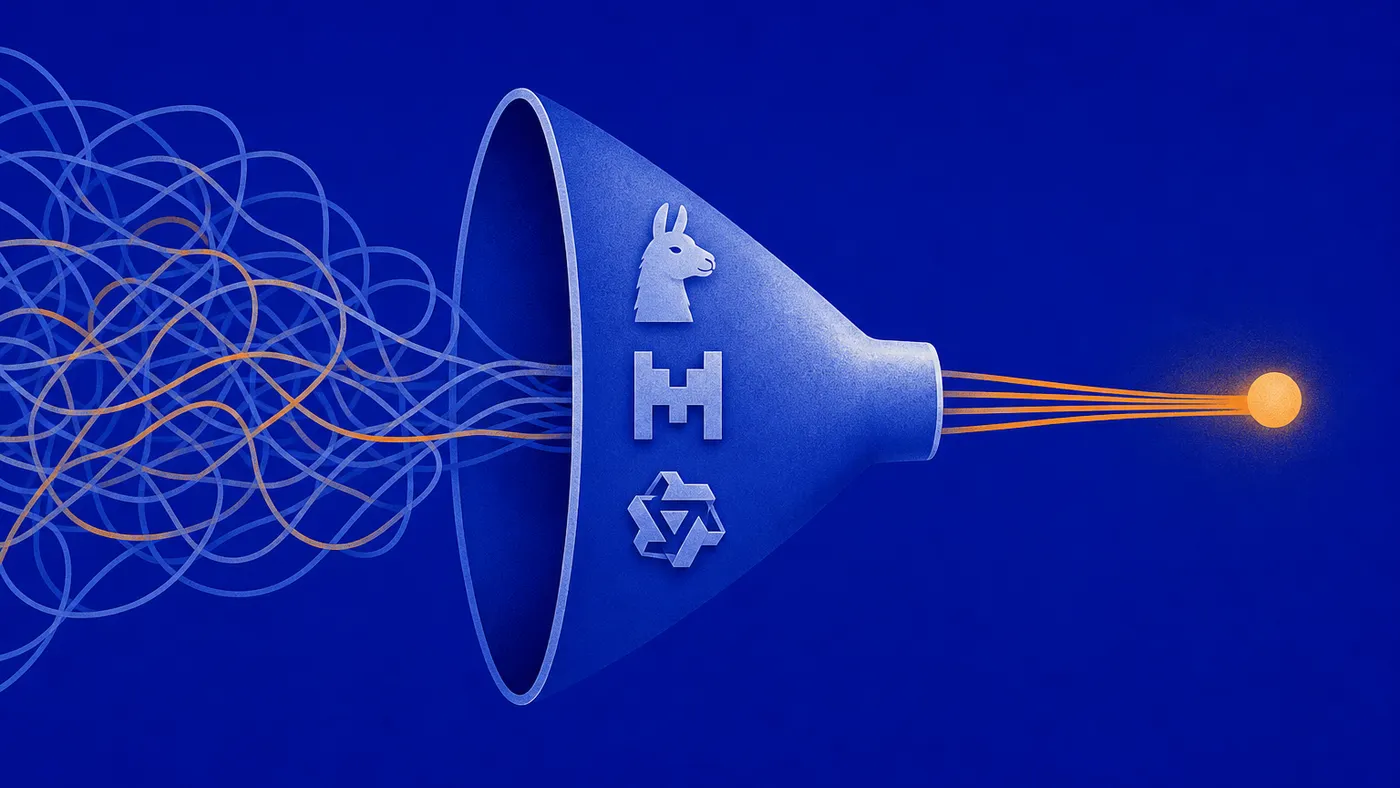
An arXiv preprint authored by researchers at Edith Cowan University in Perth explores how VectorRAG and GraphRAG can prevent small businesses' AI systems from making up facts, evaluating these methods on LLaMA, Mistral, and Qwen models S¹. The consequences are tangible: if a chatbot at a 15-person accounting firm invents a tax regulation, that fabricated information could be acted upon by a client S¹. Whether either approach genuinely functions in a real-world office environment remains an open question in the paper.
My read: This is the first SME-focused RAG study I've seen that tests only open-weight models, no GPT-4, no Claude. That choice tells me the authors are thinking about cost and data sovereignty, the two things small businesses actually care about. But I don't buy the "significant improvement" claim yet, because the abstract provides zero numbers. No accuracy percentages, no hallucination rates, no benchmark scores. Until the full paper surfaces those figures, this is a promising direction, not a proven one.
Why small business is the hard case for AI
Small and medium-sized businesses are increasingly turning to large language models for decision support and answering queries S¹. The appeal is straightforward: a 20-person company gains a tool that can summarize documents, draft emails for clients, and handle policy questions without needing to employ a data scientist.
Hallucination remains the core issue. When an AI produces incorrect but convincing text, the output turns into misleading information S¹. A large corporation might have a human reviewer to catch such mistakes before they reach a customer. In an SME, however, the individual who created the chatbot is frequently the same person depending on its outputs.
Two ways to ground the model
Retrieval-Augmented Generation (RAG) functions by fetching outside documents prior to generating a response, ensuring the answer is tied to an external source instead of just the model's pre-trained knowledge S¹. The research examines two distinct approaches:
- VectorRAG: the conventional technique, which transforms documents into numerical vectors so the model can find the closest matches to a given query.
- GraphRAG: a more recent strategy that charts the connections between concepts within a knowledge graph, attempting to grasp context that standard vector searches might overlook.
The research does not evaluate these two techniques directly against each other. While the abstract mentions both, it offers no comparative performance metrics S¹.
Open-weight models only
The testing utilizes LLaMA, Mistral, and Qwen S¹. Because all three are open-weight models, their parameters are publicly accessible and capable of being hosted locally. This is significant for an SME: it allows them to retain their data on their own servers and sidestep the per-token API fees associated with closed-source providers.
The drawback is that open-weight models typically trail leading proprietary systems in reasoning benchmarks. The study's value lies in examining if RAG can sufficiently bridge that divide for practical business applications.
The wider RAG current
This research enters a rapidly evolving field. The broader research community is attacking the hallucination problem from multiple angles: CrAM, a separate paper, modifies attention mechanisms inside the model to weigh source credibility P⁴, while the Knowledge_Interplay project tests how LLMs balance their own training knowledge against freshly retrieved context P⁵. LinkedIn's ControlLLM tackles a related problem, enhancing models without catastrophic forgetting P³.
The Edith Cowan paper's contribution is narrowing these techniques to the SME context, where the tolerance for error is lower and the budget for experimentation is smaller.
What to do about it
For a small business already using or considering an LLM, the practical takeaway is to treat any model output as a draft, not a verdict. RAG helps, but it does not eliminate hallucination S¹.
Consider a Perth-based financial advisory with 12 staff. They deploy a Qwen-based chatbot to answer questions about superannuation rules. Without RAG, the model might cite a contribution cap from its training data that changed in the last budget. With VectorRAG, the model pulls the current rule from the firm's own document store before answering. The risk drops, but a poorly indexed or outdated document in the store could still produce a wrong answer.
The one thing to check this week: if you are running any LLM tool in your business, ask the person who set it up what happens when the model doesn't know the answer. If they can't tell you, that's your hallucination risk surface.
What we don't know yet
The abstract reports "significant" improvement but provides no quantitative data S¹. No accuracy percentages, no hallucination rates, no benchmark scores. The full paper may contain these, but the announcement does not.
The evaluation used LLaMA, Mistral, and Qwen, but the abstract does not say which model performed best or whether the results were consistent across all three S¹.
The study is an arXiv preprint, not a peer-reviewed publication S¹. The findings have not undergone independent academic review.
The abstract does not describe the experimental setup in detail. It is unclear whether the tests used synthetic SME scenarios or real business data, and whether actual SME users were involved in evaluating response quality.
The next signal: the full paper at arxiv.org/html/2608.00006 P², which should contain the quantitative results and method details. We'll check the benchmark claims against it when the HTML version is available. If you want that follow-up in your inbox, subscribe and we'll send it the moment it drops.
Sources: S1 — Enhancing LLMs with Context-Specific Knowledge for Mitigating Misinfor · P2 — Enhancing LLMs with Context-Specific Knowledge for Mitigating Misinfor · P3 — linkedin/ControlLLM · P4 — CrAM: Credibility-Aware Attention Modification in LLMs for Combating M · P5 — sitaocheng/Knowledge_Interplay
More from Not A Tech Guy
- Chained RLM architecture restarts LLM reasoning with fresh context
- GPT-5.6 Sol improved, free ChatGPT access expanded
- GPT-5.6 study: max reasoning effort, zero unauthorized tool calls
Generated from an audited evidence pack with primary-source research. Social-media items are discussion signals, not verified facts. Nothing here is financial, legal or medical advice.