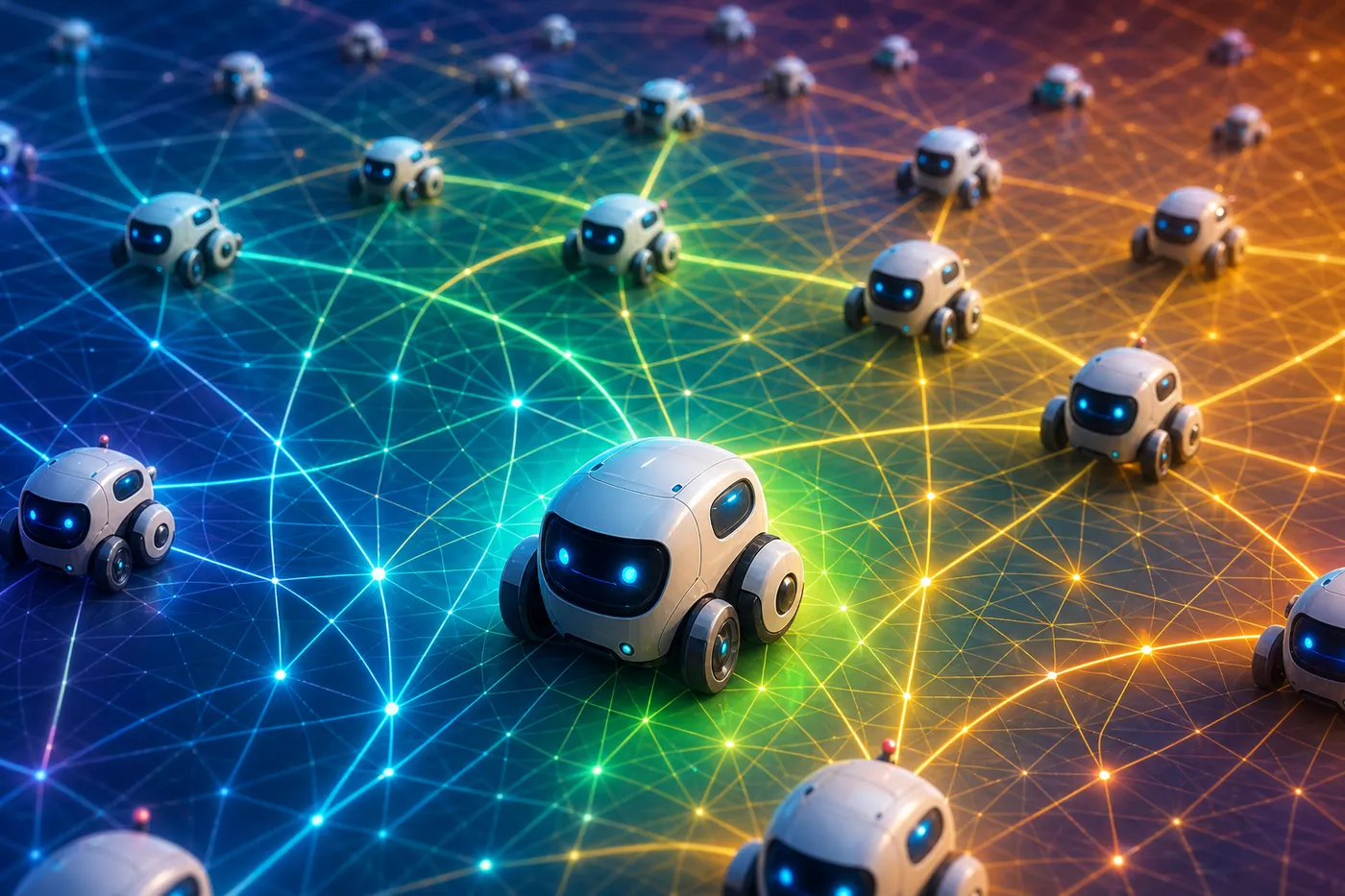
A July 2026 preprint from researchers at Zhejiang University and Westlake University introduces a tool that cracks open the black box of robot swarm AI, revealing that agents trained with simple rewards implicitly learn the geometric structure of their environment and use it to coordinate [S1][P2]. Nobody told them to. The finding raises a question that matters for anyone building multi-agent systems: if the robots are inventing strategies their designers never specified, who actually controls what happens next?
The black box problem in swarm AI
Multi-agent reinforcement learning, or MARL, trains groups of agents to cooperate or compete by rewarding behaviours that score well on a task [S1]. The approach works. The problem is that the neural networks driving each agent's decisions are opaque. The authors note that this black-box nature complicates strategic analysis [S1]. You can see what the swarm does. You cannot easily see why.
That gap matters because swarms are moving from simulation toward real deployment in logistics, search-and-rescue, and environmental monitoring. A swarm that performs well in training but for reasons nobody understands is a swarm nobody can trust at scale.
What the Agent Response Map does
The paper proposes a two-stage explanatory framework called EEC, paired with a new analytical tool called the Agent Response Map, or ARM [S1]. ARM maps how each agent responds across the physical space it operates in, revealing decision-making patterns and identifying regions where agents tend to cluster together or stay apart [S1].
Think of it as an X-ray for swarm policy. Instead of reading the neural network's weights, ARM watches where agents choose to move and reconstructs the implicit spatial logic behind those choices.
What ARM found
The researchers tested ARM on two tasks: a cooperative multi-robot shape assembly and a competitive predator-prey pursuit-evasion [S1].
In the cooperative task, ARM showed that robots moved toward the unoccupied interior of a target shape [S1]. As the centre filled up, the target region automatically shifted toward the boundary. The robots were exploring empty space on their own, without any instruction to do so [S1].
In the competitive task, ARM identified the boundary of the predators' Voronoi diagram as the convergence point for prey agents [S1]. A Voronoi diagram partitions space into regions based on distance to the nearest predator. The prey were implicitly learning where the predators' coverage was weakest and gathering there.
The common thread: in both tasks, the agents learned the geometric fields of their environment and used those structures as targets for coordinated movement [S1]. The reward functions did not include explicit aggregation incentives. The swarming behaviour emerged anyway.
What it means
The core finding is that complex collective behaviour can surface from simple rewards without anyone building aggregation into the system [S1]. The agents figure out spatial structure on their own and exploit it. ARM gives researchers a way to see that hidden logic after the fact.
For the field of explainable reinforcement learning, this matters because it offers a concrete method for reverse-engineering swarm strategies. Instead of guessing why a trained swarm behaves the way it does, researchers can use ARM to trace decisions back to geometric features in the environment. That could make swarm deployments more auditable and failures easier to diagnose.
The paper has been submitted to ICLR 2026 but has not been peer-reviewed [S1][P3]. All findings come from the authors' own framework, with no independent verification yet.
What it means for business
For operators eyeing multi-agent systems in warehouses, agriculture, or drone fleets, the research signals a shift toward explainable swarm behaviour. Today, a logistics firm deploying a fleet of autonomous mobile robots relies on vendor assurances that the system works. Tools like ARM could eventually let an integrator or auditor inspect why a fleet clusters in certain aisles, avoids certain zones, or creates bottlenecks.
A two-person robotics startup building swarm prototypes could use this kind of analysis to debug emergent behaviours before they become field failures. If a simulated swarm starts congregating in an unexpected corner, ARM-style tools could reveal whether the agents have learned a hidden geometric shortcut or whether the reward function has a flaw.
The caveat is timing. ARM is a research tool described in an unreviewed preprint. There is no public code release, no evidence it has been tested on physical robots, and no independent replication [S1]. The path from preprint to deployable diagnostic tool is long.
What we don't know yet
Several questions remain open:
- Whether ARM generalises beyond the two tasks tested. The authors validated it on shape assembly and pursuit-evasion. Real-world swarm applications involve far more complex environments with obstacles, dynamic targets, and human interaction [S1].
- Whether the findings hold on physical robots. The evidence strongly suggests simulation-based validation, but the paper does not confirm hardware experiments [S1].
- Whether the EEC framework and ARM code will be publicly released. The OpenReview page lists the paper as submitted to ICLR 2026, but there is no mention of open-sourcing the tools [P3].
- Whether independent groups can reproduce the results. All findings derive from the authors' own interpretive framework [S1].
The next concrete event to watch is the ICLR 2026 review process. If the paper is accepted, peer review will test whether the framework holds up under scrutiny. If reviewers request hardware validation or additional tasks, that will signal how far ARM still has to go.
If you want to follow what happens when swarm AI stops being a black box, this is the paper to track. Subscribe for the next instalment.
Sources
- [S1] Unveiling Complex Collective Behaviors from Simple Rewards — arXiv preprint (cs.AI, cs.LG) (attributed)
- [P2] Unveiling Complex Collective Behaviors from Simple Rewards — Unveiling Complex Collective Behaviors from Simple Rewards (attributed)
- [P3] Unveiling Complex Collective Behaviors from Simple Rewards | OpenReview — Unveiling Complex Collective Behaviors from Simple Rewards | OpenReview (attributed)
- [P4] Discovering Individual Rewards in Collective Behavior through Inverse Multi-Agent Reinforcement Learning — Discovering Individual Rewards in Collective Behavior through Inverse Multi-Agent Reinforcement Learning (attributed)
- [P5] GitHub - princeton-nlp/SimPO: [NeurIPS 2024] SimPO: Simple Preference Optimization with a Reference-Free Reward · GitHub — GitHub - princeton-nlp/SimPO: [NeurIPS 2024] SimPO: Simple Preference Optimization with a Reference-Free Reward · GitHub (attributed)
More from Not A Tech Guy
- AI agents may train your brain toward frustration, preprint says
- Spectrum can't predict when context helps time-series forecasting
- LLM rubrics for AI grading biased toward high scores
Generated from an audited evidence pack with primary-source research. Social-media items are discussion signals, not verified facts. Nothing here is financial, legal or medical advice.