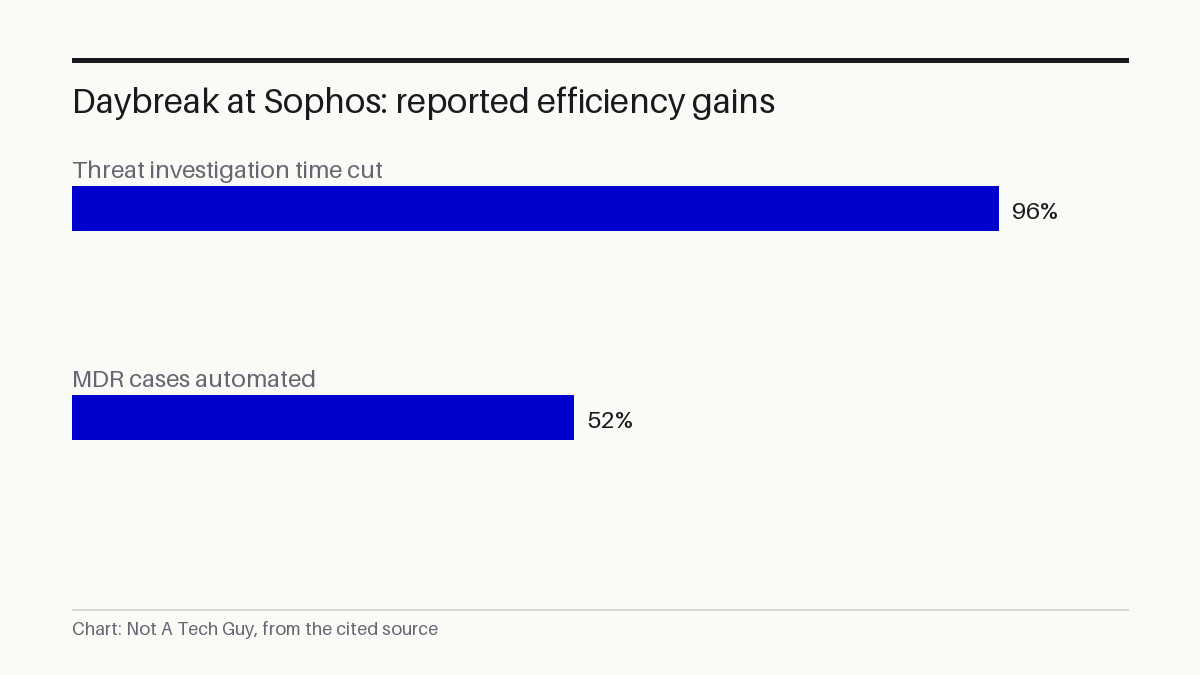

Sophos cut its cyber-threat investigation time by 96% using OpenAI's Daybreak, according to a case study OpenAI published on October 9 S¹. The figure is vendor-reported with no independent audit, no error bars, and no released code; OpenAI disclosed no methodology, baseline, or sample size behind it.
My read: The 96% reduction is the headline number, but without a stated baseline it could mean almost anything. What I find more telling is the 52% MDR automation rate: either a human closed the case or they didn't, and that is a harder figure to massage. The claim that human oversight was preserved S¹ is reassuring but vague. I'd want to know which case types were automated and what the escalation rate looked like before I trusted either number.
Daybreak splits security tasks into multi-step model workflows
OpenAI's Daybreak product runs cybersecurity work through frontier models that process thousands of sequential reasoning steps P⁶. The platform wraps those models in a governed framework tied to existing security operations P⁶. OpenAI's developer documentation, at developers.openai.com, outlines a workflow for clearing security backlogs: identifying problems, collecting supporting evidence, and pushing fixes as code or alerts P³.
For Sophos, the deployment touched its Managed Detection and Response operation. MDR is the service where a security team monitors a client's network for threats, investigates alerts, and responds to incidents. Sophos automated 52% of those MDR cases using Daybreak, according to OpenAI's announcement S¹ — a vendor's own figure with no independent verification and no breakdown of which case types were included. Sophos said it preserved human oversight S¹, but whether a human reviews every automated closure or only a sample is not specified.
Both headline figures trace to a single vendor page with no released code
Both figures, the 96% time reduction and the 52% automation rate, come from a single OpenAI case study page S¹P⁴. No independent security firm has audited the results. OpenAI has not said how many cases were measured, what the prior investigation time was, or whether the automated cases were the simple ones a junior analyst could close in minutes anyway.
Sophos does have a public GitHub repository, the Sophos-LLM-Builder-Toolkit, created in October 2024 with 14 stars and 4 forks P⁵. The repo manages the lifecycle of large language model development and supports DeepSpeed, PEFT, and QLoRA on AWS SageMaker P⁵. It is not clear whether this toolkit is the same infrastructure behind the Daybreak integration, and the repo's low star count suggests it has not seen broad external use.
The gap between vendor-reported results and independently verified outcomes is the central tension in AI-for-cybersecurity right now. Efficiency claims in AI tooling are easy to produce and hard to falsify when the methodology stays private.
MDR analysts could see routine alert triage shift to automated closures
A security operations centre handling thousands of daily alerts is the natural customer. The promise is that Daybreak handles the triage layer: the repetitive cases where an alert fires, an analyst confirms it is a false positive, and the ticket closes. If 52% of MDR cases can be automated without missing real threats, that frees analysts for the hard investigations that still need human judgement.
For a tier-1 SOC analyst at an MDR provider, the immediate change would be fewer manual triage tickets landing in their queue, with automated closures handling the routine false-positive cases that Daybreak can process end to end S¹.
The risk is the inverse. If the automation closes a case that was actually an attack, the time saved becomes irrelevant. Sophos and OpenAI say human oversight was preserved S¹, but without a published escalation or false-negative rate, that assurance rests on trust.
OpenAI's Daybreak product page is live at openai.com/daybreak P⁶, and the Sophos case study was published on October 9 S¹. Neither company has said when or whether Daybreak will be generally available to other security firms.
Sources: S1 — Sophos cuts threat investigation time by 96% with OpenAI Daybreak · S2 — Sophos cuts threat investigation time by 96% with OpenAI Daybreak - Op · P3 — Scaling cyber defenders with Daybreak · P4 — Sophos cuts threat investigation time by 96% with OpenAI Daybreak | Op · P5 — sophos/Sophos-LLM-Builder-Toolkit · P6 — Daybreak | OpenAI for cybersecurity | OpenAI
Written from 6 sourced items, 5 of them primary.