
FujiwaraChoki, a developer in Zurich, pushed an open-source video clipping tool called SupoClip onto GitHub's daily trending list, picking up 88 stars in a single day to reach 3,157 total S¹. The repository's README opens with two words aimed squarely at the market leader: "Fuck OpusClip" S¹. Every feature claim and competitive comparison in that README comes from the maintainer himself, not from an independent review, as the source material explicitly notes S¹.
My read: The maintainer has form. FujiwaraChoki's most popular repositories, MoneyPrinterV2 and MoneyPrinter, have 32,423 and 14,197 stars respectively P⁵, so this is someone who knows how to ship tools that resonate with the automated-content crowd. What I would watch is whether the AssemblyAI dependency holds up under real load, because transcription cost is the hidden bill here. The README's competitive claims about OpusClip are one-sided and unverified, and the 88-star daily jump could be organic or could be self-promotion. The number that matters for anyone evaluating this is the AssemblyAI pricing tier, which the repo does not disclose.
How SupoClip turns long video into vertical clips
Per the maintainer's README, SupoClip accepts input from several sources — YouTube links, Twitch and Kick VODs or individual clips, and files uploaded directly, and pipes the audio track into AssemblyAI to produce timestamped, word-level transcripts S¹. A configurable LLM backend (Gemini, GPT, Claude, or a locally hosted Ollama model) then scans the transcript and identifies what it judges to be the three to seven best moments for short-form content S¹. Those moments get exported as portrait-oriented 9:16 videos with automatically centred faces, subtitles timed to individual words, title cards designed as hooks, and supplementary B-roll footage where applicable S¹.
The project bundles a browser-based editor for cutting, joining, and rearranging clips, with one-click publishing to linked accounts on YouTube, TikTok, and Instagram S¹. It also exposes an MCP server for control through tools like Claude or Cursor, alongside a REST API secured by keys created at the /settings/api-keys route S¹. A managed version lives at supoclip.com and an iOS client is available on the App Store, but the AGPL-3.0 licence applies solely to the self-hosted GitHub repository S¹.
Running it yourself means standing up Docker, supplying an AssemblyAI key for the transcription step, and configuring at least one LLM — whether that is a cloud provider key from Google, OpenAI, or Anthropic, or a local Ollama instance S¹. The upshot is that even the "free" self-hosted route incurs AssemblyAI's per-minute transcription charges plus whatever token costs the chosen LLM generates, and the README does not put numbers on either.
Where the anti-OpusClip pitch holds up and where it does not
The README frames OpusClip as a platform that caps output by subscription tier, stamps branding on certain downloads, and stores creators' source material on infrastructure the company controls under its own terms of service S¹. SupoClip's pitch is that you avoid all three by running on your own hardware, keeping files local, and exporting without watermarks. But no third party has published a head-to-head evaluation, and the evidence pack includes no measurements comparing clip-selection quality, render times, or final output fidelity against OpusClip S¹.
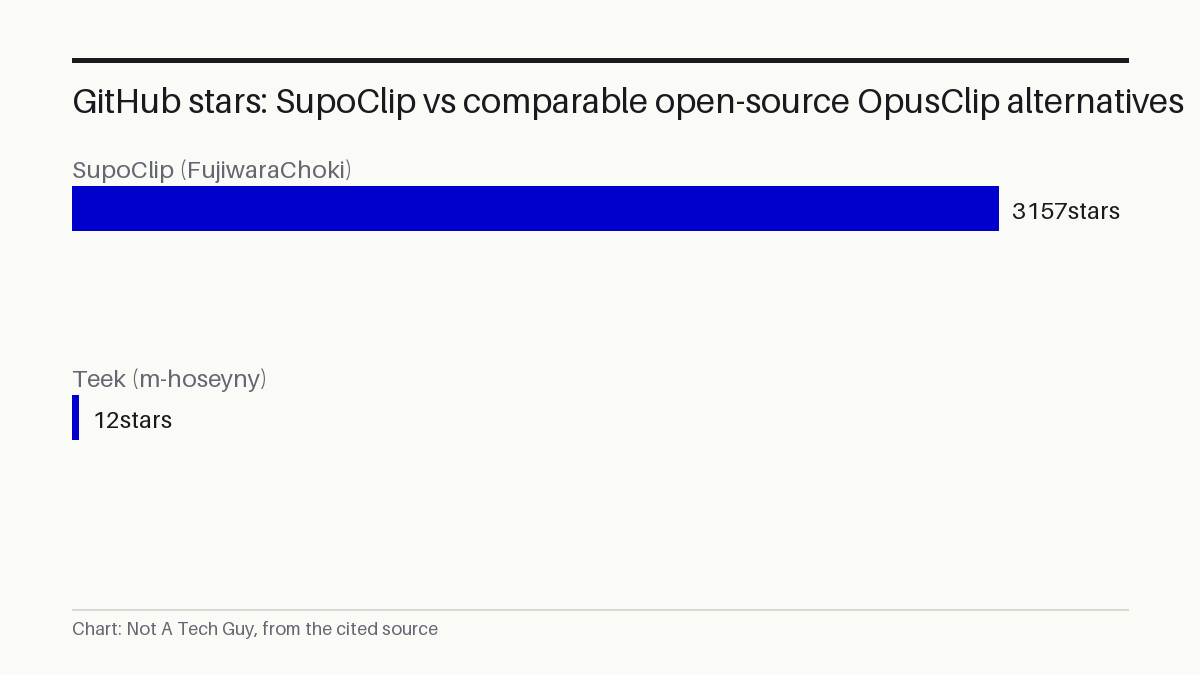
This is not the only open-source OpusClip alternative in the wild. A smaller project called m-hoseyny/teek, also AGPL-3.0 and self-hostable, sits at 12 stars and was created in February 2026 P². The gap between 12 stars and 3,157 tells you where developer attention is concentrated right now, though star counts are a snapshot, not a verdict.
For a content team producing short-form video at volume, the practical question is whether SupoClip's LLM-driven segment selection matches what a human editor would cut. A podcast producer could test this today: take a 45-minute episode, run it through SupoClip with a local Ollama model to avoid external LLM costs, and compare the three to seven selected clips against the segments their editor manually picks. If the overlap is weak, the transcription pipeline is fine but the selection layer needs tuning, and that is where the AGPL-3.0 licence lets you fork and adjust the prompt logic yourself.
The open-source tooling wave that produced projects like ArtCraft's open-source AI studio with 40,263 stars and Cline's coding agent at 70,000 stars keeps producing alternatives to paid SaaS tools, and SupoClip sits in the same current. Whether it sticks depends on whether the maintainer keeps the Docker setup working as AssemblyAI and the LLM providers update their APIs.
The next checkpoint is the repository's commit history: if the Docker Compose setup and API integrations stay current through the next provider API change, the project is alive. If not, the hosted app at supoclip.com becomes the only reliable path, and the open-source pitch weakens.
Sources: S1 — FujiwaraChoki/supoclip: An open-source OpusClip alternative · P2 — m-hoseyny/teek · P3 — Trending repositories on GitHub today · GitHub · P4 — supoclip/docs/README.md at main · FujiwaraChoki/supoclip · GitHub · P5 — FujiwaraChoki
Written from 5 sourced items, 4 of them primary.