

Technology & AI
Mycelium AI routes science context across human-agent teams
A new arXiv preprint introduces Mycelium, a shared workspace connecting researchers and AI agents, routing hypotheses to whoever can act on them.
The AI knowledge 99.9% of people never discover
OpenAI news explained — GPT model releases, pricing, safety reports and the business decisions behind them, and what each one means for people who use the tools at work.
114 stories
A new arXiv preprint introduces Mycelium, a shared workspace connecting researchers and AI agents, routing hypotheses to whoever can act on them.

OpenAI's July 2026 article outlines age-appropriate protections, learning tools and parental controls for teen ChatGPT users, but key questions remain.

Harness Handbook from Tencent and four universities builds a behaviour-to-code map for agent harnesses that cuts planner tokens and improves edit
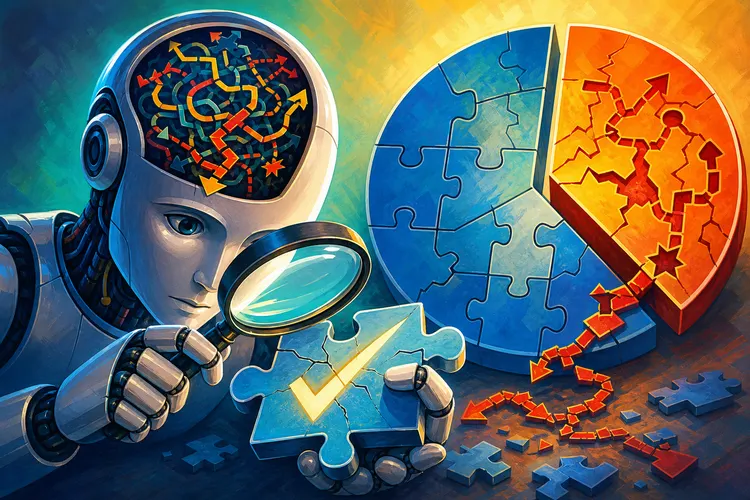
A black-box audit swaps predicates in chain-of-thought to expose when GPT-4o reaches correct answers through reasoning that ignores its stated premises.

New arXiv paper finds automatically evolving agent scaffolding doesn't consistently outperform test-time scaling, with limited generalization to new tasks.

Sarah Friar's framework shifts AI measurement from model benchmarks to useful work, cost per task, dependability and return on compute.

Australia's PM wants big AI data centres to underwrite new power and put back as much energy as they draw, but stalled renewables decide if it works.

New arXiv paper pairs world models with human preferences and justifications to train safe AI agents without risky trial-and-error deployment.

arXiv preprint reveals exact token cost of attributing AI text to a user, plus a window where generated text is provably machine-made but unattributable.

IBM Research found Claude Sonnet cost half as much as GPT-4.1 across 417 agent tasks, because caching matters more than sticker price for AI routing.

First meta-evaluation of LLM-generated rubrics for paper reproduction finds AI graders are overly generous and too detailed, but augmentation helps.

OpenAI's automated red teaming system GPT-Red uses self-play to find model weaknesses like prompt injection gaps affecting every AI user.