

A printed sticker on a workbench can make a Vision-Language-Action robot fail every single task it tries. Researchers report a 100% failure rate when VLA robots, the kind that see, understand instructions, and act, are hit with attention-hijacking patches in simulation S¹. A framework called VLAGuard, posted to arXiv on 2 August 2026, claims a fine-tuning defense that drops that failure rate to 25.9% with zero added inference cost S¹. But the gap between "mostly fixed" and "safe to deploy" is where the real story lives.
My read: This is the first paper I've seen that frames VLA robot vulnerability as an attention-pathway problem rather than a perception or control bug. The numbers are striking, but I don't buy the zero inference overhead claim yet, because it is author-reported with no independent benchmarking in the source. A residual failure rate of 25.9% in simulation and roughly 32.6% in real-world trials means one in four to one in three tasks still fail under attack. That is not a safety margin any robot operating near people can tolerate.
How a sticker hijacks a robot's mind
VLA robots combine three things: a vision system that sees the world, a language model that understands instructions, and an action module that decides how to move. The glue between them is cross-attention, the mechanism that tells the robot which parts of the visual scene matter for the current task. When a robot hears "pick up the red cup," cross-attention is what focuses its gaze on the cup and ignores everything else.
The attack module in this paper, called VASA (Visuomotor Attention-guided Semantic Attack), uses printable patches to hijack that cross-attention S¹. A sticker placed in the robot's field of view pulls its focus away from the object it should be interacting with. The robot does not crash or error out. It confidently reaches for the wrong thing, or nothing at all.
This matters because the attack is physical and cheap. No network access required. No knowledge of the model's weights. A piece of paper with the right pattern, placed where a camera can see it, is enough.
The defense that costs nothing at run time
The researchers propose Attention-Protective Fine-Tuning, or APFT, which retrains the VLA model to hold its attention steady and enforce geometric consistency between what it sees and how it moves S¹. The claim of zero inference overhead means the defended model runs at the same speed as the original, because the protection is baked into the weights during training rather than added as a runtime check.
The results, all author-reported in a non-peer-reviewed preprint S¹:
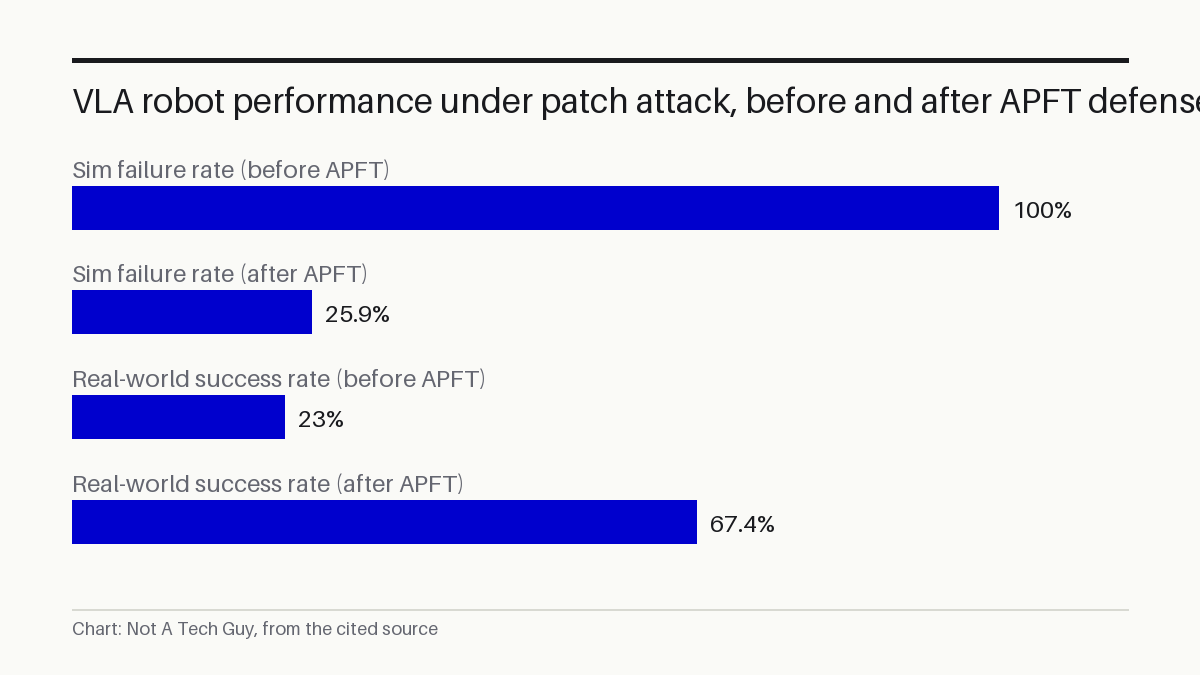
In LIBERO simulations, APFT cuts the OpenVLA failure rate from 100.0% to 25.9% under VASA attacks S¹. OpenVLA is the open-source VLA model with over 6,700 GitHub stars P⁴. That makes it a reasonable test bed for the broader VLA ecosystem.
In 2,000 real-world trials under severe patch attacks, the average success rate climbs from 23.0% to 67.4% S¹. That is a big jump, but it also means nearly one in three real-world tasks still fail when the robot is under attack.
Why attention pathways are the soft underbelly
VLA models inherit their architecture from vision-language models, which were built for describing images and answering questions, not for controlling physical machines. The cross-attention that works fine for captioning a photo becomes a liability when it drives a robot arm. VLAGuard identifies a different failure mode: the model sees fine, but its attention is redirected by an adversary.
The paper places this in the context of wireless sensor networks, where VLA robots operate as mobile edge nodes, processing sensor data and acting on it locally S¹. In a smart warehouse or factory floor, a compromised attention pathway means a robot might ignore a human worker, mishandle inventory, or collide with equipment.
What to do about it
If you run VLA robots in any environment where someone could place a sticker or printed patch in the camera's view, this paper describes a threat you should take seriously. The attack requires no digital access to your system.
Consider a warehouse robotics startup using OpenVLA-based arms to pick items from shelves. A competitor, a disgruntled worker, or even a careless label placed on a bin could trigger the attention hijack. The robot would reach for the wrong item or freeze mid-task, and the operator would see a "model error" rather than an attack. APFT, once independently validated, would be the kind of defense you fold into your model fine-tuning pipeline. But at a 32.6% real-world failure rate under attack, you would still need physical controls, restricted access to the robot's workspace, and anomaly detection on task outcomes.
This week: check whether your VLA model's attention maps shift when you introduce unfamiliar visual patterns into its workspace. If a printed shape on a nearby surface changes where the model looks, you have the same exposure this paper describes.
What we don't know yet
The paper has not been peer-reviewed, and all performance numbers are author-reported S¹. Several critical details are missing:
- The source does not specify the exact robot hardware, WSN configurations, or physical trial environments used in the 2,000 real-world tests S¹.
- Only OpenVLA is named in the simulation results. Whether APFT generalises to other VLA architectures is untested in this paper S¹.
- The zero inference overhead claim has no independent benchmarking. The authors assert it, but no third party has measured latency or throughput before and after APFT.
- The defense is tested only against patch-based attention hijacking. Other attack categories, such as lighting manipulation or adversarial textures on the objects themselves, are not addressed.
- A companion paper by some of the same authors, "Structure-Aware Robust Fine-Tuning" P³, appears to cover overlapping ground. How the two approaches relate is not clear from the available material.
The next signal: peer review and independent replication. If a lab reproduces the 67.4% real-world success rate on different hardware and against attacks beyond printable patches, the defense graduates from interesting to credible. We will check this claim against any follow-up publication or conference acceptance in the coming months.
If you want these assessments before they hit the headlines, subscribe.
Sources: S1 — VLAGuard: A Framework for Evaluating and Mitigating Physical Attention · P2 — VLAGuard: A Framework for Evaluating and Mitigating Physical Attention · P3 — Structure-Aware Robust Fine-Tuning: Defending Vision-Language-Action R · P4 — openvla/openvla · P5 — xiaoxuh/HGFF_Maximize-the-lifetime-of-WSN-with-DRL
More from Not A Tech Guy
- Strands Robots: one agent records, trains, deploys robot skills
- Telegram Mini Apps: 59% contact hidden third parties
- AI agent attack inflates costs 92% without breaking tasks
Generated from an audited evidence pack with primary-source research. Social-media items are discussion signals, not verified facts. Nothing here is financial, legal or medical advice.


