Jamie Pine launched Voicebox this week, pushing the desktop app onto GitHub's daily trending list S¹ by bundling eight text-to-speech engines and zero-shot voice cloning into a single local-first package.
Pine positions it as a free alternative to ElevenLabs and WisprFlow S¹, the cloud services that charge for synthetic voice generation and AI dictation. Every capability claim in that pitch, though, comes from the project's own README. No third party has benchmarked Voicebox against either commercial product, and the 23-language count, the 50-plus preset voices, and the eight-engine lineup are all self-reported figures with no independent verification S¹.
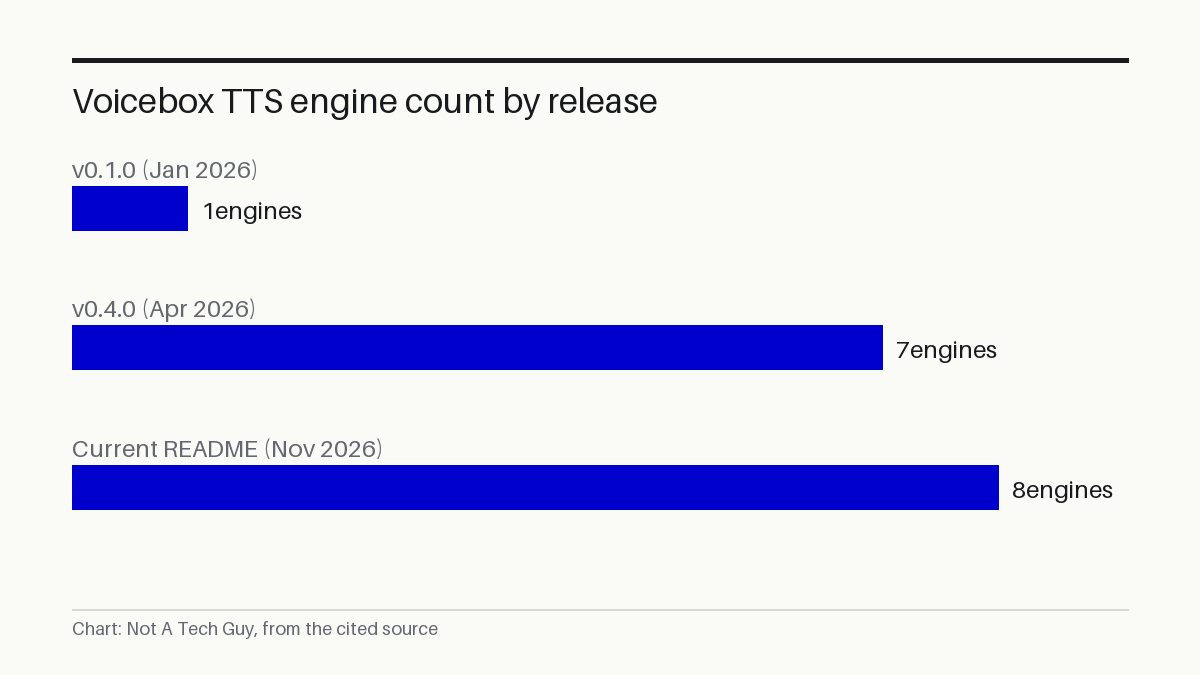
My read: The architecture decisions are the real signal. Building on Tauri with a Rust backend, rather than the Electron framework most desktop AI apps use, means a binary footprint closer to 15 megabytes than 150. Local-first processing genuinely removes the data-exposure risk that makes enterprise legal teams block cloud TTS tools. But "alternative to ElevenLabs" is marketing framing, not a tested claim. The v0.4.0 release in April listed seven engines P⁴; the current README lists eight S¹, meaning Qwen VoiceDesign was added without a tagged release I can find. I would want to see output samples across all 23 languages before trusting that number — no error bars or quality metrics have been published.
Roster grew from one model to eight in five months
The TTS engines Voicebox bundles span a range of open models. Qwen3-TTS, developed by the Qwen team at Alibaba Cloud, is the foundation. The project's first public release in January 2026 shipped with Qwen3-TTS alone P², and that model has since earned 14,281 GitHub stars under its own repository P³. On its Hugging Face model card, Qwen3-TTS covers 10 languages: Chinese, English, Japanese, Korean, German, French, Russian, Portuguese, Spanish, and Italian P⁵. Voicebox claims 23 across all its engines combined S¹ — a vendor's own figure with no released test suite, but the gap between 10 and 23 depends on the other seven engines picking up the languages Qwen3-TTS does not cover.
The April v0.4.0 release added HumeAI TADA, Kokoro 82M, and Qwen CustomVoice, bringing the roster to seven P⁴. The README now lists eight, with Qwen VoiceDesign joining LuxTTS, Chatterbox Multilingual, and Chatterbox Turbo S¹. Voicebox also ships a bundled local LLM for text refinement and per-profile personas, plus a multi-track timeline editor for arranging conversations and podcast-style narratives S¹.
Local processing sidesteps the data-exposure problem
The privacy pitch is straightforward: all audio processing, voice samples, and generated recordings remain on the user's own hardware rather than transiting a third-party server S¹. For a podcaster who wants to clone their own voice for ad reads without uploading samples to a third-party server, that removes a real friction point. For a developer building voice into an app, Voicebox exposes a REST API and a built-in MCP server, the protocol that lets AI agents call external tools, so voice input and output can be wired into existing workflows S¹.
The app runs on macOS (both Apple Silicon and Intel), Windows, and Linux, with support for AMD ROCm, Intel Arc, and Docker S¹. Linux users face a gap: pre-built binaries are not yet available, so you have to build from source using instructions the project provides S¹. The project is MIT-licensed with no splash screens or banners in the app S¹.
Development is community-driven. A "Capy Captain" thread directs day-to-day work, and crew threads test and review each contributor pull request on Linux and on a Mac Studio before Pine merges them S¹.
What is missing is independent verification. The voice-cloning quality, the 23-language coverage, and the claim that data never leaves the machine have not been audited by a third party S¹. A solo podcaster producing daily ad reads would swap a recurring ElevenLabs subscription for a one-time local setup, but only if their GPU sustains real-time generation across the engines they actually need. The next tagged release has no announced date; until it ships, the eight-engine count and 23-language coverage remain unverified README claims.
Sources: S1 — jamiepine/voicebox: The open-source AI voice studio. Clone, dictate, c · P2 — v0.1.0 · P3 — QwenLM/Qwen3-TTS · P4 — Release v0.4.0 · jamiepine/voicebox · GitHub · P5 — Qwen/Qwen3-TTS-12Hz-1.7B-CustomVoice · Hugging Face
Written from 5 sourced items, 4 of them primary.