

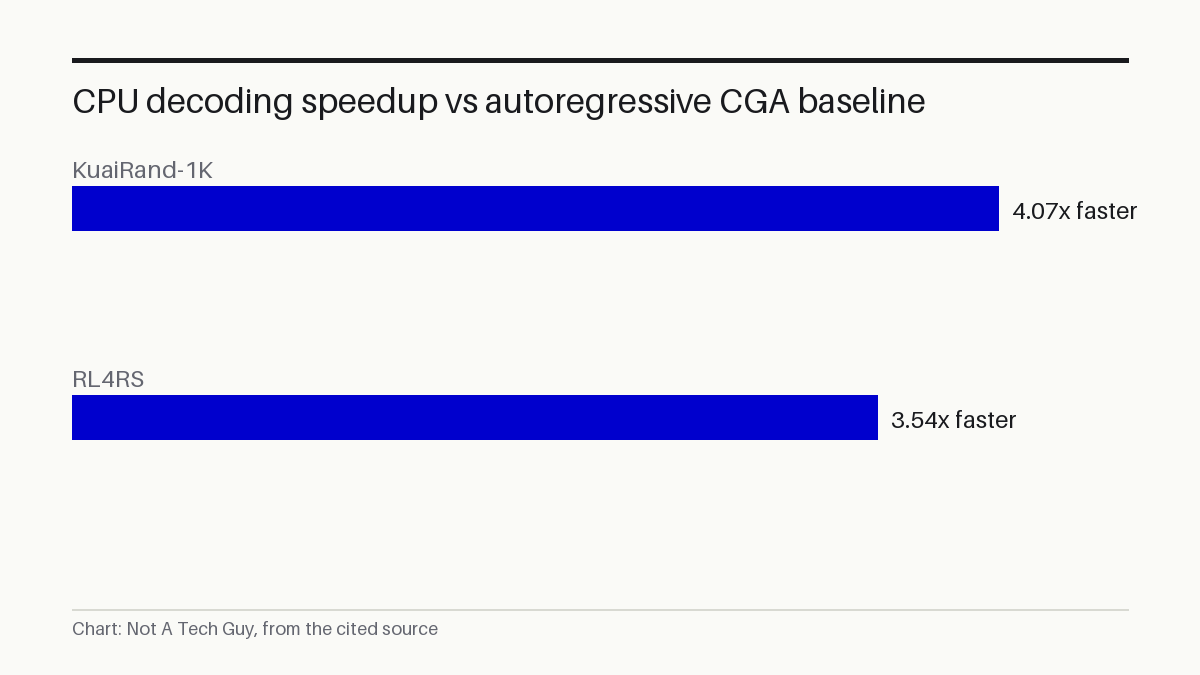
arXiv listed a cs.AI entry on November 5 reporting 4.07x faster CPU decoding for whole-page ranking while approaching the quality of slower autoregressive methods S¹. The trade-off has been the field's central tension. Score every ad and organic video together, carefully and one at a time, and your servers burn. Score them all at once and you miss how a video in slot three changes what works in slot seven.
My read: The 4x CPU speedup is the headline number, but it is measured against one specific autoregressive baseline called CGA on two academic datasets, and the paper is not peer-reviewed S¹. The industrial A/B test is more interesting but harder to judge: 0.104% and 0.058% gains on an unnamed platform, with no significance levels reported. I would watch whether anyone can reproduce the 4.07x figure on a different architecture. Until that happens, the speedup is the authors' claim, not a confirmed result.
How whole-page ranking got stuck
Whole-page ranking is the system that decides which ads and organic items appear together on a single screen, balancing business outcomes against user engagement under layout and business constraints S¹. The hard part is not ranking one item. It is ranking a page full of them where each choice changes the value of the next.
Non-autoregressive approaches, the fast option, generate a page efficiently but score each candidate independently of what has already been selected S¹. They miss order-dependent interactions, the way a comedy clip in position two might make a different ad more clickable in position five. Autoregressive methods fix this by conditioning each selection on the items already placed, but they pay for it with inference overhead that makes large-scale deployment difficult S¹.
This is the same efficiency-versus-quality tension we have seen across AI inference research, from AI agent rare-event estimation running 800x more efficiently to Honda Research lifting reasoning pass rates on Qwen3. The best results come from sequential reasoning. The cost of running it at scale forces compromises.
What MIS does differently
The authors propose Multi-Item Scoring, or MIS, a framework they describe as prefix-aware and non-autoregressive in style S¹. It folds three things into a shared representation architecture: global candidate interactions, localized prefix conditioning, and position-aware scoring S¹.
The mechanics are simple in concept.
MIS computes reusable representations once per request, then performs lightweight prefix-conditioned scoring during a constrained beam search, the step-by-step selection process that builds the page S¹. The heavy lifting, building the representations that capture how candidates relate to each other, happens a single time. The sequential context, the part that tells the model what has already been placed, gets folded into a lighter scoring step rather than triggering a full pass through the model each time S¹.
A GitHub repository called ONE-PASS, created in October 2025 by user kk97111, contains code described as "Single Forward Pass Decoding for Listwise Reranking" and marked as submitted for peer review P³. The repository has one star and one contributor. The title does not match the arXiv paper, and the evidence does not confirm they are the same project, but the one-pass concept aligns.
The numbers and their limits
On the KuaiRand-1K benchmark, MIS approaches the generation quality of an autoregressive CGA baseline while achieving 4.07x faster CPU decoding S¹. On the RL4RS benchmark, the same comparison yields 3.54x faster CPU decoding S¹. The paper states that MIS approaches the baseline. It does not claim to match or surpass it.
In a randomized evaluation on what the paper describes only as a large-scale social-video platform, MIS improved the realization metric by 0.104% and watch time by 0.058% against the existing system, while reducing ranking-service CPU consumption by 9.73% S¹.
The platform is not named.
No significance levels are reported for any of these figures.
None of the authors or their institutional affiliations are identified in the source, and the work has not been peer-reviewed S¹. The CPU speedup figures are relative to a specific autoregressive CGA baseline and may not generalize to other architectures.
The broader context connects to a line of work on efficient one-pass methods. OneGen, presented at EMNLP 2024, applies the single-forward-pass philosophy to unified generation and retrieval for large language models P⁴. A KDD 2025 paper on transformer-based ranking addresses the same scalability question from the architecture side P⁵. The thread running through all of them, and through our earlier coverage of AI agents formalizing math on a single page, is whether sequential-reasoning quality can be delivered at the cost of a single pass.
For engineering teams at content platforms that run whole-page ranking at scale, the practical first step would be running MIS on a shadow traffic pipeline alongside an existing autoregressive system, comparing the realization metric and watch time over a fixed window. The ONE-PASS repository P³, if it matches the paper's method, would be the starting point. Its single-star status and unconfirmed link to the arXiv entry mean no one outside the authors has validated the code.
Sources: S1 — Towards Efficient Whole Page Ranking with One-Pass Inference · P2 — loke-x/Web-Page-Ranking · P3 — kk97111/ONE-PASS · P4 — zjunlp/OneGen · P5 — From Features to Transformers: Redefining Ranking for Scalable Impact
Related reading
- Lean Pool: AI agents formalize math, paper is one human page — our technology desk, 2026-09-26
- AI agent rare-event estimation 800× more efficient — our technology desk, 2026-09-24
- Honda Research AI method lifts reasoning pass@12 on Qwen3 — our technology desk, 2026-10-09
Written from 5 sourced items, 4 of them primary.