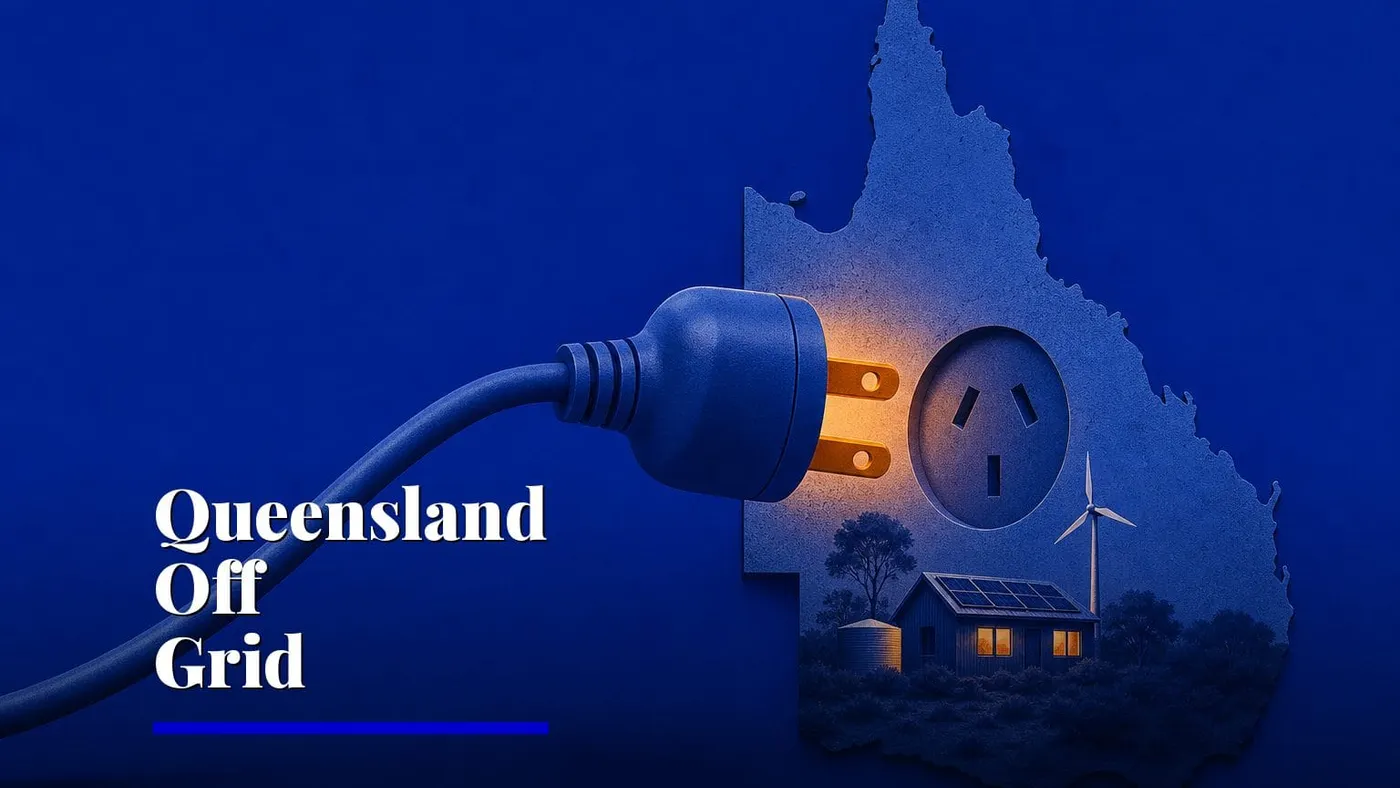
Queensland's latest energy survey has found that 25% of the state's householders intend to go off-grid, up from 22% a year earlier S¹. That intention is building as extreme weather repeatedly cuts power to hundreds of thousands of people, and one in five Australian households struggles to pay its energy bills S¹. The 25% figure reflects self-reported intention rather than verified disconnections, and the survey's methodology and error margins have not been independently checked.
My read: The 25% figure is intention, not action, and the survey of actual off-grid households covers just 40 homes in one corner of one state. But the direction is clear. Power prices rose five years in a row before easing in July 2026 S¹, and Queensland keeps getting hit by storms that black out huge numbers of people. The number I would watch is whether the next Queensland energy survey shows that 25% climbing further, or whether the reality of running short of power in a wet week cools the enthusiasm.
Off-grid households split into two distinct groups
Researchers who surveyed 40 off-grid households for The Conversation identified two broad patterns S¹. The first group — 22 households, mostly in rural or rural-residential settings, runs larger systems, averaging 6.6 kilowatts of solar capacity paired with a 40 kilowatt-hour battery S¹. For these homeowners the calculation is simple: grid connection in a regional area can run $30,000 to $60,000, making self-generation the cheaper path S¹. As one conventional homeowner told researchers, off-grid meant "an opportunity to save some money and work towards being self-reliant" S¹.
The second group — 10 households living in tiny houses on wheels, operates on a much smaller scale, with roughly 3.5 kilowatts of solar and two 4 kilowatt-hour batteries S¹. One resident sourced second-hand panels at about $70 each S¹. For this cohort, the motivation was less about avoiding connection fees and more about a deliberate choice to live simply. As one told researchers: "I lived in the suburbs, and you're just getting bills for this, bills for that" S¹. Now, they said, they can buy the components, learn how the system works, and produce their own energy. The system specifications cited for both groups are self-reported by residents and have not been independently measured.
Cloudy spells expose the central trade-off
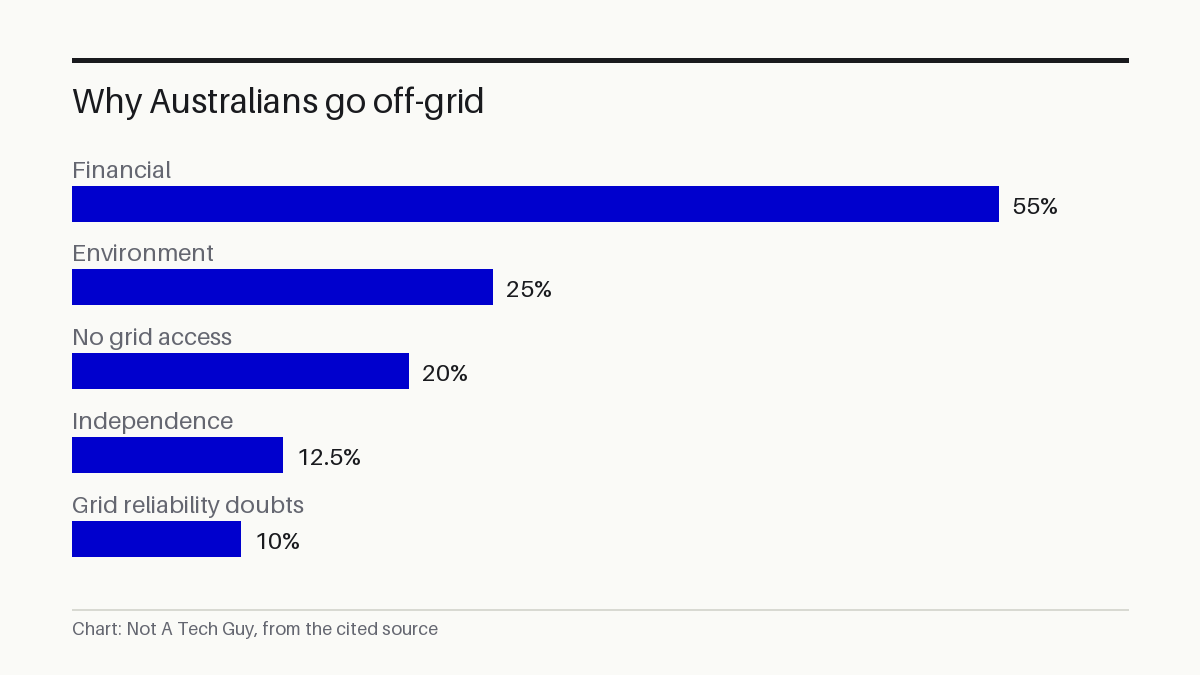
Money was the most common reason for going off-grid, cited by about 55% of respondents S¹. Environmental concerns came second at 25%, followed by no grid access at 20%, a desire for independence and control at 12.5%, and doubts about grid reliability at 10% S¹.
The most common complaint, reported by 33% of surveyed households, was running short of power during long cloudy or rainy periods S¹.
That is the trade-off at the heart of off-grid living: you gain independence but lose the grid's backup. Still, 20% of respondents saw no downsides at all S¹, and many described feeling more in control of their energy supply S¹.
The broader picture includes a grid under pressure on multiple fronts. The ABS has begun tracking household solar electricity generation in the national accounts P², a sign that rooftop solar is now large enough to register in the country's economic statistics. The ACCC's June 2026 inquiry into the National Electricity Market P⁴ is examining strains on demand from data centres and households alike.
For a regional builder quoting on a new estate where grid connection falls within the $30,000 — $60,000 range cited in the survey, the data suggests offering solar-plus-battery packages as standard could shift the economics for buyers weighing whether to connect at all S¹. A conveyancer handling rural property transactions may need to start checking whether a sale includes an off-grid system, since a household that builds with cash rather than a mortgage can disappear from official lending records S¹.
There is a catch for policymakers. Once households disconnect, they become invisible to official data records S¹. The ABS lending indicators released on 11 November 2026 P³ track new housing finance, but a household that builds off-grid with cash or a personal loan, rather than a mortgage, may not show up in the housing lending data at all. The next ABS lending indicators release is scheduled for 10 February 2027 P³.
Sources: S1 — Second-hand solar, tiny houses, no bills – we asked how Australians a · P2 — Household solar electricity generation in the Australian national acco · P3 — Lending indicators, September Quarter 2026 | Australian Bureau of Stat · P4 — Inquiry into the National Electricity Market
Written from 4 sourced items, 3 of them primary.