

A systematic review of agentic AI landed on arXiv on 20 August under identifier 2608.18110v1, covering everything from the theoretical evolution of machine agency to a proposed framework for how stakeholders decide to adopt these systems S¹. The paper has no experiments, no benchmark scores, no market-size figures. That absence tells you something. What does it mean when a field moves so fast that the most useful contribution is an attempt to draw a map?
My read: This is the first comprehensive systematic review of agentic AI I've seen that tries to stitch together the whole picture, from theory to adoption. I'm skeptical of the authors' claim that agentic AI has "significant potential to enable rapid transformation across various domains" S¹, because that is a preprint assertion, not peer-reviewed consensus, and the abstract offers no specific evidence to back it. But the mere existence of this paper, combined with what we are seeing in the wild, suggests the field has crossed from lab demos into something people are actually building with.
Why a review with no data matters
The paper sets out to do six things: trace the history of agency in artificial systems, explain how agentic AI works, map its architecture, survey real-world applications, analyse current challenges, and propose a framework for understanding adoption S¹. That last piece is the interesting one. The authors propose using "system quality dimensions" to model why stakeholders would choose to use agentic AI S¹. In plain terms: they want to know what makes a person or organisation trust an autonomous AI system enough to deploy it.
This matters because adoption is the bottleneck right now, not capability. The models can think. The infrastructure to let them act at scale is what creaks.
The signals in the wild
The deep research for this story turned up concrete evidence of where agentic AI is actually landing. OpenAI's openai-agents-python repository, a framework for multi-agent workflows, has accumulated 28,787 stars on GitHub since it was created in March 2025 P². That is a staggering growth rate for a developer tool that is barely 18 months old. Builders are not waiting for a systematic review to tell them what agentic AI is. They are already writing code.
OpenScholar, a separate project that uses retrieval-augmented language models to synthesise scientific literature, has 1,548 stars since its creation in November 2024 P³. Smaller, but it points to the same pattern: agentic systems that can search, read, and reason over large bodies of knowledge are attracting real developer attention.
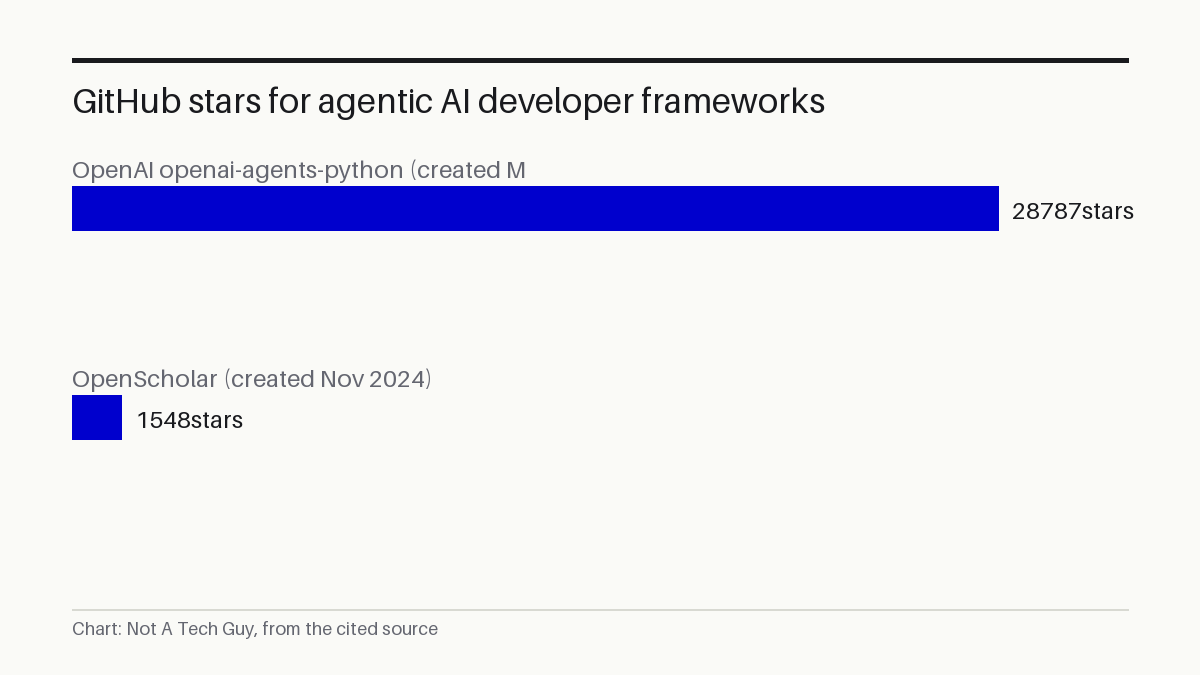
The pattern is clear: agentic AI is moving from demo to deployment, one domain at a time.
What the paper gets right and where it strains
The review's strength is its scope. By tracing the historical and theoretical evolution of agency in artificial systems S¹, it gives readers a foundation that most coverage of agentic AI skips. The field did not start with ChatGPT. It has roots in decades of work on autonomous agents, planning, and multi-agent systems.
The strain shows in the evaluative language. The authors describe agentic AI as having "significant potential to enable rapid transformation across various domains" S¹ and argue its "potential to revolutionize various domains" creates a need for deeper investigation S¹. These are the authors' views, stated in an unreviewed preprint. They are not wrong, exactly, but they are not yet supported by the kind of evidence this review is meant to synthesise. The paper identifies current challenges and future research directions S¹, but the abstract does not name a single one.
What to do about it
If you run a business that relies on processing large volumes of documents, the agentic AI wave is closer than you think. Consider a mid-sized conveyancing firm in Sydney that currently uses a single LLM to extract clauses from contracts. The model can read, but it cannot decide what to do next. An agentic system, built on a framework like OpenAI's openai-agents-python P², could read the clause, check it against a database of precedents, flag a risk, and draft a query to the other side's solicitor, all in one chain. The firm's IT lead does not need to read the arXiv review to start prototyping this. They need to pick a framework, define the workflow, and test it on a small batch of real files this week.
The practical step: if you have a workflow that currently requires a human to copy information from one system to another, that is your first candidate for an agentic prototype. Start there.
What we don't know yet
The paper is a preprint. It has not been peer-reviewed, and the abstract provides no specific empirical findings, adoption rates, or named commercial products S¹. The proposed adoption framework, built on system quality dimensions, is a conceptual contribution that has not been tested against real adoption data. We do not know which domains the paper identifies as most promising, which challenges it flags as hardest, or whether the adoption framework holds up when actual organisations try to use it.
The next signal: the peer-reviewed version of this paper, if it clears review, and the next round of agentic AI benchmark results from the major labs in the September to November conference season. We will check the claims against both. If you want that follow-up in your inbox, subscribe now and we will send it the day it lands.
Sources: S1 — Emergence of Agentic AI: A Review on Evolution, Background, Working Pr · P2 — openai/openai-agents-python · P3 — AkariAsai/OpenScholar · P4 — The AI Community Building the Future? A Quantitative Analysis of Devel
More from Not A Tech Guy
- LeakGauge detects AI context-leakage attacks, AUROC to 0.996
- NVIDIA uses ChatGPT Work to scale internal expertise
- StagedWorkspace lifts AI agent office task scores by 34 points
Generated from an audited evidence pack with primary-source research. Social-media items are discussion signals, not verified facts. Nothing here is financial, legal or medical advice.


