

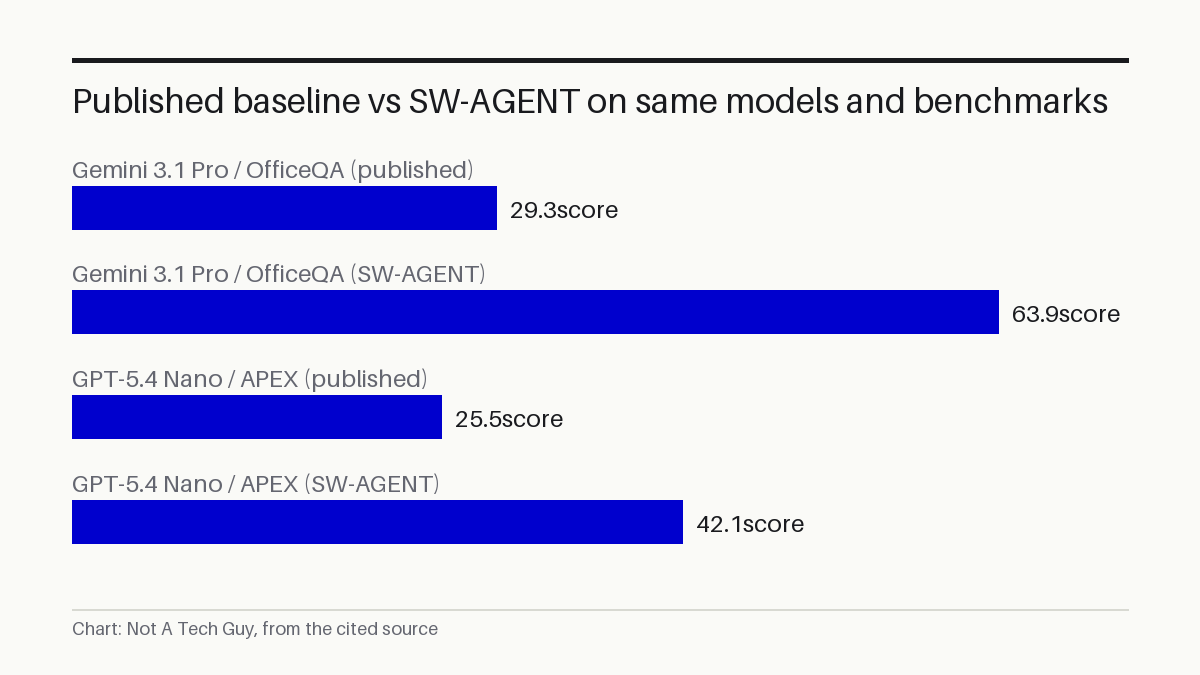
Gemini 3.1 Pro scored 29.3% on the OfficeQA benchmark in its published results. Fed the same questions through a system called StagedWorkspace, it hit 63.9% S¹. Same model, same test, a 34-point gap created entirely by changing how the agent sees its own files. The preprint proposing this system landed on arXiv on 18 August 2026 S¹, and it raises a question every team building document-handling agents should be asking: what if the biggest accuracy gains right now come from better workspaces, not bigger models?
My read: This is the first paper I've seen that treats workspace state as a first-class experimental variable for knowledge-work agents, and the numbers are large enough to take seriously. I don't buy the 29.3-to-63.9 jump as a clean measure of the workspace effect, because it bundles several changes together: dual file access, diff visibility, the full SW-AGENT system. The controlled ablation, which only swaps single-view for dual-view on the same setup, shows a more modest 8.3 to 12.1 points S¹. That is still a real effect. But the headline comparison includes everything but the kitchen sink. I'd watch for independent replication before trusting the absolute scores.
Why coding agents have it easy
Software development agents use git. When they query a code repository, implement changes, or execute tests, the repository enforces a guarantee: each action corresponds to a particular file version S¹. Should a file be modified during a task, the agent is aware. The environment remains stable.
Agents handling knowledge work lack this guarantee. When an agent processes a PDF, modifies a spreadsheet, or revises a presentation, it relies on a parsed representation (structured information pulled from the document) that becomes outdated instantly if the original file is updated S¹. The agent believes it is viewing version A. The actual file is version B. It was never notified. For mixed-format project directories containing PDFs, notebooks, slides, and spreadsheets simultaneously, the issue becomes even more complex S¹.
The workspace-state contract
StagedWorkspace, developed by a team from Harvard, the University of Technology Sydney, Raycaster AI, and the University of Washington P², offers a solution. Its central concept is a workspace-state contract: any data presented to an agent must be directly linked to a specific version of the workspace's current state S¹. To achieve this, the framework connects parsed data and review diffs (which show differences between versions) to the content hashes of original files as they are modified S¹. A content hash acts as a brief identifier for a file's data. If the file is altered, this identifier no longer matches, alerting the agent that its information is outdated.
Think of it as git for office documents. The system gives agents dual access to files: the parsed view for reasoning, and the native view for ground truth. In fixed-harness ablations (controlled experiments that swap one component at a time) on the OfficeQA Pro and APEX-Agents benchmarks, dual parsed/native access had the highest point estimate for every tested model S¹.
What the numbers show
The isolated ablation provides the most reliable comparison. Replacing a single view with dual parsed/native access increased OfficeQA Pass@1 (the probability of a correct answer on the initial try) by 8.3 to 12.1 points, and APEX mean rubric score by 4.7 to 9.2 points across the models tested S¹.
The complete system evaluation is more striking. SW-AGENT, the agent constructed on StagedWorkspace, achieved 63.9% with Gemini 3.1 Pro on OfficeQA, compared to a published baseline of 29.3% for the same model S¹. For APEX, SW-AGENT reached 42.1 with GPT-5.4 Nano, versus a published baseline of 25.5 S¹.
An additional paired ablation involving 57 file-editing tasks revealed better scores when agents had access to diffs of their own modifications S¹. The ability to inspect modifications against the prior state enhanced the quality of the edits.
What to do about it
Imagine a consulting firm using agents to process client directories full of PDFs, Excel models, and PowerPoint presentations. Currently, an agent might read a spreadsheet, pull out figures, and write a summary, only for the spreadsheet to be updated by the client moments later. The agent's summary now relies on outdated information, which goes unnoticed until human review. StagedWorkspace's method of linking each parsed view to a content hash would highlight this discrepancy before the summary is delivered.
The immediate lesson for teams developing document-processing agents: check if your agent's parsed views include any form of version tracking. If an agent accesses a file at time T and the file is modified at time T+1, is the agent notified? If not, that is the vulnerability this research addresses. Without deploying the entire StagedWorkspace framework, implementing a basic content hash verification before an agent uses a parsed view would prevent the most frequent stale-data errors.
What we don't know yet
All scores in this study are reported by the creators of the system themselves S¹. No external group has reproduced the findings. The evaluations are limited to OfficeQA Pro and APEX-Agents, which are both office-document benchmarks, and it remains unclear if the approach generalizes to other fields such as legal contracts, medical records, or engineering specifications. The research exists as an arXiv preprint without peer review S¹, and the model names and baseline figures are provided by the authors without outside confirmation.
The underlying trend is genuine, however. StagedWorkspace applies this logic to the file layer: by making an agent's perception of its workspace explicit and version-controlled, accuracy improves. The open-source community is shifting similarly, with initiatives like NoKV's durable agent workspace P⁴ and Anthropic's knowledge-work plugins for Claude Cowork P⁵ addressing different aspects of the issue.
If this research is relevant to your work, subscribe to see the replication when it occurs. The next milestone: the initial peer-reviewed publication or independent reproduction of these results. We will compare the ablation improvements against it.
Sources: S1 — StagedWorkspace: A Versioned Workspace for Knowledge-Work Agents · P2 — StagedWorkspace: A Versioned Workspace for Knowledge-Work Agents · P3 — swadhinbiswas/contexa · P4 — NoKV-Lab/NoKV · P5 — anthropics/knowledge-work-plugins
More from Not A Tech Guy
- Alibaba's Wuying browser agent hits 65% on 38-step web tasks
- Agent memory boosts gpt-oss 16 points but does nothing for GLM-5
- OpenAI adds safeguards to pace frontier AI model development
Generated from an audited evidence pack with primary-source research. Social-media items are discussion signals, not verified facts. Nothing here is financial, legal or medical advice.


